

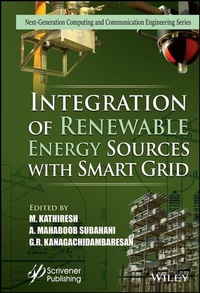
Integration of Renewable Energy Sources with Smart Grid
Description

Provides comprehensive coverage of renewable energy and its integration with smart grid technologies.
This book starts with an overview of renewable energy technologies, smart grid technologies, and energy storage systems and covers the details of renewable energy integration with smart grid and the corresponding controls. It also provides an enhanced perspective on the power scenario in developing countries. The requirement of the integration of smart grid along with the energy storage systems is deeply discussed to acknowledge the importance of sustainable development of a smart city. The methodologies are made quite possible with highly efficient power convertor topologies and intelligent control schemes. These control schemes are capable of providing better control with the help of machine intelligence techniques and artificial intelligence. The book also addresses modern power convertor topologies and the corresponding control schemes for renewable energy integration with smart grid. The design and analysis of power converters that are used for the grid integration of solar PV along with simulation and experimental results are illustrated. The protection aspects of the microgrid with power electronic configurations for wind energy systems are elucidated. The book also discusses the challenges and mitigation measure in renewable energy integration with smart grid.
Audience
The core audience is hardware and software engineers working on renewable energy integration related projects, microgrids, smart grids and computing algorithms for converter and inverter circuits. Researchers and students in electrical, electronics and computer engineering will also benefit reading the book.
More details
Other editions
Additional editions
Persons
M. Kathiresh PhD from Anna University and is a faculty member in the Department of Electrical and Electronics Engineering, PSG College of Technology, Anna University, India. He is the recipient of the IE Young Achiever Award in 2020.
A. Mahaboob Subahani PhD works in the Department of Electrical and Electronics Engineering, PSG College of Technology, Anna University, India. He has published more than 20 journal and conference papers.
G.R. Kanagachidambaresan PhD from PSG College of Technology, Anna University is an associate professor in the Department of Computer Science and Engineering in Vel Tech Rangarajan Dr Sagunthala R&D Institute of Science and Technology. He has published more than 25 articles in SCI journals, edited more than 8 books, published more than 10 patents, developed and copyrighted more than 10 pieces of software.
Content
Preface xv
1 Renewable Energy Technologies 1 V. Chamundeswari, R. Niraimathi, M. Shanthi and A. Mahaboob Subahani
1. Introduction 1
1.1 Types of Renewable Energy 2
1.1.1 Solar Energy 3
1.1.2 Wind Energy 7
1.1.3 Fuel Cell 8
1.1.4 Biomass Energy 11
1.1.5 Hydro-Electric Energy 13
1.1.6 Geothermal Energy 14
References 17
2 Present Power Scenario in India 19 Niraimathi R., Pradeep V., Shanthi M. and Kathiresh M.
2.1 Introduction 20
2.2 Thermal Power Plant 20
2.2.1 Components of Thermal Power Plant 21
2.2.2 Major Thermal Power Plants in India 23
2.3 Gas-Based Power Generation 24
2.3.1 Basics of Gas-Based Power Generation 24
2.3.2 Major Gas-Based Power Plants in India 25
2.4 Nuclear Power Plants 26
2.4.1 India's Hold in Nuclear Power 27
2.4.2 Major Nuclear Power Plants 27
2.4.3 Currently Operational Nuclear Power Plants 28
2.4.4 Challenges of Nuclear Power Plants 28
2.5 Hydropower Generation 29
2.5.1 Pumped Storage Plants 29
2.6 Solar Power 30
2.6.1 Photovoltaic 30
2.6.2 Photovoltaic Solar Power System 30
2.6.3 Concentrated Solar Power System 31
2.6.4 Major Solar Parks in India 32
2.7 Wind Energy 32
2.8 The Inherited Structure 34
References 34
3 Introduction to Smart Grid 37 G. R. Hemanth, S. Charles Raja and P. Venkatesh
3.1 Need for Smart Grid in India 38
3.2 Present Power Scenario in India 38
3.2.1 Performance of Generation From Conventional Sources 40
3.2.2 Status of Renewable Energy Sources 40
3.3 Electric Grid 43
3.3.1 Evolving Scenario of the Electric Grid 45
3.3.1.1 Integrated Grid 46
3.3.1.2 Prosumers 46
3.3.1.3 Transmission v/s Energy Storage 47
3.3.1.4 Changing Nature of Loads 47
3.3.1.5 Electric Vehicles 48
3.3.1.6 Microgrids 48
3.4 Overview of Smart Grids 49
3.4.1 Purpose of Smart Grid 49
3.5 Smart Grid Components for Transmission System 50
3.5.1 Supervisory Control and Data Acquisition System 50
3.5.1.1 SCADA Overview 51
3.5.1.2 Components of SCADA 51
3.5.2 Energy Management System 52
3.5.3 Wide-Area Monitoring System 52
3.6 Smart Grid Functions Used in Distribution System 53
3.6.1 Supervisory Control and Data Acquisition System 53
3.6.2 Distribution Management System 54
3.6.3 Distribution Automation 54
3.6.4 Substation Automation 55
3.6.5 Advanced Metering Infrastructure 55
3.6.6 Geographical Information System 57
3.6.7 Peak Load Management 58
3.6.8 Demand Response 58
3.6.9 Power Quality Management 59
3.6.10 Outage Management System 59
3.6.11 Distribution Transformer Monitoring System 59
3.6.12 Enterprise Application Integration 59
3.6.13 Smart Street Lights 60
3.6.14 Energy Storage 60
3.6.15 Cyber Security 60
3.6.16 Analytics 60
3.7 Case Study: Techno-Economic Analysis 61
3.7.1 Peak Load Shaving and Metering Efficiency 61
3.7.2 Outage Management System 63
3.7.3 Loss Detection 64
3.7.4 Tamper Analysis 66
3.8 Case Study: Solar PV Awareness of Puducherry SG Pilot Project 69
3.9 Recent Trends in Smart Grids 70
3.9.1 Smart GRIP Architecture 70
3.9.2 Implementation of Smart Meter With Prepaid Facility 74
References 74
4 Internet of Things-Based Advanced Metering Infrastructure (AMI) for Smart Grids 77 V. Gomathy, V. Kavitha, C. Nayantara, J. Mohammed Feros Khan, Vimalarani G. and S. Sheeba Rani
4.1 Introduction 78
4.1.1 Smart Grids 78
4.1.2 Smart Meters 80
4.2 Advanced Metering Infrastructure 81
4.2.1 Smart Devices 82
4.2.2 Communication 83
4.2.3 Data Management System 85
4.2.4 Mathematical Modeling 87
4.2.5 Energy Theft Detection Techniques 89
4.3 IoT-Based Advanced Metering Infrastructure 89
4.3.1 Intrusion Detection System 90
4.4 Results 93
4.5 Discussion 94
4.6 Conclusion and Future Scope 97
References 97
5 Requirements for Integrating Renewables With Smart Grid 101 Indrajit Sarkar
5.1 Introduction 102
5.1.1 Smart Grid 102
5.1.2 Renewable Energy Resources 105
5.1.3 How Smart Grids Enable Renewables 111
5.1.4 Smart Grid and Distributed Generation 111
5.1.5 Grid Integration Terminologies 112
5.2 Challenges in Integrating Renewables Into Smart Grid 112
5.2.1 The Power Flow Control of Distributed Energy Resources 113
5.2.2 Investments on New Renewable Energy Generations 113
5.2.3 Transmission Expansion 114
5.2.4 Improved Flexibility 114
5.2.5 High Penetration of Renewables in Future 115
5.2.6 Standardizing Control of ESS 115
5.2.7 Regulations 116
5.2.8 Standards 116
5.3 Conclusion 116
References 117
6 Grid Energy Storage Technologies 119 Chandra Sekhar Nalamati
6.1 Introduction 120
6.1.1 Need of Energy Storage System 121
6.1.2 Services Provided by Energy Storage System 122
6.2 Grid Energy Storage Technologies: Classification 123
6.2.1 Pumped Hydro Storage System 123
6.2.2 Compressed Air Storage System 124
6.2.3 Flywheel Energy Storage System 125
6.2.4 Superconducting Magnet Storage System 125
6.2.5 Battery Storage System 127
6.2.6 Capacitors and Super Capacitor Storage System 129
6.2.7 Fuel Cell Energy Storage System 130
6.2.8 Thermal Storage System 131
6.3 Grid Energy Storage Technologies: Analogy 132
6.4 Applications of Energy Storage System 135
6.5 Power Conditioning of Energy Storage System 136
6.6 Conclusions 136
References 137
7 Multi-Mode Power Converter Topology for Renewable Energy Integration With Smart Grid 141 M. Sathiyanathan, S. Jaganathan and R. L. Josephine
7.1 Introduction 142
7.2 Literature Survey 144
7.3 System Architecture 145
7.3.1 Solar PV Array 146
7.3.2 Wind Energy Generator 147
7.4 Modes of Operation of Multi-Mode Power Converter 149
7.4.1 Buck Mode 150
7.4.2 Boost Mode 152
7.4.3 Bi-Directional Mode 155
7.5 Control Scheme 158
7.5.1 Mode Selection 159
7.5.2 Maximum Power Point Tracking 159
7.5.3 Reconfigurable SPWM Generation 161
7.6 Results and Discussion 163
7.7 Conclusion 167
References 168
8 Decoupled Control With Constant DC Link Voltage for PV-Fed Single-Phase Grid Connected Systems 171 C. Maria Jenisha
8.1 Introduction 171
8.2 Schematic of the Grid-Tied Solar PV System 173
8.2.1 DC Link Voltage Controller 175
8.2.2 MPPT Controller 176
8.2.3 SPWM-Based dq Controller 176
8.3 Simulation and Experimental Results of the Grid Tied Solar PV System 178
8.4 Conclusion 183
References 184
9 Wind Energy Conversion System Feeding Remote Microgrid 187 K. Arthishri and N. Kumaresan
9.1 Introduction 188
9.2 Literature Review 189
9.3 Direct Grid Connected Configurations of Three-Phase WDIG Feeding Single-Phase Grid 191
9.4 Three-Phase WDIG Feeding Single-Phase Grid With Power Converters 191
9.5 Performance of the Three-Phase Wind Generator System Feeding Power to Single-Phase Grid 193
9.5.1 Wind Turbine Characteristics 193
9.5.2 Generator Analysis 194
9.6 Power Converter Configurations 198
9.6.1 Configuration 1: WDIG With Uncontrolled Rectifier-Line Commutated Inverter 198
9.6.2 Configuration 2: WDIG With Uncontrolled Rectifier-(DC-DC)-Line Commutated Inverter 200
9.6.2.1 Closed-Loop Operation of UR-DC/DC-LCI Configuration 200
9.6.3 Configuration 3: WDIG With Uncontrolled Rectifier-Voltage Source Inverter 201
9.6.3.1 Closed-Loop Operation of UR-VSI Configuration 202
9.7 Conclusion 204
References 204
10 Microgrid Protection 209 Suman M., Srividhya S. and Padmagirisan P.
10.1 Introduction 209
10.2 Necessity of Distributed Energy Resources 210
10.3 Concept of Microgrid 210
10.4 Why the Protection With Microgrid is Different From the Conventional Distribution System Protection 211
10.4.1 Role of the Type of DER on Protection 212
10.5 Foremost Challenges in Microgrid Protection 212
10.5.1 Relay Blinding 212
10.5.2 Variations in Fault Current Level 213
10.5.3 Selectivity 214
10.5.4 False/Unnecessary Tripping 214
10.5.5 Loss of Mains (Islanding Condition) 214
10.6 Microgrid Protection 215
10.6.1 Overcurrent Protection 215
10.6.2 Distance Protection 216
10.6.2.1 Effect of Distributed Generator Inclusion in the Distribution System on Distance Relay 218
10.6.3 Differential Protection 219
10.6.3.1 Drawbacks in Differential Protection 220
10.6.4 Hybrid Tripping Relay Characteristic 220
10.6.5 Voltage-Based Methods 221
10.6.6 Adaptive Protection Methods 222
10.7 Literature Survey 223
10.8 Comparison of Various Existing Protection Schemes for Microgrids 225
10.9 Loss of Mains (Islanding) 225
10.10 Necessity to Detect the Unplanned Islanding 227
10.10.1 Health Hazards to Maintenance Personnel 227
10.10.2 Unsynchronized Reclosing 228
10.10.3 Ineffective Grounding 228
10.10.4 Inept Protection 229
10.10.5 Loss of Voltage and Frequency Control 229
10.11 Unplanned Islanding Identification Methods 229
10.11.1 Communication-Based Methods (Remote Method) 230
10.11.2 Non-Communication-Based Methods (Local Method) 230
10.11.2.1 Passive Method 230
10.11.2.2 Active Method 231
10.11.2.3 Hybrid Method 232
10.12 Comparison of Unplanned Islanding Identification Methods 234
10.13 Discussion 234
10.14 Conclusion 235
References 235
11 Microgrid Optimization and Integration of Renewable Energy Resources: Innovation, Challenges and Prospects 239 Blesslin Sheeba T., G. Jims John Wessley, Kanagaraj V., Kamatchi S., A. Radhika and Janeera D.A.
11.1 Introduction 240
11.2 Microgrids 242
11.3 Renewable Energy Sources 245
11.3.1 Renewable Energy Technologies (RETs) 246
11.3.2 Distributed Storage Technologies 247
11.3.3 Combined Heat and Power 248
11.4 Integration of RES in Microgrid 248
11.5 Microgrid Optimization Schemes 250
11.5.1 Load Forecasting Schemes 251
11.5.2 Generation Unit Control 252
11.5.3 Storage Unit Control 252
11.5.4 Data Monitoring and Transmission 253
11.5.4.1 Communication Systems 254
11.5.5 Energy Management and Power Flow 256
11.6 Challenges in Implementation of Microgrids 257
11.7 Future Prospects of Microgrids 259
11.8 Conclusion 259
References 260
12 Challenges in Planning and Operation of Large-Scale Renewable Energy Resources Such as Solar and Wind 263 J. Vishnupriyan and A. Dhanasekaran
12.1 Introduction 264
12.2 Solar Grid Integration 265
12.3 Wind Energy Grid Integration 267
12.4 Challenges in the Integration of Renewable Energy Systems with Grid 267
12.4.1 Disturbances in the Grid Side 269
12.4.2 Virtual Synchronous Machine Method 271
12.4.3 Frequency Control 272
12.4.4 Solar Photovoltaic Array in Frequency Regulation 275
12.4.5 Harmonics 275
12.5 Electrical Energy Storage (EES) 276
12.6 Conclusion 277
References 278
13 Mitigating Measures to Address Challenges of Renewable Integration-Forecasting, Scheduling, Dispatch, Balancing, Monitoring, and Control 281 K. Latha Maheswari, B. Sathya and A. Maideen Abdhulkader Jeylani
13.1 Introduction 282
13.2 Microgrid 283
13.2.1 Types of Microgrid 284
13.2.1.1 DC Microgrid 284
13.2.1.2 AC Microgrid 285
13.2.1.3 Hybrid AC-DC Microgrid 286
13.3 Large-Scale Integration of Renewables: Issues and Challenges 287
13.4 A Review on Short-Term Load Forecasting Methods 288
13.4.1 Short-Term Load Forecasting Methods 290
13.4.1.1 Statistical Technique 290
13.5 Overview on Control of Microgrid 291
13.5.1 Need for Microgrid Control 291
13.5.2 Fully Centralized Control 292
13.5.3 Decentralized Control 292
13.5.4 Hierarchical Control 293
13.5.4.1 Primary Control 293
13.5.4.2 Secondary Control 295
13.5.4.3 Tertiary Control 295
13.6 Measures to Support Large-Scale Renewable Integration 296
13.6.1 Basic Idea of Preventive Control 297
13.6.1.1 Maximum Output Control Mode 297
13.6.1.2 Output Following Mode 298
References 298
14 Mitigation Measures for Power Quality Issues in Renewable Energy Integration and Impact of IoT in Grid Control 305 Hepsiba D., L.D. Vijay Anand, Granty Regina Elwin J., J.B. Shajilin and D. Ruth Anita Shirley
14.1 Introduction 306
14.2 Impact of Power Quality Issues 308
14.2.1 Power Quality in Renewable Energy 314
14.2.2 Power Quality Issues in Wind and Solar Renewable Energy 316
14.2.2.1 Wind Renewable Energy 316
14.2.2.2 Solar Renewable Energy 317
14.3 Mitigation of Power Quality Issues 317
14.3.1 UPQC 317
14.3.2 DVR 318
14.3.3 D-STATCOM 319
14.3.4 UPS 319
14.3.5 TVSS 320
14.3.6 Internet of Things in Distributed Generations Systems 320
14.4 Discussions 321
14.5 Conclusion and Future Scope 322
References 323
15 Smart Grid Implementations and Feasibilities 327 Suresh N. S., Padmavathy N. S., S. Arul Daniel and Ramakrishna Kappagantu
15.1 Introduction 328
15.1.1 Smart Grid Technologies-Literature Review 328
15.2 Need for Smart Grid 329
15.2.1 Smart Grid Description 330
15.3 Smart Grid Sensing, Measurement, Control, and Automation Technologies 331
15.3.1 Advanced Metering Infrastructure 332
15.3.2 Key Components of AMI 332
15.3.3 Smart Meter 332
15.3.4 Communication Infrastructure and Protocols for AMI 333
15.3.4.1 Data Concentrator Unit 334
15.3.5 Benefits of AMI 335
15.3.6 Peak Load Management 336
15.3.7 Distribution Management System 336
15.3.8 Distribution Automation System 337
15.4 Implementation of Smart Grid Project 339
15.4.1 Challenges and Issues of SG Implementation 339
15.4.2 Smart Grid Implementation in India: Puducherry Pilot Project 341
15.4.3 Power Quality of the Smart Grid 341
15.5 Solar PV System Implementation Barriers 342
15.6 Smart Grid and Microgrid in Other Areas 343
15.6.1 Maritime Power System 343
15.6.2 Space Electrical Grids 343
15.7 Conclusion 344
References 345
Index 347
1
Renewable Energy Technologies
V. Chamundeswari1*, R. Niraimathi2, M. Shanthi3 and A. Mahaboob Subahani4
1Department of EEE, St. Joseph's College of Engineering, Chennai, Tamilnadu, India
2Department of EEE, Mohamed Sathak Engineering College, Kilakarai, TN, India
3Department of ECE, University College of Engg. Ramanathapuram, Ramanathapuram, TN, India
4Department of EEE, PSG College of Technology, Coimbatore, TN, India
Abstract
Most of the people around the world rely on the conventional energy sources such as oil, natural gas, and coal for their energy needs. Because of the fast depletion of these energy sources, there is a current global need for clean and renewable energy sources (RESs). The RESs are derived from natural sources such as the sun, wind, rain, tides of ocean, biomass, and geothermal. These are also referred as endless energy since they are replenished constantly. They are also considered as the most suitable energy sources for the future to achieve sustainable development, because the energy produced from these renewable sources does not harm the environment. In addition, they produce less pollutant while the energy conversion process.
Keywords: Renewable energy sources, solar, wind, hydro, tidal, geothermal
1. Introduction
Today's world is completely dependent on energy. As the demand for energy increases day by day and the conventional energy sources are depleting, there is an immediate need for finding out alternative energy sources. Hence, the contribution of renewable energy sources (RESs) in energy generation over the conventional energy sources has been increasing year by year as shown in Figure 1.1. It is because of the reason that, the RESs are readily available and they are also sustainable. The energy from these sources is converted into a usable form and utilized for domestic as well as industrial applications. The renewable energies such as solar, wind, biomass, geothermal, hydro, and ocean energy can be converted into more useful energy like electricity. They deliver power with minimal impact on the environment. These sources are typically more green/cleaner than conventional energies like oil or coal. Among all the RESs, solar and wind energy plays a significant role in electric power generation [1]. They can supply power to either gird or isolated AC or DC loads [2]. Hydro energy is the next most used source for electricity generation. Geothermal energy which is produced from the heat of the earth's crust can also be used for energy conversion. Here, the thermal energy from the inner surface of the earth is converted into electricity. Tidal energy is also effectively utilized nowadays as low tide and high tide plays a vital role in producing electrical energy. All these RESs are discussed in detail in the following sections.
1.1 Types of Renewable Energy
Renewable energy includes:
- Solar energy
- Wind energy
- Fuel cell
- Biomass
- Hydropower
- Geothermal energy
Figure 1.1 Increasing rate of energy generation from RES (present and future).
The above-mentioned types of RESs are described along with their features as follows.
1.1.1 Solar Energy
The light energy produced from the sun is considered as one of the abundant and readily available energy resources. It is a significant source of renewable energy. The heat from the sun can also be extracted as thermal energy and used for solar-based heating applications. Depending on the type of energy capture and distribution, the solar power conversion technique is broadly classified as follows:
- Active solar technique
- Passive solar technique
The active solar technique uses the concept of the solar photovoltaic (PV) system, concentrated solar power (CSP), and solar heating system, whereas the passive solar uses the technique of selecting materials of thermal nature and light dispersion property.
i. Active Solar Techniques
A. Solar Photovoltaic System
It works with the phenomenon of the PV effect, which is a combination of the physical and chemical process that generates voltage and current when light falls on a semiconducting device. In a semiconductor, conduction takes place when the electrons move from valence band to conduction band. There is some energy required for this operation. In a solar cell, the energy is produced from photons that are emitted from the sun. These photons help in moving the electrons from valence band to conduction band, thereby overcoming the gap between the bands. A photon incident on the surface could be reflected or transmitted. If it is reflected, then the electron cannot be dislodged. So, the photon must be absorbed to move the electrons from the valence band to the conduction band. Thus, the electron movement across the metallic junction takes place, creating a negative charge on one side with respect to the other. It is similar to a battery with a negative terminal on one side and positive on the other side. The voltage and current are generated as long as light radiation is incident on the material. This effect only exists in the solar cells used in solar panels.
A solar panel is constructed by arranging PV cells or solar cells in series and parallel. A solar cell is a typical PN junction layer sandwiched as shown in Figure 1.2. Sunlight consists of photons or radiant solar energy. When the photons are incident on a PV cell, some get reflected and some get absorbed [3]. The absorbed photons aids in dislodging the electrons from the atoms of the solar cell material. These electrons move to the front surface of the solar cell and create an imbalance with respect to the back surface due to more flow of negative charge on one side. This imbalance results in a developed potential which creates electricity and a flow of current through an external load as shown in Figure 1.2. In general, a solar panel may have 60 cells connected together, yet, some solar panels are having even 72 cells also.
Monocrystalline and polycrystalline are the two major types of the solar cell. A monocrystalline solar cell is made from a single crystal of silicon, whereas polycrystalline cells are made by melting together many shards of silicon crystals. Monocrystalline solar cells are efficient when compared to polycrystalline type. It is due to the usage of monolithic crystal of silicon which aids in the easy flow of electrons that constitute the electric current. The electricity flow in polycrystalline silicon is very difficult due to the many layers of silicon structure. The process of making solar panel using polycrystalline is very simple when compared to monocrystalline.
Figure 1.2 Structure of a solar cell.
B. Concentrated Solar Power
The main objective of CSP is to focus the entire solar beam into a specific area. The heat energy thus produced in that area is converted into electricity. Other techniques developed based on the concept are parabolic trough system, dish system, and linear Fresnel collector. The concentrated solar beam produces heat energy which is used to drive the steam turbine and generate electricity.
Figure 1.3 shows the diagram of a CSP system. It uses lenses or mirrors to concentrate the major beam of light to concentrate on an area that is a receiver here. The light energy is converted into heat energy and it drives the steam turbine coupled with a generator and generates electricity. The following are the types of CPS system.
B1.1 Parabolic Trough Collector
Figure 1.4 shows the parabolic trough collector system which consists of a parabolic reflector that focuses the light onto a receiver aligned on the focal line of a reflector. The receiver is a tube which is filled with a working fluid and located above the reflector mirror arrangement. The working fluid is heated with the obtained light energy from the sun through the concentrator system [4].
Figure 1.3 Concentrated solar power system.
Figure 1.4 Parabolic trough collector.
B1.2 Parabolic Dish System
Figure 1.5 shows the parabolic dish system which consists of a parabolic dish concentrator to focus the solar beam. An axis tracking system to follow the sun's radiation is incorporated. The heat energy [5] from the concentrator is collected at the receiver side and used for generating electricity. The temperature at the dish can reach the maximum and can be used in solar reactors which are need for high temperature.
B1.3 Linear Fresnel System
Figure 1.6 shows the Fresnel reflector system. It uses flat mirrors to focus sunlight onto the receiver tubes which contains fluid in it. The diagram shows a primary and a secondary reflector system to make light energy completely fall on the receiving tubes [6]. As a result of it, the fluid is heated and steam produced drives the steam turbine. The generator coupled with the turbine generates electricity and fed to the loads. They are cheaper than the parabolic system and also captures more light energy from the sun. It can also be designed in various sizes.
Figure 1.5 Parabolic dish system.
Figure 1.6 Linear Fresnel system.
Sometimes, the output yield is very low in this Fresnel system and so Fresnel reflectors with ray tracing was introduced to yield...
