

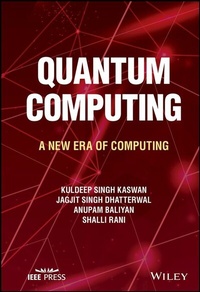
Quantum Computing
Description

A helpful introduction to all aspects of quantum computing
Quantum computing is a field combining quantum mechanics--the physical science of nature at the scale of atoms and subatomic particles--and information science. Where ordinary computing uses bits, logical values whose position can either be 0 or 1, quantum computing is built around qubits, a fundamental unit of quantum information which can exist in a superposition of both states. As quantum computers are able to complete certain kinds of functions more accurately and efficiently than computers built on classical binary logic, quantum computing is an emerging frontier which promises to revolutionize information science and its applications.
This book provides a concise, accessible introduction to quantum computing. It begins by introducing the essentials of quantum mechanics that information and computer scientists require, before moving to detailed discussions of quantum computing in theory and practice. As quantum computing becomes an ever-greater part of the global information technology landscape, the knowledge in Quantum Computing will position readers to join a vital and highly marketable field of research and development.
The book's readers will also find:
* Detailed diagrams and illustrations throughout
* A broadly applicable quantum algorithm that improves on the best-known classical algorithms for a wide range of problems
* In-depth discussion of essential topics including key distribution, cluster state quantum computing, superconducting qubits, and more
Quantum Computing is perfect for advanced undergraduate and graduate students in computer science, engineering, mathematics, or the physical sciences, as well as for researchers and academics at the intersection of these fields who want a concise reference.
More details
Other editions
Additional editions
Persons
Kuldeep Singh Kaswan, PhD, is Professor in the School of Computing Science and Engineering at Galgotias University, Greater Noida, India. He is co-editor of the Wiley-Scrivener title Swarm Intelligence: An Approach from Natural to Artificial.
Jagjit Singh Dhatterwal, PhD, is Associate Professor in the Department of Artificial Intelligence & Data Science at Koneru Lakshmaiah Education Foundation, Vaddeswaram, AP, India. He is co-editor of the Wiley-Scrivener title Swarm Intelligence: An Approach from Natural to Artificial.
Anupam Baliyan, PhD, is Additional Director with the University Institute of Engineering at Chandigarh University, Punjab, India.
Shalli Rani, PhD, is Professor at Chitkara University Institute of Engineering and Technology, Chitkara University, Punjab, India. She is co-editor of the Wiley title IoT-enabled Smart Healthcare Systems, Services and Applications.
Content
- Cover
- Title Page
- Copyright
- Contents
- Preface
- Author Biography
- Chapter 1 Introduction of Quantum Computing
- 1.1 Introduction
- 1.2 What Is the Exact Meaning of Quantum Computing?
- 1.2.1 What Is Quantum Computing in Simple Terms?
- 1.3 Origin of Quantum Computing
- 1.4 History of Quantum Computing
- 1.5 Quantum Communication
- 1.6 Build Quantum Computer Structure
- 1.7 Principle Working of Quantum Computers
- 1.7.1 Kinds of Quantum Computing
- 1.8 Quantum Computing Use in Industry
- 1.9 Investors Invest Money in Quantum Technology
- 1.10 Applications of Quantum Computing
- 1.11 Quantum Computing as a Solution Technology
- 1.11.1 Quantum Artificial Intelligence
- 1.11.2 How Close Are We to Quantum Supremacy?
- 1.12 Conclusion
- References
- References
- Chapter 2 Pros and Cons of Quantum Computing
- 2.1 Introduction
- 2.2 Quantum as a Numerical Process
- 2.3 Quantum Complexity
- 2.4 The Pros and Cons of the Quantum Computational Framework
- 2.5 Further Benefits of Quantum Computing
- 2.6 Further Drawbacks to Quantum Computing
- 2.7 Integrating Quantum and Classical Techniques
- 2.8 Framework of QRAM
- 2.9 Computing Algorithms in the Quantum World
- 2.9.1 Programming Quantum Processes
- 2.10 Modification of Quantum Building Blocks
- References
- Chapter 3 Methods and Instrumentation for Quantum Computing
- 3.1 Basic Information of Quantum Computing
- 3.2 Signal Information in Quantum Computing
- 3.3 Quantum Data Entropy
- 3.4 Basics of Probability in Quantum Computing
- 3.5 Quantum Theorem of No-Cloning
- 3.6 Measuring Distance
- 3.7 Fidelity in Quantum Theory
- 3.8 Quantum Entanglement
- 3.9 Information Content and Entropy
- References
- Chapter 4 Foundations of Quantum Computing
- 4.1 Single-Qubit
- 4.1.1 Photon Polarization in Quantum Computing
- 4.2 Multi-qubit
- 4.2.1 Blocks of Quantum States
- 4.2.2 Submission of Vector Space in Quantum Computing
- 4.2.3 Vector Spacing in Quantum Blocks
- 4.2.4 States of n-Qubit Technology
- 4.2.5 States of Entangled
- 4.2.6 Classical Measuring of Multi-Qubit
- 4.3 Measuring of Multi-Qubit
- 4.3.1 Mathematical Functions in Quantum Operations
- 4.3.2 Operator Measuring Qubits Projection
- 4.3.3 The Measurement Postulate
- 4.3.4 EPR Paradox and Bell's Theorem
- 4.3.5 Layout of Bell's Theorem
- 4.3.6 Statistical Predicates of Quantum Mechanics
- 4.3.7 Predictions of Bell's Theorem
- 4.3.8 Bell's Inequality
- 4.4 States of Quantum Metamorphosis
- 4.4.1 Solitary Steps Metamorphosis
- 4.4.2 Irrational Metamorphosis: The No-Cloning Principle
- 4.4.3 The Pauli Transformations
- 4.4.4 The Hadamard Metamorphosis
- 4.4.5 Multi-Qubit Metamorphosis from Single-Qubit
- 4.4.6 The Controlled-NOT and Other Singly Controlled Gates
- 4.4.7 Opaque Coding
- 4.4.8 Basic Bits in Opaque Coding
- 4.4.9 Quantum Message Teleportation
- 4.4.10 Designing and Constructing Quantum Circuits
- 4.4.11 Single Qubit Manipulating Quantum State
- 4.4.12 Controlling Single-Qubit Metamorphosis
- 4.4.13 Controlling Multi Single-Qubit Metamorphosis
- 4.4.14 Simple Metamorphosis
- 4.4.15 Unique Setup Gates
- 4.4.16 The Standard Circuit Model
- References
- Chapter 5 Computational Algorithm Design in Quantum Systems
- 5.1 Introduction
- 5.2 Quantum Algorithm
- 5.3 Rule 1 Superposition
- 5.4 Rule 2 Quantum Entanglement
- 5.5 Rule 3 Quantum Metrology
- 5.6 Rule 4 Quantum Gates
- 5.7 Rule 5 Fault-Tolerant Quantum Gates
- 5.8 Quantum Concurrency
- 5.9 Rule 7 Quantum Interference
- 5.10 Rule 8 Quantum Parallelism
- 5.11 Summary
- References
- Chapter 6 Optimization of an Amplification Algorithm
- 6.1 Introduction
- 6.2 The Effect of Availability Bias
- 6.2.1 Optimization of an Amplification Algorithm
- 6.2.2 Specifications of the Mathematical Amplification Algorithm
- 6.3 Quantum Amplitude Estimation and Quantum Counting
- 6.4 An Algorithm for Quantitatively Determining Amplitude
- 6.4.1 Mathematical Description of Amplitude Estimation Algorithm
- 6.5 Counting Quantum Particles: An Algorithm
- 6.5.1 Mathematical Description of Quantum Counting Algorithm
- 6.5.2 Related Algorithms and Techniques
- References
- Chapter 7 Error-Correction Code in Quantum Noise
- 7.1 Introduction
- 7.2 Basic Forms of Error-Correcting Code in Quantum Technologies
- 7.2.1 Single Bit-Flip Errors in Quantum Computing
- 7.2.2 Single-Qubit Coding in Quantum Computing
- 7.2.3 Error-Correcting Code in Quantum Technology
- 7.3 Framework for Quantum Error-Correcting Codes
- 7.3.1 Traditional Based on Error-Correcting Codes
- 7.3.2 Quantum Error Decode Mechanisms
- 7.3.3 Correction Sets in Quantum Coding Error
- 7.3.4 Quantum Errors Detection
- 7.3.5 Basic Knowledge Representation of Error-Correcting Code
- 7.3.6 Quantum Codes as a Tool for Error Detection and Correction
- 7.3.7 Quantum Error Correction Across Multiple Blocks
- 7.3.8 Computing on Encoded Quantum States
- 7.3.9 Using Linear Transformation of Correctable Codes
- 7.3.10 Model of Classical Independent Error
- 7.3.11 Independent Quantum Inaccuracies Models
- 7.4 Coding Standards for CSS
- 7.4.1 Multiple Classical Identifiers
- 7.4.2 Traditional CSS Codes Satisfying a Duality Consequence
- 7.4.3 Code of Steane
- 7.5 Codes for Stabilizers
- 7.5.1 The Use of Binary Indicators in Quantum Correction of Errors
- 7.5.2 Using Pauli Indicators to Fix Errors in Quantum Techniques
- 7.5.3 Using Error-Correcting Stabilizer Algorithms
- 7.5.4 Stabilizer State Encoding Computation
- 7.6 A Stabilizer Role for CSS Codes
- References
- Chapter 8 Tolerance for Inaccurate Information in Quantum Computing
- 8.1 Introduction
- 8.2 Initiating Stable Quantum Computing
- 8.3 Computational Error Tolerance Using Steane's Code
- 8.3.1 The Complexity of Syndrome-Based Computation
- 8.3.2 Error Removal and Correction in Fault-Tolerant Systems
- 8.3.3 Steane's Code Fault-Tolerant Gates
- 8.3.4 Measurement with Fault Tolerance
- 8.3.5 Readying the State for Fault Tolerance
- 8.4 The Strength of Quantum Computation
- 8.4.1 Combinatorial Coding
- 8.4.2 A Threshold Theorem
- References
- Chapter 9 Cryptography in Quantum Computing
- 9.1 Introduction of RSA Encryption
- 9.2 Concept of RSA Encryption
- 9.3 Quantum Cipher Fundamentals
- 9.4 The Controlled-Not Invasion as an Illustration
- 9.5 Cryptography B92 Protocol
- 9.6 The E91 Protocol (Ekert)
- References
- Chapter 10 Constructing Clusters for Quantum Computing
- 10.1 Introduction
- 10.1.1 State of Clusters
- 10.2 The Preparation of Cluster States
- 10.3 Nearest Neighbor Matrix
- 10.4 Stabilizer States
- 10.4.1 Aside: Entanglement Witness
- 10.5 Processing in Clusters
- References
- Chapter 11 Advance Quantum Computing
- 11.1 Introduction
- 11.2 Computing with Superpositions
- 11.2.1 The Walsh-Hadamard Transformation
- 11.2.2 Quantum Parallelism
- 11.3 Notions of Complexity
- 11.3.1 Query Complexity
- 11.3.2 Communication Complexity
- 11.4 A Simple Quantum Algorithm
- 11.4.1 Deutsch's Problem
- 11.5 Quantum Subroutines
- 11.5.1 The Importance of Unentangling Temporary Qubits in Quantum Subroutines
- 11.5.2 Phase Change for a Subset of Basis Vectors
- 11.5.3 State-Dependent Phase Shifts
- 11.5.4 State-Dependent Single-Qubit Amplitude Shifts
- 11.6 A Few Simple Quantum Algorithms
- 11.6.1 Deutsch-Jozsa Problem
- 11.6.2 Bernstein-Vazirani Problem
- 11.6.3 Simon's Problem
- 11.6.4 Distributed Computation
- 11.7 Comments on Quantum Parallelism
- 11.8 Machine Models and Complexity Classes
- 11.8.1 Complexity Classes
- 11.8.2 Complexity: Known Results
- 11.9 Quantum Fourier Transformations
- 11.9.1 The Classical Fourier Transform
- 11.9.2 The Quantum Fourier Transform
- 11.9.3 A Quantum Circuit for Fast Fourier Transform
- 11.10 Shor's Algorithm
- 11.10.1 Core Quantum Phenomena
- 11.10.2 Periodic Value Measurement and Classical Extraction
- 11.10.3 Shor's Algorithm and Its Effectiveness
- 11.10.4 The Efficiency of Shor's Algorithm
- 11.11 Omitting the Internal Measurement
- 11.12 Generalizations
- 11.12.1 The Problem of Discrete Logarithms
- 11.12.2 Hidden Subgroup Issues
- 11.13 The Application of Grover's Algorithm It's Time to Solve Some Difficulties
- 11.13.1 Explanation of the Superposition Technique
- 11.13.2 The Black Box's Initial Configuration
- 11.13.3 The Iteration Step
- 11.13.4 Various of Iterations
- 11.14 Effective State Operations
- 11.14.1 2D Geometry
- 11.15 Grover's Algorithm and Its Optimality
- 11.15.1 Reduction to Three Inequalities
- 11.16 Amplitude Amplification using Discrete Event Randomization of Grover's Algorithm
- 11.16.1 Altering Each Procedure
- 11.16.2 Last Stage Variation
- 11.16.3 Solutions: Possibly Infinite
- 11.16.4 Varying the Number of Iterations
- 11.16.5 Quantum Counting
- 11.17 Implementing Grover's Algorithm with Gain Boosting
- References
- Chapter 12 Applications of Quantum Computing
- 12.1 Introduction
- 12.2 Teleportation
- 12.3 The Peres Partial Transposition Condition
- 12.4 Expansion of Transportation
- 12.5 Entanglement Swapping
- 12.6 Superdense Coding
- References
- Index
- EULA
