

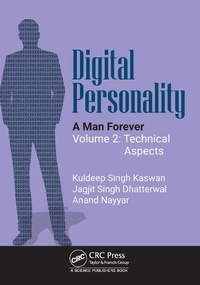
Digital Personality
A Man Forever Volume 2: Technical Aspects
1st Edition
Published on 30. August 2024
440 pages
978-1-040-12672-1 (ISBN)
Description

A computer that imbibes human characteristics is considered to have a digital personality. The character is akin to real-life human with his/her distinguishing characteristics such as history, morality, beliefs, abilities, looks, and sociocultural embeddings. It also contains stable personality characteristics; fluctuating emotional, cognitive, SOAR technology, and motivational states. Digital Personality focuses on the creation of systems and interfaces that can observe, sense, predict, adapt to, affect, comprehend, or simulate the following: character based on behavior and situation, behavior based on character and situation, or situation based on character and behavior. Character sensing and profiling, character-aware adaptive systems, and artificial characters are the three primary subfields in digital personality.
Digital Personality has attracted the interest of academics from a wide range of disciplines, including psychology, human-computer interaction, and character modeling. It is expected to expand quickly as technology and computer systems become more and more intertwined into our daily lives. Digital Personality is expected to draw at least as much attention as Affective Computing. The goal of affective computing is to enable computers to comprehend both spoken and nonverbal messages from people, use implicit body language, gaze, speech tones, and facial expressions, etc. to infer the emotional state and then reply appropriately or even show affect through interaction modalities. More natural and seamless human-computer connection would be the larger objective. Users will benefit from a more individualized experience as a result. Additionally, this will affect how well the user performs since they will have the assistance of the robots to do their jobs quickly and effectively.
This book provides an overview of the character dimensions and how technology is aiding this area of study. It offers a fresh portrayal of character from several angles. It also discusses the applications of this new field of study.
Digital Personality has attracted the interest of academics from a wide range of disciplines, including psychology, human-computer interaction, and character modeling. It is expected to expand quickly as technology and computer systems become more and more intertwined into our daily lives. Digital Personality is expected to draw at least as much attention as Affective Computing. The goal of affective computing is to enable computers to comprehend both spoken and nonverbal messages from people, use implicit body language, gaze, speech tones, and facial expressions, etc. to infer the emotional state and then reply appropriately or even show affect through interaction modalities. More natural and seamless human-computer connection would be the larger objective. Users will benefit from a more individualized experience as a result. Additionally, this will affect how well the user performs since they will have the assistance of the robots to do their jobs quickly and effectively.
This book provides an overview of the character dimensions and how technology is aiding this area of study. It offers a fresh portrayal of character from several angles. It also discusses the applications of this new field of study.
More details
Edition
1. Auflage
Language
English
Place of publication
London
United Kingdom
Publishing group
Taylor & Francis Ltd
Target group
College/higher education
Professional and scholarly
Illustrations
5 Illustrations, color; 38 Illustrations, black and white
ISBN-13
978-1-040-12672-1 (9781040126721)
Copyright in bibliographic data and cover images is held by Nielsen Book Services Limited or by the publishers or by their respective licensors: all rights reserved.
Schweitzer Classification
Other editions
Additional editions
Kuldeep Singh Kaswan | Jagjit Singh Dhatterwal | Anand Nayyar
Digital Personality
A Man Forever Volume 2: Technical Aspects
Book
12/2025
1st Edition
CRC Press
€108.80
Shipment within 10-20 days
Kuldeep Singh Kaswan | Jagjit Singh Dhatterwal | Anand Nayyar
Digital Personality
A Man Forever Volume 2: Technical Aspects
Book
08/2024
1st Edition
CRC Press
€235.20
Shipment within 10-20 days
Persons
Kuldeep Singh Kaswan is with the School of Computing Science & Engineering, Galgotias University, Uttar Pradesh, India. His focus is on BCI, Cyborg and Data Science. He received Doctorate in Computer Science from Banasthali Vidyapith, Rajasthan. He Received Doctor of Engineering (D. Engg.) from Dana Brain Health Institute, Iran. He has supervised many UG and PG projects of engineering students. He has supervised three PhD graduates and presently supervising four more PhD students. He has published number of books and book chapters. He has also number of publications in important journals and conferences.
Jagjit Singh Dhatterwal is an Associate Professor with the Department of Artificial Intelligence & Data Science Koneru Lakshmaiah Education Foundation, Vaddeswaram, Andhra Pradesh, India. He obtained the Doctorate in Computer Science from Mewar University, Rajasthan, India. He has also worked with Maharishi Dayanand University, Rohtak and PDM University, Bahadurgarh, Haryana, India. His areas of interest include Artificial Intelligence, BCI, Cyborg and Multi-Agents Technology. He has a number of books, book chapters, journal articles and conference papers to his name.
Anand Nayyar is with the School of Computer Science, Duy Tan University, Da Nang, Vietnam as Professor, Scientist, Vice-Chairman (Research) and Director of IoT and Intelligent Systems Laboratory. He has published more than 200+ research papers in various ISI-SCI/SCIE/SSCI journals. He is listed in Top 2% Scientists and Research.com. He is the Managing Editor of International Journal of Knowledge and Systems Science and Editor-in-Chief of International Journal of Smart Vehicles and Smart Transportation, both published by IGI Global, USA.
Jagjit Singh Dhatterwal is an Associate Professor with the Department of Artificial Intelligence & Data Science Koneru Lakshmaiah Education Foundation, Vaddeswaram, Andhra Pradesh, India. He obtained the Doctorate in Computer Science from Mewar University, Rajasthan, India. He has also worked with Maharishi Dayanand University, Rohtak and PDM University, Bahadurgarh, Haryana, India. His areas of interest include Artificial Intelligence, BCI, Cyborg and Multi-Agents Technology. He has a number of books, book chapters, journal articles and conference papers to his name.
Anand Nayyar is with the School of Computer Science, Duy Tan University, Da Nang, Vietnam as Professor, Scientist, Vice-Chairman (Research) and Director of IoT and Intelligent Systems Laboratory. He has published more than 200+ research papers in various ISI-SCI/SCIE/SSCI journals. He is listed in Top 2% Scientists and Research.com. He is the Managing Editor of International Journal of Knowledge and Systems Science and Editor-in-Chief of International Journal of Smart Vehicles and Smart Transportation, both published by IGI Global, USA.
Content
Preface. Introduction to Cognitive Digital Personality. Basics of SOAR Architectures in Digital Personality. Parameters and Program in Digital Personality. Control Structure in Digital Personality. Virtual Sensors in Digital Personality. Personality Synthesis in Digital Personality. Communicating with Ignorance versus Empathy. Adapting to Different Personality. Personality AI for Different Conversations. Personality AI for Various Situations. Mixed Reality in Digital Personality. Navigating Stories in Digital Personality. Event-Based Film Browsing in Digital Personality. Alternative Reality Cinema in Digital Personality. Chatbot Infotainment in Digital Personality. Character-IoT in Digital Personality. Index.
