

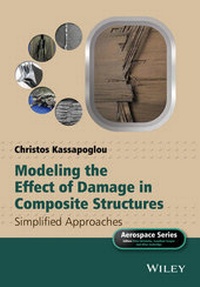
Modeling the Effect of Damage in Composite Structures
Description

Reviews / Votes
"This will help the readers - engineers who will be designing the next generation of airframe structures - to develop not only better understanding of underlying damage mechanisms, but also critical thinking and open-mindedness needed for evaluation of any new simplified approaches that may emerge in the future" Professor Maria Kashtalyan, University of Aberdeen on behalf of the Aeronautical Journal, Oct 2017More details
Other editions
Additional editions
Person
Content
Preface xi
1 Damage in Composite Structures: Notch Sensitivity 1
1.1 Introduction 1
1.2 Notch Insensitivity 2
1.3 'Complete' Notch Sensitivity 4
1.4 Notch Sensitivity of Composite Materials 5
Exercises 6
References 7
2 Holes 9
2.1 Stresses around Holes 13
2.2 Using the Anisotropic Elasticity Solution to Predict Failure 16
2.3 The Role of the Damage Zone Created Near a Hole 17
2.4 Simplified Approaches to Predict Failure in Laminates with Holes: the Whitney-Nuismer Criteria 19
2.5 Other Approaches to Predict Failure of a Laminate with a Hole 24
2.6 Improved Whitney-Nuismer Approach 25
2.7 Application: Finding the Stacking Sequence Which Results in Good OHT Performance 34
Exercises 35
References 39
3 Cracks 41
3.1 Introduction 41
3.2 Modelling a Crack in a Composite Laminate 42
3.3 Finite-Width Effects 45
3.4 Other Approaches for Analysis of Cracks in Composites 46
3.5 Matrix Cracks 49
Exercises 52
References 56
4 Delaminations 57
4.1 Introduction 57
4.2 Relation to Inspection Methods and Criteria 60
4.3 Modelling Different Structural Details in the Presence of Delaminations 63
4.3.1 Buckling of a Through-Width Delaminating Layer 63
4.3.2 Buckling of an Elliptical Delaminating Layer 69
4.3.3 Application - Buckling of an Elliptical Delamination under Combined Loads 73
4.3.4 Onset of Delamination at a Straight Free Edge of a Composite Laminate 75
4.3.5 Delamination at a Flange-Stiffener Interface of a Composite Stiffened Panel 84
4.3.6 Double Cantilever Beam and End Notch Flexure Specimen 88
4.3.7 The Crack Closure Method 92
4.4 Strength of Materials Versus Fracture Mechanics - Use of Cohesive Elements 96
4.4.1 Use of Cohesive Elements 99
Exercises 100
References 103
5 Impact 105
5.1 Sources of Impact and General Implications for Design 105
5.2 Damage Resistance Versus Damage Tolerance 109
5.3 Modelling Impact Damage as a Hole 111
5.4 Modelling Impact Damage as a Delamination 114
5.5 Impact Damage Modelled as a Region of Reduced Stiffness 117
5.6 Application: Comparison of the Predictions of the Simpler Models with Test Results 121
5.6.1 Modelling BVID as a Hole 122
5.6.2 Modelling BVID as a Single Delamination 123
5.6.3 Modelling BVID as an Elliptical Inclusion of Reduced Stiffness 124
5.6.4 Comparisons of Analytical Predictions to Test Results - Sandwich Laminates 124
5.7 Improved Model for Impact Damage Analysed as a Region of Reduced Stiffness 125
5.7.1 Type and Extent of Damage for Given Impact Energy 125
5.7.2 Model for Predicting CAI Strength 148
Exercises 163
References 168
6 Fatigue Life of Composite Structures: Analytical Models 171
6.1 Introduction 171
6.2 Needed Characteristics for an Analytical Model 175
6.3 Models for the Degradation of the Residual Strength 177
6.3.1 Linear Model 177
6.3.2 Nonlinear Model 180
6.4 Model for the Cycles to Failure 183
6.4.1 Extension to Spectrum Loading 196
6.5 Residual Strength and Wear-Out Model Predictions Compared to Test Results 200
6.5.1 Residual Strength Predictions Compared to Test Results 200
6.5.2 Cycles to Failure Predictions Compared to Test Results (Constant Amplitude) 202
6.5.3 Cycles to Failure Predictions Compared to Test Results (Spectrum Loading) 204
6.6 A Proposal for the Complete Model: Accounting for Larger Scale Damage 206
6.6.1 First Cycle, Tension Portion 207
6.6.2 First Cycle, Compression Portion 207
6.6.3 Subsequent Load Cycles 208
6.6.4 Discussion 208
6.6.5 Application: Tension-Compression Fatigue of Unidirectional Composites 209
6.6.6 Application: Tension-Tension Fatigue of Cross-Ply Laminates 214
Exercises 218
References 219
7 Effect of Damage in Composite Structures: Summary and Useful Design Guidelines 221
Index 227
