

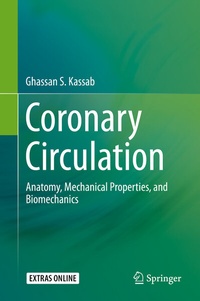
Coronary Circulation
Description

This comprehensive text examines both global and local coronary blood flow based on morphometry and mechanical properties of the coronary vasculature. Using a biomechanical approach, this book addresses coronary circulation in a quantitative manner based on models rooted in experimental data that account for the various physical determinants of coronary blood flow including myocardial-vessel interactions and various mechanisms of autoregulation. This is the first text dedicated to a distributive analysis (as opposed to lumped) and provides digital files for detailed anatomical data (e.g., diameters, lengths, node-to-node connections) of the coronary vessels. This book also provides appendices with specific mathematical formulations for the biomechanical analyses and models in the text. Written by Dr. Ghassan S. Kassab, a leader in the field of coronary biomechanics, Coronary Circulation: Anatomy, Mechanical Properties, and Biomechanics is a synthesis of seminal topics in the field and is intended for clinicians, bioengineers, and researchers as a compendium on the topic. The detailed anatomical and mechanical data provided are intended to be used as a platform to address new questions in this exciting and clinically very important research area.
More details
Other editions
Additional editions
Person
Dr. Kassab received his BS (Chemical Engineering), MS (Engineering Sciences), and PhD (Bioengineering, Summa Cum Laude) from UCSD. He previously served as the Guidant Chair and Professor at Indiana/Purdue University. He is the founder and current President of California Medical Innovations Institute in San Diego.Dr. Kassab is the recipient of the NIH Young Investigator Award, AHA Established Investigator Award, Farriborz Maseeh Best Research Award, Abraham M. Max Distinguished Professor Award, Eminent Engineer Award of Tau Beta Pi Engineering Honor Society, Indiana's President Circle Award, and Glenn IrwinChancellor Best Research Scholar Award. Dr. Kassab has published over 300full-length publications and his scientific interests encompass the biomechanics of cardiovascular and gastroenterology systems in health and disease. He also has over 250 issued or pending patents in the areas of diagnosis and treatment of heart disease, aneurysm, and obesity. Dr. Kassab's intellectualproperties have resulted in multiple start-ups and licensesto the medical device industry.
Content
Chapter 1: Biomechanics.- Chapter 2: Morphometry of Coronary Vasculature.- Chapter 3: Mechanical Properties and Microstructure of the Coronary Vasculature.- Chapter 4: Constitutive Models of Coronary Vasculature.- Chapter 5: Network Analysis of Coronary Circulation: I. Steady State Flow.- Chapter 6: Network Analysis of Coronary Circulation: II. Pulsatile Flow.- Chapter 7: Scaling Laws of Coronary Vasculature.- Chapter 8: Local Coronary Flow and Stress Distribution.
