

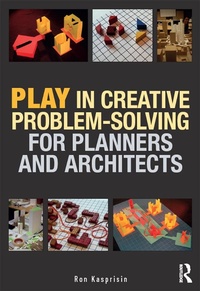
Play in Creative Problem-solving for Planners and Architects
Published on 1. July 2016
238 pages
978-1-317-31161-4 (ISBN)
Description

In Play in Creative Problem-solving for Planners and Architects, "play" is defined, explored and demonstrated as a critical catalyst in creative problem-solving processes. The book defines the current psychological research into play and creative problem-solving, explores the necessary integration of the two, and exemplifies for students and practitioners the use of play in creative endeavors; and the role that play serves in separating linear from creative problem-solving approaches.
Play is explored regarding its elements (tools, skills, environment), characteristics (a free activity without failure) and attitude as it relates to and activates the creative process with the focus on urban design, planning, architecture, and landscape architecture. The book re-establishes the whole mind-body thinking process of play as a means of object-learning; to provide designers and planners with alternative ways of design-thinking; and to challenge the over-utilization of digital technologies in creative processes. Creative problem-solving requires an appreciation for ambiguity, uncertainty of outcome, complexity that leads to the discovery of novelty and innovation.
The book incorporates examples and exercises in play activities related to the design and planning fields, and exercises related to play-tools and skills for students and professionals. It also defines terms used in play and creativity psychology; provides examples and structure for play and creative problem-solving activities; describes the type and use of appropriate play-tools; contains an extensive bibliography on play and creative problem-solving texts; and provides significant illustrations making it fundamental reading for students and professionals in urban design and planning fields.
Play is explored regarding its elements (tools, skills, environment), characteristics (a free activity without failure) and attitude as it relates to and activates the creative process with the focus on urban design, planning, architecture, and landscape architecture. The book re-establishes the whole mind-body thinking process of play as a means of object-learning; to provide designers and planners with alternative ways of design-thinking; and to challenge the over-utilization of digital technologies in creative processes. Creative problem-solving requires an appreciation for ambiguity, uncertainty of outcome, complexity that leads to the discovery of novelty and innovation.
The book incorporates examples and exercises in play activities related to the design and planning fields, and exercises related to play-tools and skills for students and professionals. It also defines terms used in play and creativity psychology; provides examples and structure for play and creative problem-solving activities; describes the type and use of appropriate play-tools; contains an extensive bibliography on play and creative problem-solving texts; and provides significant illustrations making it fundamental reading for students and professionals in urban design and planning fields.
Reviews / Votes
"Design is a serendipitous conversation between the sketching hand and the critical eye. This iterative process is dull and incomplete without some playful speculation and explorative fun, which loosen the senses and shuffle preconceptions. This agile book privileges the physical hand over the electronic hand." -Doug Kelbaugh, University of Michigan"Kaspirin's consideration of how play overcomes fear and unleashes creativity could stimulate new directions in how faculty promote critical thinking within students and how to encourage and absorb diverse perspectives within class discussions." -Mary Stimming, Associate Director of Special Projects for the Wabash Center for Teaching and Learning in Theology and Religion
More details
Language
English
Place of publication
London
United Kingdom
Publishing group
Taylor & Francis Ltd
Target group
College/higher education
Professional and scholarly
Product notice
Reflowable
Illustrations
157 Farbfotos bzw. farbige Rasterbilder
157 Halftones, color
File size
16,99 MB
ISBN-13
978-1-317-31161-4 (9781317311614)
Copyright in bibliographic data and cover images is held by Nielsen Book Services Limited or by the publishers or by their respective licensors: all rights reserved.
Schweitzer Classification
Other editions
Additional editions
Book
07/2016
1st Edition
Routledge
€84.47
Shipment within 10-20 days
Book
07/2016
1st Edition
Routledge
€282.73
Shipment within 10-20 days
Person
Ron Kasprisin is an architect, urban planner and watercolor artist, and Professor Emeritus, Urban Design and Planning, College of Built Environments, University of Washington, Seattle. Ron has practiced as Kasprisin Pettinari Design since 1975 and taught urban design since 1989. His books include: Urban Design: The composition of complexity, Design Media, Visual Thinking for Architects and Designers, and Watercolor in Architectural Design.
Content
1. Creative Problem-solving (CPS) for Design and Planning
2. Object-learning through Play: Object-Learning, Constructivism, and Self-learning through Symbolic Play
3. The Gifts of Friedrich Froebel
4. How Do Designers Play?
5. Setting the Stage-Play Environment
6. Object-learning with Play-tools/Skills
7. Object-learning Applications in Design and Planning
8. Integration of Digital Technologies and Crafting Processes
2. Object-learning through Play: Object-Learning, Constructivism, and Self-learning through Symbolic Play
3. The Gifts of Friedrich Froebel
4. How Do Designers Play?
5. Setting the Stage-Play Environment
6. Object-learning with Play-tools/Skills
7. Object-learning Applications in Design and Planning
8. Integration of Digital Technologies and Crafting Processes
