

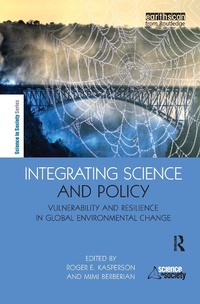
Integrating Science and Policy
Vulnerability and Resilience in Global Environmental Change
1st Edition
Published on 6. August 2012
416 pages
978-1-136-53900-8 (ISBN)
Description

As progress towards a greater knowledge in sustainability science continues, the question of how better to integrate scientific progress with actual decisions made by practitioners remains paramount. This book aims to help close the gap between science and practice. Based on a two year collaborative project between Harvard and Clark Universities, the book takes as its focus the vulnerability and resilience of people around the world to the effects of environmental change, a mature area of research in which one might expect the gap between science and policy/practice to have been extensively bridged. The book presents analysis of past studies, interviews conducted with the producers and users of scientific knowledge, and case studies performed by leading scholars across a spectrum of international settings and political systems. Crucially, the authors identify new directions and tools for closing the gap between science and policy across a range of situations and societies. The result is an illuminating collection of studies and analyses that suggest to researchers, students, practitioners, and policy-makers alike how best to ensure that high quality environmental research informs good environmental policy and practice.
ACKNOWLEDGEMENTS
The editors and authors are grateful to Lu Ann Pacenka, who formatted the text of the book. The editors also wish to express their appreciation to Bill Clark and Nancy Dickson of Harvard University, who commissioned and provided oversight for the preparation of the volume. Both editors and authors wish to express their appreciation to the David and Lucile Packard Foundation for providing funds to support the project. Finally, the editors are grateful for the continuing support of the George Perkins Marsh Institute at Clark University.
Published with Science in Society
ACKNOWLEDGEMENTS
The editors and authors are grateful to Lu Ann Pacenka, who formatted the text of the book. The editors also wish to express their appreciation to Bill Clark and Nancy Dickson of Harvard University, who commissioned and provided oversight for the preparation of the volume. Both editors and authors wish to express their appreciation to the David and Lucile Packard Foundation for providing funds to support the project. Finally, the editors are grateful for the continuing support of the George Perkins Marsh Institute at Clark University.
Published with Science in Society
Reviews / Votes
'This is a timely and important volume that offers a refreshingly new view of the interactions between scientists and policy makers. Conventional ideas are challenged and practical implications identified. Anyone interested in science, society and the environment will find it highly informative.'Dr Michael Howes, Senior Lecturer in Environmental Policy, Griffith University, Australia
More details
Series
Language
English
Place of publication
London
United Kingdom
Publishing group
Taylor & Francis Ltd
Target group
College/higher education
Product notice
Reflowable
File size
33,89 MB
ISBN-13
978-1-136-53900-8 (9781136539008)
Copyright in bibliographic data and cover images is held by Nielsen Book Services Limited or by the publishers or by their respective licensors: all rights reserved.
Schweitzer Classification
Other editions
Additional editions
Roger E. Kasperson
Integrating Science and Policy
Vulnerability and Resilience in Global Environmental Change
Book
02/2011
1st Edition
Earthscan Ltd
€238.09
Shipment within 3-4 weeks
Roger E. Kasperson
Integrating Science and Policy
Vulnerability and Resilience in Global Environmental Change
Book
02/2011
1st Edition
Earthscan Ltd
€91.50
Shipment within 3-4 weeks
Person
Roger Kasperson is Research Professor at Clark University and a Visiting Scholar at START in Washington, DC. He is a member of the US National Academy of Sciences and the American Academy of Arts and Sciences. He is a fellow of the American Association for the Advancement of Science and the Society for Risk Analysis. He has served on numerous committees of the US National Research Council. He was a former Executive Director of the Stockholm Environment Institute.
Mimi Berberian is a Senior Staff Associate at the George Perkins Marsh Institute at Clark University. She has participated with researchers in various studies of natural and technological hazards, risk assessment and risk management, and global environmental change. She has a long experience in editing and has facilitated the preparation of numerous research results for publication as journal articles and books. Among those published are Equity Issues in Radioactive Waste Management, Climate Impact Assessment, and Social Contours of Risk.
Mimi Berberian is a Senior Staff Associate at the George Perkins Marsh Institute at Clark University. She has participated with researchers in various studies of natural and technological hazards, risk assessment and risk management, and global environmental change. She has a long experience in editing and has facilitated the preparation of numerous research results for publication as journal articles and books. Among those published are Equity Issues in Radioactive Waste Management, Climate Impact Assessment, and Social Contours of Risk.
Content
INTRODUCTION: CHARACTERIZING THE SCIENCE/PRACTICE GAP
PART I: WHAT DO WE KNOW NOW?
1. Knowledge to Practice in the Vulnerability, Adaptation, and Resilience Literature: A Propositional Inventory
2. Integrating Science and Practice for the Mitigation of Natural Disasters: Barriers, Bridges, Propositions
3. Linking Vulnerability, Adaptation, and Resilience Science to Practice: Pathways, Players, and Partnerships
PART II: GROWING POLITICAL URGENCY: CLIMATE CHANGE
1.From the U.S. Global Change Research Act (1990) to the Climate Change Science Program
2. Linking Climate Change Science with Policy in California
3. Russia's Climate Policy and the Kyoto Ratification Deal: Assessing the Science/Practice Interface
4. Urban and Social Vulnerability to Climate Variability in Tijuana, Mexico
PART III: THE SCIENCE/PRACTICE GAP: GLOBAL PERSPECTIVES
1. Food Insecurity in South Africa
2. Science and Vulnerability in Taiwan after the 1999 Chi-Chi Earthquake
3. Participatory Evaluation of Development Interventions in a Vulnerable African Environment
4. Science and Indigenous Knowledge in Resource Management in the Canadian Arctic
5. Reducing Vulnerability of Rural Communities in the Philippines: Modeling Social Links between Science and Policy
6. Addressing Vulnerability in the European Program for Food Aid and Food Security: Knowledge Gaps, Obstacles, and Opportunities Across the Science/Practice Interface
7. Land in Transition: Coping with Market Forces in Managing Rangelands in Mongolia
8. Managing Floods and Scarcity in a Monsoon Climate
PART IV: WHERE DO WE GO FROM HERE?
1. Issues That Need to be Addressed: Assessing Experience
2. Directions for Closing the Science/Practice Gap:
PART I: WHAT DO WE KNOW NOW?
1. Knowledge to Practice in the Vulnerability, Adaptation, and Resilience Literature: A Propositional Inventory
2. Integrating Science and Practice for the Mitigation of Natural Disasters: Barriers, Bridges, Propositions
3. Linking Vulnerability, Adaptation, and Resilience Science to Practice: Pathways, Players, and Partnerships
PART II: GROWING POLITICAL URGENCY: CLIMATE CHANGE
1.From the U.S. Global Change Research Act (1990) to the Climate Change Science Program
2. Linking Climate Change Science with Policy in California
3. Russia's Climate Policy and the Kyoto Ratification Deal: Assessing the Science/Practice Interface
4. Urban and Social Vulnerability to Climate Variability in Tijuana, Mexico
PART III: THE SCIENCE/PRACTICE GAP: GLOBAL PERSPECTIVES
1. Food Insecurity in South Africa
2. Science and Vulnerability in Taiwan after the 1999 Chi-Chi Earthquake
3. Participatory Evaluation of Development Interventions in a Vulnerable African Environment
4. Science and Indigenous Knowledge in Resource Management in the Canadian Arctic
5. Reducing Vulnerability of Rural Communities in the Philippines: Modeling Social Links between Science and Policy
6. Addressing Vulnerability in the European Program for Food Aid and Food Security: Knowledge Gaps, Obstacles, and Opportunities Across the Science/Practice Interface
7. Land in Transition: Coping with Market Forces in Managing Rangelands in Mongolia
8. Managing Floods and Scarcity in a Monsoon Climate
PART IV: WHERE DO WE GO FROM HERE?
1. Issues That Need to be Addressed: Assessing Experience
2. Directions for Closing the Science/Practice Gap:
