

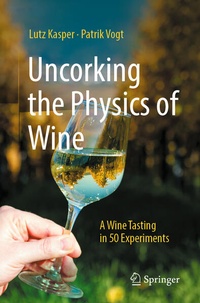
Uncorking the Physics of Wine
Description

A still sealed wine bottle, a corkscrew, and a smartphone are undoubtedly a promising combination. Notify good friends with one device and extract the cork from the bottle with the other - what more could one want? Perhaps, in addition to quenching the thirst, the "mind" also craves satisfaction!
With this book, you practice your physics mindfulness during the enjoyment of wine: you learn how to determine the speed of sound with the characteristic pop sound when opening the bottle, how to properly decant wine, what peculiarities red wine shows in laser light, and what Pythagoras has to do with wine.
Uncorking the Physics of Wine creates the wonderful connection between science and wine. An inspiring non-fiction book - with experiments to participate in and replicate, or simply to savor.
The authors
Lutz Kasper studied physics and mathematics at University of Hannover to become a teacher and completed his doctorate in physics education at the University of Potsdam. He has been a professor of physics and physics education at University of Education Schwäbisch Gmünd since 2011. In recent years, he also has worked as an invited visiting professor in the physics department of Grand Valley State University (MI) and at the Taraz Pedagogical University (Kazakhstan).
Patrik Vogt studied physics and mathematics on a teaching degree at the University of Koblenz-Landau and was a research assistant and secondary school teacher at various schools and universities in Germany until 2019. Since then, he is head of the department "Media Education, Mathematics, Natural Sciences, Music, Philosophy" at the ILF in Mainz, Germany. His work focuses on the possible uses of mobile devices in physics lessons, especially as a measuring instrument, task culture and the physics of everyday life.
More details
Other editions
Additional editions
Persons
Lutz Kasper studied physics and mathematics at University of Hannover to become a teacher and completed his doctorate in physics education at the University of Potsdam. He has been a professor of physics and physics education at University of Education Schwäbisch Gmünd since 2011. In recent years, he also has worked as an invited visiting professor in the physics department of Grand Valley State University (MI) and at the Taraz Pedagogical University (Kazakhstan).
Patrik Vogt studied physics and mathematics on a teaching degree at the University of Koblenz-Landau and was a research assistant and secondary school teacher at various schools and universities in Germany until 2019. Since then, he is head of the department "Media Education, Mathematics, Natural Sciences, Music, Philosophy" at the ILF in Mainz, Germany. His work focuses on the possible uses of mobile devices in physics lessons, especially as a measuring instrument, task culture and the physicsof everyday life.
