

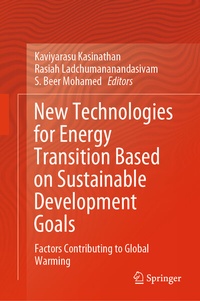
New Technologies for Energy Transition Based on Sustainable Development Goals
Description

This book describes numerous issues and brings an improved understanding of a key agenda item for the sustainable development goals (SDGs). The SDGs represent an urgent call for action by all countries, developed and developing, working jointly within the global community. A few of the industries it supports include food processing, energy, biomedical science, space research, drug delivery, and biosensors. This book highlights multidisciplinary solutions for protecting the environment while ensuring the future of our planet.
The book mainly targets undergraduates, postgraduates, and doctoral students who are working in materials science and researchers across the world working in interdisciplinary research for climate change for sustainable growth.
More details
Other editions
Additional editions
Persons
Kasinathan Kaviyarasu is a material scientist currently working as a senior researcher at the University of South Africa (UNISA) under UNESCO Africa Chair in Nanosciences/Nanotechnology category. And his research is focused on the design and development of advanced materials for low-carbon emission technologies which play a key role to mitigate climate change.
Professor Rasiah Ladchumananandasivam is a full professor at the Federal University of Rio Grande do Norte-UFRN. He has experience in the area of chemical engineering, polymer sciences and fiber engineering, flexible and rigid composites with textile fibers. It mainly works on the following topics: nanotechnology, nanocomposites, nanomaterials-synthesize and study of structures, optics and antimicrobials, electrotrophy, wet chemical processes, technical technologies, smart technologies, functional technologies, and management and marketing.
Dr. S. Beer Mohamed is currently working as an associate professor in the Department of Materials Science, School of Technology, Central University of Tamil Nadu, Thiruvarur, India. He has worked in the fabrication of nanowire-based solar cells using PECVD in silicon nanodevice laboratory, Singapore. He is currently doing research in nanomaterials synthesis and fabrication, composites, functional materials, carbon nanotubes, thin films, and graphene.
Content
1. Pioneering Role of Two-Dimensional Materials in Revolutionizing Biomedical Sensing.- 2. An overview of drug delivery for wellbeing based on polysaccharides.- 3. Advanced nanomaterials, medical materials, and nanotechnology for the improved patient care.- 4. Electroanalysis and sensors for biomedical and clinical applications.- 5. Biomedical applications of nanocellulose-based biomaterials: recent advancements.
