

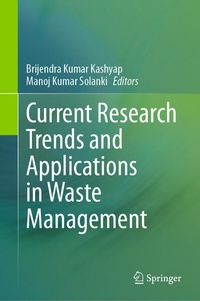
Current Research Trends and Applications in Waste Management
Description

This book covers latest information on organic and inorganic waste management, and how the waste can be utilized as an energy source. An increasing world population and climate change rate hint that environmental health needs a sustainable waste recycling system worldwide. Management of wastes material plays a substantial role in the environment and climate regulation. Chapters contain modern tools and techniques for managing inorganic, biomedical, municipality, and food waste. The title covers the role of contemporary microbiology and biotechnological tools in waste management and how these microbial agents can enhance waste degradation and bioenergy production. The book covers interesting topics such as bio-ethanol production from agro-waste, microbial fuel cells, biogas production from animal waste, nanotechnology in waste recycling, etc. The primary audiences are researchers, scientists, students, and policymakers interlinked with waste management and applied microbial sectors.
More details
Other editions
Additional editions
Persons
Dr Brijendra Kumar Kashyap is an assistant professor at the Department of Biotechnology Engineering, Institute of Engineering and Technology, Bundelkhand University (IET, BU), Jhansi, India, and a member of the ongoing project TEQIP-III. His graduation and post-graduation are from Banaras Hindu University (BHU), Varanasi, and PhD (pursuing) from Bundelkhand University, India. He had received numerous prestigious awards, including the Young Scientist Award of Society of Bioinformatics and Biological Sciences (SBBS), India, JRF(NET)-CSIR, SRF-CSIR, SRF-ICAR, IIT-Fellowship, ARS(NET)-ICAR, GATE, DBT-Fellowship, etc. He had delivered numerous oral and poster presentations at various national and international conferences and had published more than 20 papers in peer-reviewed journals. He is having more than 15 years of teaching and research experience.
Manoj Kumar Solanki (PhD) is currently working as a scientist in the University of Silesia in Katowice, Poland, under the Police National Agency for Academic Exchange Program. He obtained his Master's in Microbiology from Barkatullah University in 2006 and a PhD in Microbiology from Rani Durgawati University, India, in 2013. He has awarded a visiting scientist fellowship from the Guangxi Academy of Agriculture Sciences, China, in 2013-2015, and also awarded as visiting scientist from the Volcani Center, Agricultural Research Organization, Israel 2016-2020. He has been engaged in various research activities on plants-microbes interaction, soil microbiology, plant disease management, and enzymology, and published many books, chapters, and various research papers in many international journals. He has a great interest in agriculturally important microorganisms (such as bacteria, actinomycetes, fungi, and yeast), especially in the utilization of microorganisms in soil and crop health management and other allied areas.
