

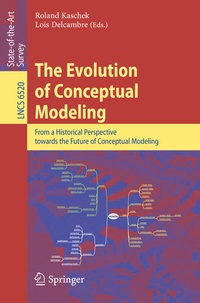
The Evolution of Conceptual Modeling
Description

Conceptual modeling represents a recent approach to creating knowledge. It has emerged in response to the computer revolution, which started in the middle of the 20th century.
Computers, in the meantime, have become a major knowledge media. Conceptual modeling provides an answer to the difficulties experienced throughout the development of computer applications and aims at creating effective, reasonably priced, and sharable knowledge about using computers in business. Moreover, it has become evident that conceptual modeling has the potential to exceed the boundaries of business and computer usage.
This state-of-the-art survey originates from the International Seminar on the Evolution of Conceptual Modeling, held in Dagstuhl Castle, Germany, in April 2008. The major objective of this seminar was to look into conceptual modeling from a historical perspective with a view towards the future of conceptual modeling and to achieve a better understanding of conceptual modeling issues in several different domains of discourse, going beyond individual (modeling) projects.
The book contains 14 chapters. These were carefully selected during two rounds of reviewing and improvement from 26 presentations at the seminar and are preceded by a detailed preface providing general insights into the field of conceptual modeling that are not necessarily discussed in any of the chapters but nevertheless aid in conceptualizing the inner structure and coherence of the field. The chapters are grouped into the following three thematic sections: the evolution of conceptual modeling techniques; the extension of conceptual modeling to a service-oriented, peer-to-peer, or Web context; and new directions for conceptual modeling.
More details
Other editions
Additional editions
Content
- Title
- Preface
- Organization
- Table of Contents
- Section I: The Evolution of Conceptual Modeling Techniques
- Real-World Semantics of Conceptual Models
- Introduction
- Conceptual Modelling as Domain Modelling
- The Engineering Argument
- Domain Models versus Software Specifications
- Conceptual Modelling Notations Since the 1970s
- Entity-Oriented Approaches
- Communication-Oriented Approaches
- Behavior-Oriented Approaches
- Real-World Semantics: Domain Structure
- Real-World Semantics: Solution Impact
- Physical, Social and Digital Domains
- Physical Modelling
- Performative Modelling
- Summary and Conclusions
- References
- Templates in Domain Modeling - A Survey
- Introduction
- Types of Templates
- Templates for the Schema (Model) Level
- Templates for the Instance Level
- Graphical Modeling Languages vs. Template-Based Approaches
- An Advocacy for Graphical Modeling Languages?
- Limitations of Graphical Modeling Languages
- Why Template-Based Approaches?
- Template-Based versus Diagrams - Comparison Studies
- A Historical Survey of Important Template-Based Approaches
- Forms, Tables, Matrices, Glossaries
- Forms on the Instance Level
- Controlled Language Sentences
- Controlled Language Sentences on the Instance Level
- The Story of KCPM
- The Beginnings
- Research
- Practical Studies
- Beyond Glossaries - Current State of KCPM
- Conclusion and Future Vision
- Conclusion
- Templates in SW Development - Future Vision
- Summary
- References
- Integrity Constraints in (Conceptual) Database Models
- Revisiting Database Constraint Theory
- Omnipresence of Database Constraints
- Separation of Integrity Constraints by Their Use and Usage
- Quality Criteria for Constraint Sets
- Optimisation of Behaviour through Normalisation of Database Structuring
- Outline of the Paper
- Systematic Constraints Deployment
- The Constraints Handling Framework
- Implicit Model-Inherent Integrity Constraints
- Separation of Concerns
- Difficult Unsolved Problems
- Global versus Local Normalisation
- Optimal Synthesis Algorithm
- Treatment of Almost Valid Constraints
- Consideration of Constraint Sets Instead of Singleton and Isolated Constraints
- The Expressive Power and Language Relativity
- Background Theories and Results
- The Power of Simplicity
- The Power of Graphical Reasoning
- The Power of Equivalence Class Reasoning
- Application of the Background Theories and Results
- BV Constraints and Their Axiomatisation
- Optional, Complex and Null-`Valued' Structures
- General Normalisation and Optimisation
- Summary and Conclusion
- References
- Modeling Techniques for Multi-level Abstraction
- Introduction
- Sample Problem and Comparison Criteria
- Techniques Supporting Multi-level Abstraction
- Potency-Based Deep Instantiation
- Powertypes
- Materialization
- Multi-level Objects
- The Higher-Order Entity Relationship Model
- The Component Model
- Conclusion
- References
- Random Thoughts on Multi-level Conceptual Modelling
- Introduction
- Abstraction
- Multiple Levels
- Ontologies and Metamodels
- Model Quality - Some Observations
- Application of Conceptual Models
- Objects, Agents and Method Engineering Applications of Modelling
- Extending IT Modelling into Business Process Management
- Future Research Opportunities
- References
- On the Evolution of Quality Conceptualization Techniques
- Introduction
- A Concept of Quality
- Quality Conceptualization Techniques: Dimensions of Evolution
- Conceptualization Process Dimensions
- Quality Properties Support Dimensions
- Quality Perception Support Dimensions
- Quality Usage Support Dimensions
- Applicability Dimensions
- Towards a QCT Evaluation Framework
- Evaluating Quality of Quality Conceptualizations
- Engineering Quality Conceptualizations for Situational Methods
- Related Work
- Conclusions and Future Work
- References
- Section II: Extensions of Conceptual Modeling
- A Web of Knowledge: A Conceptual-Modeling Perspective
- Introduction
- From a Web of Pages to a Web of Knowledge
- From Symbols to Knowledge - Ontological and Epistemological Tools
- Querying Knowledge - Logic Tools
- WoK Tools
- Ontology/Epistemology Creation Tools
- Query Tools
- Conclusion
- References
- Service-Based Semantic Collaboration in Networked Systems: A Conceptual Perspective
- Introduction
- Contribution
- Related Work
- Ontology-Based Service Description
- Ontology Mapping
- P2P Semantic-Driven Service Discovery
- Application Scenario
- Overview of the P2P Collaborative Network
- The Semantic Overlay Modeling Framework
- Modeling the Peer Knowledge
- Ontology-Based Matchmaking Techniques for Semantic Overlay Creation and Evolution
- The Collaboration Model
- Emergent Semantic Overlay from Local Interactions
- Service Semantic Overlay Evolution
- Navigating the Service Semantic Overlay for Service Discovery
- Conclusions
- References
- Conceptual Modeling Approaches for Dynamic Web Service Composition
- Introduction
- A Dynamic Service Composition Life-Cycle
- Design Phase
- Configuration Phase
- Enactment Phase
- Related Work
- Surveys on Web Service Compositions
- Orchestration and Choreography
- Service Description Approaches
- Service Discovery
- Service Mediation
- Service Composition
- Requirements and Evaluation
- Conclusion
- References
- The Dynamics of Process Modeling: New Directions for the Use of Events and Rules in Service-Oriented Computing
- Introduction
- Conceptual Modeling of Business Processes
- Graph-Based Modeling Techniques
- Rule-Based Modeling Techniques
- Motivation for New Rule Functionality
- Assurance Point and Rule Functionality
- Dynamic Behavior with Integration Rules
- Dynamic Behavior with Assurance Points
- Dynamic Behavior with Invariants
- Dynamic Behavior with Application Exception Rules
- Summary and Future Directions
- References
- Exception Handling in Web Service Processes
- Introduction
- Process Modeling Languages
- BPMN
- Yet Another Workflow Language - YAWL
- WS-BPEL
- Other "Programming in the Large" Modeling Languages
- Choreography Models
- Toward More Intelligent Error Handling Methods
- Error Diagnosis and Repair
- Semantic Web Technology
- Summary
- References
- Leveraging Model-Based Tool Integration by Conceptual Modeling Techniques
- Introduction
- Metamodel Bridging at a Glance
- The Mapping View
- The Transformation View
- Mapping Operators of the CAR Mapping Language
- Motivating Example
- CAR Mapping Language at a Glance
- Conditional C2C Mapping Operator
- A2C Mapping Operator
- R2C Mapping Operator
- A2R Mapping Operator
- An Inheritance Mechanism for CAR Mappings
- Inheritance for C2C Mappings
- Representing Inheritance within Transformation Nets
- Evaluation
- Related Work
- Reusable Model Transformations
- Ontology Mapping for Bridging Structural Heterogeneities
- Petri Nets and Model Transformations
- Conclusion and Future Research Issues
- References
- Section III: New Directions for Conceptual Modeling
- Data Model for Scientific Models and Hypotheses
- Introduction
- Related Work
- A Neuroscience Scientific Model
- Data Models for Scientific Models
- The Observed Phenomenon
- Scientific Model
- Computational Model
- Simulation
- Simulation Language
- Simulation Predicate
- Semantics of a Single Simulation Predicate
- Semantics of the Body of a Simulation Expression
- Simulation Query
- Hypothesis Modeling
- Running Example
- Hypotheses Model
- Complex Scientific Models
- Managing Scientific Models
- Conclusion
- References
- Model-Based Engineering Applied to the Interpretation of the Human Genome
- Introduction
- Related Work
- An Initial Conceptual Schema for the Human Genome
- Conceptual Schema Evolution
- The Current Version of Conceptual Schema
- Gene-Mutation View
- Transcription View
- Genome View
- Conclusions
- References
- Author Index
