

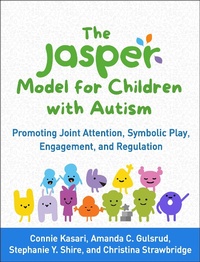
The JASPER Model for Children with Autism
Promoting Joint Attention, Symbolic Play, Engagement, and Regulation
Published on 4. October 2021
360 pages
978-1-4625-4759-3 (ISBN)
Description

Early intervention specialists, clinical psychologists, special educators, child psychiatrists, social workers, ABA specialists, speech-language pathologists, and occupational therapists. May serve as a supplemental text in graduate-level courses.
More details
Other editions
Additional editions
Connie Kasari | Amanda C. Gulsrud | Stephanie Y. Shire
The JASPER Model for Children with Autism
Promoting Joint Attention, Symbolic Play, Engagement, and Regulation
Book
01/2022
1st Edition
Guilford Press
€70.00
Shipment within 15-20 days
Persons
Connie Kasari, PhD, is Distinguished Professor of Human Development and Psychology in the Graduate School of Education and Information Studies and Distinguished Professor of Psychiatry in the Semel Institute for Neuroscience and Human Behavior at the University of California, Los Angeles (UCLA). Dr. Kasari is a founding member of the UCLA Center for Autism Research and Treatment. Her research aims to develop novel, tested interventions implemented in community settings. Recent projects include targeted treatments for early social communication development in infants, toddlers, and preschoolers at risk for or diagnosed with autism spectrum disorder (ASD), and for peer relationships in school-age children with ASD. She has led many multisite federally funded projects investigating the efficacy of interventions for children with ASD and other neurodevelopmental conditions. Dr. Kasari is on the science advisory board of the Autism Speaks Foundation and regularly presents to academic and practitioner audiences locally, nationally, and internationally.
Amanda C. Gulsrud, PhD, is Associate Clinical Professor in the Division of Child and Adolescent Psychiatry at the David Geffen School of Medicine at the University of California, Los Angeles (UCLA), and Clinical Director of the multidisciplinary UCLA Child and Adult Neurodevelopmental Clinic. Dr. Gulsrud is a clinical psychologist who specializes in autism spectrum disorder (ASD) and the development of behavioral interventions across the lifespan. Her research focuses on the early identification and treatment of infants and toddlers with ASD and related neurodevelopmental disorders, using the JASPER intervention. She has played an integral role in the development and adaptation of JASPER for infants and toddlers, has worked closely with the team testing JASPER's effectiveness across a variety of settings, and is a collaborator on several current research trials using JASPER.
Stephanie Y. Shire, PhD, is Assistant Professor in Early Intervention and Early Childhood Special Education in the College of Education at the University of Oregon. Her research interests focus on the development, adaptation, and real-world effectiveness of intervention programs for children with autism spectrum disorder and other neurodevelopmental disorders, examined through community partnerships in both low- and high-resource settings. She is interested in the use of effectiveness-implementation hybrid designs to examine community practitioners' adoption of intervention strategies as well as children's development. Dr. Shire has played an integral role in the development and dissemination of the JASPER intervention. She has worked on studies focusing on classroom adaptation and deployment, JASPER for children who have minimal verbal language, and community implementation and training, including remote training strategies. She conducts JASPER training nationally and internationally.
Christina Strawbridge is Research Associate in the Semel Institute for Neuroscience and Human Behavior at the University of California, Los Angeles. Ms. Strawbridge joined the Kasari Lab in 2012, and spends most of her time writing about JASPER, in the form of training materials, clinicians' manuals, and websites. She played a key role in translating the in-person training program into systemized written instruction and headed up the writing and development of The JASPER Model for Children with Autism.
Amanda C. Gulsrud, PhD, is Associate Clinical Professor in the Division of Child and Adolescent Psychiatry at the David Geffen School of Medicine at the University of California, Los Angeles (UCLA), and Clinical Director of the multidisciplinary UCLA Child and Adult Neurodevelopmental Clinic. Dr. Gulsrud is a clinical psychologist who specializes in autism spectrum disorder (ASD) and the development of behavioral interventions across the lifespan. Her research focuses on the early identification and treatment of infants and toddlers with ASD and related neurodevelopmental disorders, using the JASPER intervention. She has played an integral role in the development and adaptation of JASPER for infants and toddlers, has worked closely with the team testing JASPER's effectiveness across a variety of settings, and is a collaborator on several current research trials using JASPER.
Stephanie Y. Shire, PhD, is Assistant Professor in Early Intervention and Early Childhood Special Education in the College of Education at the University of Oregon. Her research interests focus on the development, adaptation, and real-world effectiveness of intervention programs for children with autism spectrum disorder and other neurodevelopmental disorders, examined through community partnerships in both low- and high-resource settings. She is interested in the use of effectiveness-implementation hybrid designs to examine community practitioners' adoption of intervention strategies as well as children's development. Dr. Shire has played an integral role in the development and dissemination of the JASPER intervention. She has worked on studies focusing on classroom adaptation and deployment, JASPER for children who have minimal verbal language, and community implementation and training, including remote training strategies. She conducts JASPER training nationally and internationally.
Christina Strawbridge is Research Associate in the Semel Institute for Neuroscience and Human Behavior at the University of California, Los Angeles. Ms. Strawbridge joined the Kasari Lab in 2012, and spends most of her time writing about JASPER, in the form of training materials, clinicians' manuals, and websites. She played a key role in translating the in-person training program into systemized written instruction and headed up the writing and development of The JASPER Model for Children with Autism.
Content
I. Introduction to JASPER
1. What Is JASPER?
2. Core Domains
II. Setting Targets
3. SPACE Administration
4. Identifying Mastered and Target Skills
III. Preparing for Session
5. Introduction to JASPER Routines
6. Assembling JASPER Routines
7. Preparing a JASPER Environment
8. Setting the Foundation for Engagement and Regulation
IV. Play
9. Imitating and Modeling Play
10. Establishing the Base
11. Expanding Routines
V. Communication
12. Core Communication Strategies
13. Programming for Gestures and Language
14. Incorporating a Speech-Generating Device
VI. Troubleshooting
15. Supporting Engagement
16. Supporting Regulation
17. Supporting Productive Play in the Context of RRBs
VII. Conclusion
18. Putting It All Together
Appendix A. Strategies Checklist
Appendix B. Exercise Answers
Appendix C. Caity's Toy Box
References
Index
1. What Is JASPER?
2. Core Domains
II. Setting Targets
3. SPACE Administration
4. Identifying Mastered and Target Skills
III. Preparing for Session
5. Introduction to JASPER Routines
6. Assembling JASPER Routines
7. Preparing a JASPER Environment
8. Setting the Foundation for Engagement and Regulation
IV. Play
9. Imitating and Modeling Play
10. Establishing the Base
11. Expanding Routines
V. Communication
12. Core Communication Strategies
13. Programming for Gestures and Language
14. Incorporating a Speech-Generating Device
VI. Troubleshooting
15. Supporting Engagement
16. Supporting Regulation
17. Supporting Productive Play in the Context of RRBs
VII. Conclusion
18. Putting It All Together
Appendix A. Strategies Checklist
Appendix B. Exercise Answers
Appendix C. Caity's Toy Box
References
Index
