

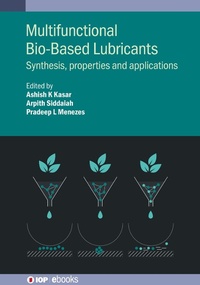
Multifunctional Bio-Based Lubricants
Description

There is a critical need for engineers to move away from using conventional petroleum-based oils and lubricants in mechanical systems due to their environmental impact. To fulfil this need, multifunctional plant-based lubricants have been developed, and improving the performance of these lubricants is an active area of research.
As the first book dedicated to multifunctional bio-based lubricants, this reference text provides detailed coverage on all aspects of the field, including the need for these lubricants and their performance, their synthesis and design routes, and their valuable multifunctional properties. The environmental benefits and superior properties of these lubricants are covered to promote their usage on an industrial scale. The book provides guidelines to allow a practitioner or researcher to modify a bio-based ionic liquid lubricant to display multiple properties, and covers the future market of multifunctional bio-based lubricants based on the potential applications.
With sustainability as a key focus, the book raises awareness of the need to develop bio-based lubricants with a lower environmental footprint than traditional lubricants, covers methods for synthesising lubricants from waste plastics (an emerging technique) and discusses suitable techniques for their eventual disposal. The text will be invaluable for researchers in the fields of mechanical engineering and tribology, particularly those designing or investigating multifunctional bio-based lubricants.
More details
Other editions
Additional editions

Persons
Ashish Kasar received his Ph.D. in Mechanical Engineering from the University of Nevada, Reno. He is working in the field of tribology that specifically includes composites with solid lubricants for severe environmental conditions, and environmentally friendly bio-lubricants such as vegetable oil and ionic liquids. He has published 36 articles in peer-reviewed journals and two book chapters. He has presented his research work at prestigious conferences - Society of Tribologists and Lubrication Engineers (STLE), The Minerals, Metals & Materials Society (TMS) and The Materials Science & Technology (MS&T).
Arpith Siddaiah received his Ph.D. in Mechanical Engineering from the University of Nevada, Reno. His expertise in tribology, surface engineering, CAD/CAM, GD&T, and automated manufacturing has enabled him to be involved in innovative R&D projects and produce 25 research articles, 14 conference publications, and a patent. He is an editor of the book "Tribocorrosion: Fundamentals, Methods, and Materials" and is a reviewer for two reputed research journals.
Pradeep Menezes is an Associate Professor in the Mechanical Engineering Department at the University of Nevada, Reno. He previously worked as an Adjunct Assistant Professor at the University of Wisconsin-Milwaukee and Research Assistant Professor at University of Pittsburgh. His productive research career has produced over 160 peer-reviewed journal publications (citations over 8000, h-index 43), 40 book chapters, eight books and one patent.
Content
1 Synthesis of bio-based lubricants
2 Bio-based lubricants and their environmental sustainability
3 Tribology of multifunctional bio-based lubricants
4 Multiphase bio-lubricants for engine components
5 Machine learning to develop lubrication strategies
6 Environmentally friendly grease
7 Additives for lubricants
8 Environmentally friendly cutting fluids
