

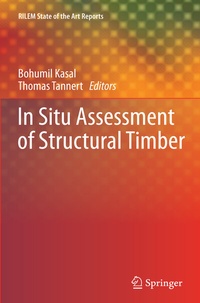
In Situ Assessment of Structural Timber
Description

Wood is one of the most intriguing structural materials and the only one that is truly renewable. Along with stone, wood is the oldest structural material on the planet and has been extensively used throughout human history. Due to its aesthetical value and positive environmental impact, wood has experienced a renaissance in construction.
As a biodegradable, hygroscopic, non-isotropic material, wood presents special challenges for a professional and requires through knowledge ranging from biology to continuum mechanics.
This state-of-the-art report reflects the current knowledge in the area of in situ assessment of the physical and mechanical properties of wood structures. Nondestructive, semi-destructive and destructive methods are described in a systematic manner where technology, equipment and limitations are discussed. Some of the discussed methods are used in other materials such as masonry and concrete. Most of the methods, however, are specific to wood andspecial qualifications are required to understand and apply these methods effectively. Existing methods are constantly improved and new methods are being developed. This report includes methods that are used in practice or have shown significant promise and have a body of knowledge that supports statements made in this report.
This is a useable tool for professionals, researchers, educators and students
Reviews / Votes
"And not only to the practicing structural engineer but also of value to craftspeople, conservators, architects, building owners, and anyone else involved in the evaluation or assessment of historic timber structures. . The papers are organized clearly and consistently . ." (Craig M. Bennett, APT Bulletin, The Journal of Preservation Technology, Vol. 52 (4), 2021More details
Other editions
Additional editions
Content
Preface; List of Symbols and Abbreviations; List of Figures; List of Tables; Introduction; References.- 1 Stress Waves, by Bohumil Kasal, Gretchen Lear, and Thomas Tannert.- 2 Ground Penetrating Radar, by Mehdi Sbarte.- 3 Radiography, by Bohumil Kasal, Gretchen Lear and Ron Anthony.- 4 Resistance Drilling, by Gretchen Lear, Bohumil Kasal and Ron Anthony.- 5 Core-Drilling, by Bohumil Kasal.- 6 Shear Test of Glue Lines, by Thomas Tannert.- 7 Tension Micro-Specimens, by Bohumil Kasal.- 8 Screw Resistance, by Nobuyoshi Yamaguchi.- 9 Hardness Test, by Mariapaola Riggio and Maurizio Piazza.- 10 Moisture Measurement, by Bohumil Kasal and Gretchen Lear.- 11 Species Identification, by Nicola Macchioni.- 12 Dendrochronology, by Olivia Pignatelli.- 13 Review of Codes and Standards, by Nicola Macchioni, Clara Bertolini and Thomas Tannert; Key Words Index.
