

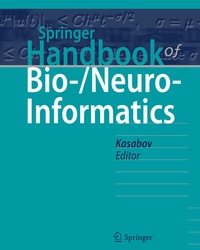
Springer Handbook of Bio-/Neuro-Informatics
Description

Reviews / Votes
From the book reviews:
"This handbook is structured in 12 parts, covering a wide variety of notions associated with bio- and neuroinformatics . . The handbook is a valuable and timely resource, which can be used by undergraduates, postgraduates and established researchers. By presenting together a variety of (linked) approaches, it provides a fantastic source for bioinformaticians and neuroinformaticians alike." (Irina Ioana Mohorianu, zbMATH, Vol. 1304, 2015)
"This is the very best of the encyclopedias and comprehensive book's about both Medical, Molecular, Genetic, and Neural Informatics currently available. . this is a good textbook for graduate students as a Primer on Neurophysiology and Molecular Medicine. Professionals in these areas will find this book very useful in their daily work . . book is very well referenced at the end of each chapter discussion. . I am pleased to recommend this book to new researchers in the field." (Joseph J. Grenier, Amazon.com, November,2014)More details
Other editions
Additional editions
Person
He has published over 350 works, among them journal papers, textbooks, edited research books and monographs, conference papers, book chapters, edited conference proceedings, patents and authorship certificates in the area of intelligent systems, connectionist and hybrid connectionist systems, fuzzy systems, expert systems, speech recognition, bioinformatics, neurocomputing and neural networks.
Prof. Kasabov is a Fellow of IEEE, Fellow of the Royal Society of New Zealand and the New Zealand Computer Society, President of the International Neural Network Society (INNS), Past President of the Asia Pacific Neural Network Assembly (APNNA) and also a member of INNS, ENNS, and the IEEE Computer Society. Recently Prof. Kasabov was endowed the titleof 'Guest Professor' at Shanghai Jiao Tong University, China.
Prof. Kasabov is the General Chairman of a series of biannual international conferences on Neurocomputing in New Zealand. In 2007 Prof. Kasabov was awarded The Bayer Science Innovator Award. He received The Royal Society of New Zealand Silver Medal for contribution to Science and Technology in 2001. He is an Associate Editor of numerous international journals and a leader of a National Research Programme funded by the Foundation for Research, Science and Technology (FRST)
Content
Part A (Ed. Heike Sichtig) Understanding Information Processes in Biological Systems.- Part B (Ed.: Chris Brown) Molecular Biology, Genome and Proteome Informatics.- Part C (Eds: Irwin King, Kaizhu Huang, Heike Sichtig) Machine Learning Methods.- Part D (Eds: Chris Brown, Heike .Sichtig, Irwin King, Kaizhu Huang, Francesco Masulli ) Modeling Regulatory Networks: The Systems Biology Approach.- Part E (Ed.: Francesco Masulli) Bioinformatics Databases and Ontologies.- Part F (Eds: Francesco Masulli, Danilo Mandic) Bioinformatics in Medicine, Health and Ecology.- Part G (Ed.: Heike Sichtig) Understanding Information Processes in the Brain and the Nervous System.- Part H (Ed.: Danilo Mandic) Advanced Signal Processing Methods for Brain Signal Analysis and Modeling.- Part I (Eds: Lubica Benuskova, Heike Sichtig) Information Modeling of Perception, Sensation and Cognition.- Part J (Eds: Shiro Usui, Raphael Ritz) Neuroinformatics Databases and Ontologies.- Part K (Eds: Lubica Benuskova, Francesco Masulli) Information Modeling for Brain Diseases.- Part L (Eds: Lubica Benuskova, Danilo Mandic) Nature Inspired Integrated Information Technologies Glossary Appendix A Methods of Information Science Appendix B The Human Genome Appendix C Brain Genes and Diseases Acknowledgements.- About the Authors.- Subject Index.
