

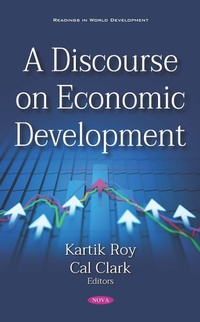
Discourse on Economic Development
Published on 13. March 2019
265 pages
978-1-5361-4843-5 (ISBN)
Description

A Discourse on Economic Development is based on two recently published books by Kartik Roy. Governance Institutions and Economic Development: Emerging China, India, East Asia presented an in-depth analysis of the reasons for successes and failures of these nations' developmental efforts. Economic, Environmental and Political Governance in China, Japan, India, Brazil, Korea, Indonesia, Thailand, Malaysia, Singapore and Vietnam brought acknowledged the urgency of the need for countries' political leaders to follow the teachings of Kautilya, Confucius, Ibn Khaldun, Karl Marx and Mahatma Gandhi and to make serious efforts to implement those lessons in practice. It is worth noting here Mancur Olson's famous remarks that economic decisions are unlikely to be taken in the collective interest of individuals due to bargaining costs and the problem of free riders, unless they are members of small groups. Such a coalition of self-interest individuals is likely to try to redistribute income towards itself instead of working to raise efficiency and national income for the full benefit of the entire population and country. Hence, the authors feel that it is more likely that in all democracies rather than in autocracies, members of the ministry will form Olson's coalition of self-interest fulfilling persons who are semi-literate, have rarely been engaged in any income earning activity, and who are adept at taking recourse to dishonest means to fill up their pockets, as well as to attain glory, and who have no knowledge of the teachings of Kautilya, Confucius, Khaldun, Marx, Gandhi and other great men of the past. Likewise, they will have no interest in their implementation on practice. In this book, the authors have made an effort to create a synergy between the theory and practice in economic development.
More details
Other editions
Additional editions
Kartik Roy | Cal Clark
A Discourse on Economic Development
Book
03/2019
Nova Science Publishers Inc
€210.94
Shipment within 15-20 days
Content
- Intro
- Contents
- Preface
- Introduction
- Abstract
- Development in Theory and in Action
- Part I. Development in Theory
- Chapter 1
- Emerging Development Issues in Continental Asia and the World: Their Institutional Implications
- Abstract
- Introduction
- The Role of Institutions
- Enforcement of Informal Contracts
- Profiling Development Management Issues in Developing and Developed Countries
- Kautilya's Arthashastra (300 BC)
- Confucian Teachings (552-479 BC)
- Ibon Khaldun's Muqaddimach (1377)
- Gandhi-Schumacher
- Young Marx
- Conclusion
- References
- Chapter 2
- Culture System and Development: A Theoretical Perspective and Conceptual Framework for Further Research
- Abstract
- Introduction
- Conceptualization of a "Cultural System"
- Analytical Approach to the Relationship between the Cultural System and Development
- Significance of the Research and Review of the Existing Literature
- Direction for Further Research
- References
- Chapter 3
- The Gandhian View of Economic Development and Its Relevance Today
- Abstract
- Introduction
- The Gandhian View of Economic Development
- The Economics of Non-Violence
- Decentralised Economy
- Khadi Industry
- Use of Machines
- Village Economy
- The Trusteeship Doctrine
- The Relevance of Gandhian Economics to Modern India
- For Poverty and Unemployment
- Village Industry
- Use of Technology
- A New Mode of Economic Development
- Implementation and Criticism of Gandhian Views
- Criticisms about Current Relevance
- References
- Chapter 4
- A Confucian Lesson in Development
- Abstract
- The Confucian Undertaking
- How to Change the World into a Higher State of Development: Ren and Li
- How the World is Changed: The Junzi
- The Inner Workings of Change and Transformation
- Harmony - A Recipe
- Three Present-Day Examples
- Conclusion
- References
- Chapter 5
- Recent Trends and Developments in Well-Being Measurements
- Abstract
- Introduction
- Conceptual Framework of Well-Being
- Subjective and Objective Well-Being
- Subjective Well-Being
- Objective Well-Being
- Movement from GDP to Well-Being: Theoretical Evidence
- Integrated GDP Indicators
- The Measure of Economic Welfare (MEW)
- Index of Sustainable Economic Welfare (ISEW)
- Genuine Saving Indicator
- Genuine Progress Indicator (GPI)
- Index of Economic Well-Being (IEWB)
- GDP Adjusted Indicators
- Human Development Index
- Inequality-Adjusted Human Development Index (IHDI)
- Quality of Life Index
- Indicators Replacing GDP
- Physical Quality of Life Index (PQLI)
- Index of Social Health (ISH)
- Index of Living Standards (ILS)
- Ontario Social Development Quality of Life Index
- Multidimensional Poverty Index (MPI)
- Happy Planet Index (HPI)
- The Gender Inequality Index (GII)
- The EU Sustainable Development Indicators (SDIS)
- Millennium Development Goals (MDGS)
- Organization for Economic Co-Operation and Development
- Evaluating Well-Being Indicators
- Health
- Education
- Subjective Well-Being
- Environment
- Economy and a Decent Standard of Living
- Political Participation
- Shelter, Security and Safety
- Social Capital
- Methodological Issues
- Conclusion
- References
- Part II: Development in Action
- Chapter 6
- China's Eco-Civilization: From History to Policy
- Abstract
- Dangerous Assumptions: The Anthropocene and Eco-Civilization
- China's Ecological Civilization Construction
- China's Problematic Mastery of Agricultural Resources
- Food Security in the 21st Century Context
- Challenging But Not Beyond Reach: Eco-Civilization as Societal Security
- References
- Chapter 7
- The Progress Made in the Attainment of MD Goals: A Commentary on Gujarat's Performance in India
- Abstract
- Introduction
- The Concept and Measurement of Poverty
- The Status of Children
- Empowerment
- Sustainability of a Pristine Environment
- References
- Chapter 8
- Economic Growth and Human Resource Development: An Indian Perspective
- Abstract
- Introduction
- Review of Literature
- Data and Methodology
- Results and Discussion
- Education and Economic Growth
- Health and Economic Growth
- Human Capital (Both Education and Health) and Economic Growth
- Summary and Conclusion
- Policy Recommendations
- References
- Appendix. Variables in the Analysis
- Appendix 1. (Continued)
- Chapter 9
- An Overview of the Agriculture Sector in India
- Abstract
- Introduction
- Review of Literature
- Major Programmes Implemented in Agriculture and Its Allied Sectors
- National Food Security Mission (NFSM)
- Rashtriya Krishi Vikas Yojana (RKVY)
- Macro Management of Agriculture (MMA)
- Integrated Scheme of Oilseeds, Pulses, Oil Palm, and Maize (ISOPOM)
- National Mission for Sustainable Agriculture (NMSA)
- Recent Trends and Performance of Indian Agriculture
- Growth Rate
- Growth Rates in Yields
- Agriculture Research and Education
- References
- Chapter 10
- India's Land-Holder Agriculture: The Case of the Sugar Industry in Gujarat Province of India
- Abstract
- Introduction
- Review of Literature
- Objectives of the Study
- Research Methodology
- Selection of Sugar Factories
- Selection of Respondents
- Source of Data
- Analysis of Data
- Development of the Sugar Industry in India
- Sugar Co-Operatives in Gujarat
- Problems Faced by the Sugarcane Growers
- Factor Analysis
- Scree Plot
- Interpretation of Results
- Conclusion
- References
- Chapter 11
- Tribal Education in India: With Special Reference to Gujarat
- Abstract
- Introduction
- Scheduled Tribes
- Literature Review
- Objective of the Study
- Methodology and Collection of Data
- Status of Education among the Scheduled Tribes
- District Literacy Rates among the ST Population
- Important Findings
- How to Enhance the Quality of Education for the ST Population
- Appendix 1. Rank of Literacy Rates by Sex for ST Population of All the Districts of Gujarat, 2011
- References
- Chapter 12
- Higher Education in Tribal Girls: A Case Study of Mahila College Valia
- Abstract
- Introduction
- Education
- Tribal
- College Profile
- Educational Accomplishments
- Vision and Mission
- The Impact of the Institute on Scheduled Tribes' Girls
- Suggestions
- Suggestions for Education
- Suggestions for the Health Care of Tribal Girls
- Suggestions for Women's Employment
- Suggestions for Government Measures
- Other Suggestions
- Conclusion
- Part III: Conclusion
- Chapter 13
- Lessons for Development
- Abstract
- About the Editors
- About the Contributors
- Index
- Blank Page
