

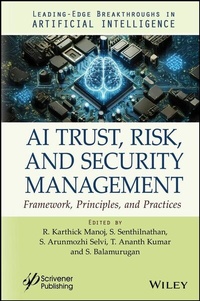
AI Trust, Risk, and Security Management
Description

For industry practitioners, academic researchers, and governance professionals alike, this book offers both clarity and depth in one of the most important domains of modern technology. As AI matures, trust and risk management will define its success-and this book lays the groundwork for achieving that vision.
As AI continues to permeate sectors ranging from healthcare to finance, ensuring that these systems are not only powerful but also accountable, transparent, and secure, is more critical than ever. This book offers a vital exploration into the intersection of trustworthiness, risk mitigation, and security governance in artificial intelligence systems, serving as a definitive guide for professionals, researchers, and policymakers striving to build, deploy, and manage AI responsibly in high-stakes environments. Using a comprehensive approach, it explores how to integrate technical safeguards, organizational practices, and regulatory alignment to manage the unique risks posed by AI, including algorithmic bias, data misuse, adversarial attacks, and opaque decision-making. The result is a strategic approach that not only identifies vulnerabilities, but also promotes resilient, auditable, and trustworthy AI ecosystems.
At its core, AI TRiSM is a forward-looking concept that embraces the realities of AI in production environments. The framework moves beyond traditional static models of governance to propose dynamic, adaptive controls that evolve alongside AI systems. Through real-world case studies, the book outlines how tools like model cards, bias audits, and zero-trust architectures can be embedded into the AI development lifecycle.
Readers will find the volume:
- Introduces concepts to stay ahead of regulations and build trustworthy AI systems that customers and stakeholders can rely on;
- Addresses security threats, bias, and compliance gaps to avoid costly AI failures;
- Explores proven frameworks and best practices to deploy AI responsibly and strategies to outperform;
- Provides comprehensive guidance through real-world case studies and contributions from industry and academia.
Audience
AI and machine learning engineers, data scientists, cybersecurity and risk management specialists, academics, researchers, and policymakers specializing in AI ethics, security, and risk management.
More details
Other editions
Additional editions
Persons
R. Karthick Manoj, PhD is an Assistant Professor at the Academy of Maritime Education and Training Tamil Nadu, India, with more than 14 years of experience. His scholarly contributions include six national and twelve international journal articles, four patents, three books, ten book chapters, and more than fifteen conference presentations.
S. Senthilnathan, PhD is an Assistant Professor in the Department of Electronics and Communication Engineering in the School of Engineering and Technology at Christ University, Bangalore, India. His research interests include quantum dot cellular automata and quantum computing.
S. Arunmozhi Selvi, PhD is a Professor in the Holy Cross Engineering College, Anna University, Tamil Nadu, India with more than 15 years of research and teaching experience. She has published 30 articles in international journals and conference proceedings and written many book chapters.
T. Ananth Kumar, PhD is an Associate Professor in the Department of and Computer Science and Engineering, IFET College of Engineering, Tamil Nadu, India. He has authored one book, edited six books and several book chapters, and presented papers in various national and international journals and conferences.
S. Balamurugan, PhD is the Director of Research at iRCS, an Indian Technological Research and Consulting, Coimbatore India. He has published 100 books, 300 papers in international journals and conferences, and 300 patents. With 20 years of experience researching various cutting-edge technologies, he provides expert guidance in technology forecasting and decision making for leading companies and startups.
Content
Series Preface xix
Preface xxi
Part I: Fundamentals of Trustworthy and Transparent AI 1
1 Creating Trustworthy AI: A Lifecycle Risk Management Framework 3
Satish Kumar S., Bharathi K., Vinod S., Rudhra S., Balaraman R. and Suresh A.
2 Comprehensibility and Transparency of AI Systems with Applications 19
N. Hemalatha, R. Elavarasi, P. Gajalakshmi, N. Magadevi and D. Kadhiravan
3 Leveraging Correlation Analysis for Effective Feature Selection in AI Model Development 43
Raju Arumugam
4 Fusion-Based CNN Ensemble with Grad-CAM for Trustworthy and Transparent Plant Disease Detection 73
G. Abirami and S. Aasha Nandhini
5 Case Studies and Applications of Explainability and Interpretability in AI Models 99
P. Gajalakshmi, N. Hemalatha, R. Elavarasi, N. Magadevi and D. Kadhiravan
Part II: Privacy-Preserving and Secure AI Systems 125
6 Privacy-Preserving AI Techniques: Protecting Data in the Age of AI 127
N. Ram Shankar, S. Suhasini, M. Aravind Adityaa, B. Charan Sai, R. Deekshit, D. Derrick Nathaniel and K. Manikandan
7 Federated Learning for Early Detection of Chronic Diseases: Privacy-Preserving Models in Population Health Management 153
A.V. Sriharsha and Sai Nomitha Yarabolu
8 Secure and Trustworthy AI for Efficient Diabetic Retinopathy Screening with Deep Learning Model 183
S. Sreedevi, K. Sarmila Har Beagam, G. Ezhilarasi and D. Lakshmi
9 Addressing Security Challenges in AI-Driven Cyber Security: Enhancing Resilience While Fostering Sustainable Practices with Green Computing 205
P. Geetha, G. Abirami, T. Padmavathy, S. Sivagami and D. Vinodha
Part III: AI in Smart Healthcare, Agriculture and Energy and Power Systems 227
10 Enhancing Breast Cancer Health Care Using Vision Transformer Processing with Dingo Optimization 229
S. Baulkani and Koushalya S.
11 Enhancing Biometric Identification: A Trustworthy Framework for Toddler Iris Recognition through AI Innovations 249
Ramesh S. and V. Krishnaveni
12 AI-Enhanced Reactive Power Compensation in Weak Grids Integrating Wind Energy Systems: A Trustworthy and Risk-Managed Approach 279
R. Rajasree, D. Lakshmi, K. Stalin and R.K. Padmashini
13 AI-Based Frequency Regulation for a Deregulated Two-Area Power System 305
D. Lakshmi, V. Pramila, S. Aasha Nandhini and R. Rajasree
Part IV: Real-World AI Applications and Future Opportunities 329
14 Smart Defense Vehicle (Bot) with AI-Assisted Security System 331
V. Sridevi and S. Priya
15 Smart Motor Fault Detection Leveraging LabVIEW and IoT Integration 251
Vinoth Kumar P., Priya S., Prakash S., Gunapriya D. and Sridevi V.
References 368
Index 371
1
Creating Trustworthy AI: A Lifecycle Risk Management Framework
Satish Kumar S.1*, Bharathi K.1, Vinod S.2, Rudhra S.2, Balaraman R.2 and Suresh A.1
1Department of Marine Engineering, AMET University, Tamil Nadu, India
2Department of Electrical and Electronics Engineering, Jerusalem College of Engineering, Tamil Nadu, India
Abstract
Potential benefits of a successful lifetime risk management strategy; detailed explanation of risk management concepts: a well-written chapter should describe important risk management words and concepts so that readers with varying degrees of experience can grasp them. Each chapter ought to offer a variety of risk assessment approaches appropriate for various risk categories and project stages. Risk Mitigation Techniques: comprehensive explanation of several risk mitigation strategies, including proactive measures, backup plans, and risk transfer systems. Reporting and Communication: advice on how to effectively notify stakeholders about risks, including precise reporting forms and templates. Stress the value of continual risk assessment and monitoring, along with methods for modifying the risk management procedure as the project develops.
Keywords: Artificial intelligence (AI), risk assessment, AI lifecycle, information privacy and security, AI risk management framework, continuous monitoring
1.1 Introduction
AI has enormous potential to raise our standard of living. However, incorporating AI into the systems and goods we use on a daily basis may also jeopardize our privacy, safety, and security. Our research indicates that the current status of AI development is clearly linked to hazards to human welfare [1]. Unless significant steps are taken to improve the dependability of these systems, AI has the potential to worsen already-existing inequities. Significant challenges include.
Innovation and competition are stifled by monopoly and centralization in AI development since only a small number of powerful tech firms possess the resources needed to build AI technology [2]. AI is frequently developed utilizing significant data gathering, storage, and sharing procedures, which can be invasive and pose ethical concerns [3, 4]. This further adds to worries about data privacy and governance.
AI frequently produces discriminatory or biased results that disproportionately affect underprivileged groups [5]. This happens as a result of AI's reliance on data, frameworks, and computational models that mirror prevailing societal prejudices [6]. Furthermore, many businesses do not reveal the inner workings of their AI systems, which makes it challenging to evaluate their fairness and dependability and impedes accountability and transparency [7].
This study produced a number of guiding principles for AI, including safety, privacy, accountability, agency, and fairness. Mozilla created a theory of change to support more reliable AI based on this work. This idea outlines the fixes and adjustments that we think need to be investigated.
Many of the AI developers are looking for innovative approaches to accountability and responsibility in the creation of the goods and services we use on a daily basis. More builders should be encouraged to adopt this strategy, and we should make sure they have the tools and assistance they require throughout the whole product creation, deployment, and research process. We'll know we're becoming better when:
The acceptance of best practices in crucial areas of trustworthy AI is what propels the development of industry standards [8]. Developers are in higher demand as AI technology develops, and they are urged to think more critically about their work. Nowadays, a wide spectrum of stakeholders actively participate in the development of AI, guaranteeing a more responsible and inclusive approach [9]. Businesses and organizations are also spending more money on reliable AI services and solutions. These modifications demonstrate how lifecycle risk management is becoming increasingly acknowledged as a crucial framework for guaranteeing AI systems are dependable, moral, and compliant with industry standards. It will take a significant change in the conventions that support our existing computer environment and culture to create a reliable AI ecosystem [10]. Although they are ambitious, the improvements we desire are achievable. Fifteen years ago, we witnessed the globe transition from a single desktop computing platform to the open platform known as the web. Evidence suggests that it is already beginning to recur [11]. From a specialized topic to one that frequently makes headlines, online privacy has changed. Significant data protection laws have been implemented in California, Europe, and other countries, and consumers are calling on businesses to treat them and their data with greater consideration and decency [12]. These trends all point to a positive change.
1.2 Methodology
In many nations, new technology is developing faster than regulations. This implies that millions of individuals are being used to test new AI systems and goods without adequate government control or oversight. At the same time, a lot of legislators are keen to pass new laws to curtail the influence of internet firms. However, it is still unclear if those laws are technically sound and adequately handle the current issues.
We will need policymakers to embrace a clear, technically and socially grounded strategy for AI regulation if we are to enhance the trustworthy AI ecosystem. Legislators will also be required to guarantee that the foundation of any AI legislative framework is the provision of fundamental consumer and privacy rights.
One thing to highlight is that we have purposefully decided to use the regulatory environment in Europe as an example of what constructive change could entail. This is due to the fact that Europe is seeing some of the most intriguing advancements in data protection and governance, and we believe that the EU's approach to AI regulation is the most developed and promising. Other nations that manufacture AI technologies may use its legislative framework as a template. But there are still concerns about whether the EU model can and should serve as a template for other nations, party the fundamental elements of an RMF (risk management framework).
Recognizing possible hazards are
- Risk measurement
- Strategies for risk minimization
- Observation and reporting
- Administration
1.2.1 Risk Measurement
Overall information security risk can be controlled via a risk management program. It is a method to recognize, measure, reduce, and keep an eye on hazards. The goal of taking a holistic approach to risk assessment is to ensure that no one area receives too much or too little attention. Additionally, frameworks assist you in determining the larger aspects of risk that require evaluation and reduction. Prioritizing the treatment of specific risks is also beneficial. You can reduce your audit workload and reassure your clients that standard risk management is in place by adhering to risk frameworks.
AI systems should undergo testing both prior to and during operation. Documenting elements of the systems' dependability and usefulness is one way to quantify AI risk. Monitoring measures for reliable traits, societal impact, and human-AI setups are all part of measuring AI risks. Formalized reporting and documentation of results, comparisons to performance benchmarks, and stringent software testing and performance evaluation methods with associated uncertainty measurements should all be part of the MEASURE function's protocols. A thorough risk management program usually comprises multiple essential stages, including risk identification, analysis, evaluation, treatment, and ongoing risk monitoring, to maximize testing efficacy while reducing internal biases and conflicts of interest. An effective risk management system should include a variety of risk categories, be practical for businesses to implement, be updated to reflect real-world risks, be built on auditable and reviewable controls, and be dependable to guarantee vendor and client acceptance.
1.2.2 Strategies for Risk Minimization
To handle risks, exposures, and unanticipated events, each business, regardless of size or industry, needs a risk management strategy. Effective risk management is best understood as a cyclical process that continuously detects, assesses, controls, and monitors new and ongoing hazards rather than as a collection of jobs. This makes it possible to update and analyze evaluations as new information becomes available, and then take appropriate action to protect the business, its personnel, and its assets. This ongoing focus on detail not only increases resilience but also makes it easier to make well-informed decisions in the face of shifting risks and challenges.
Large volumes of data are processed by AI systems, which also make choices at previously unheard-of rates. Although these skills increase productivity, they also provide particular risks, like: Adversarial assaults: These assaults change input data in order to trick AI systems into classifying or predicting things incorrectly. Attackers might, for instance, purposefully inject bias or produce adversarial examples in an effort to interfere with the algorithm's decision-making process.
Prompt injection is inserting malicious inputs into what appear to be authentic prompts, these attacks take advantage of large language...
