

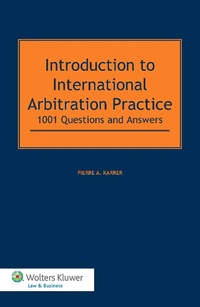
Introduction to International Arbitration Practice
1001 Questions and Answers
Published on 11. June 2014
352 pages
978-90-411-5290-9 (ISBN)
Description

This remarkable and unprecedented guide to the practice of international arbitration è^' equally useful to party advisors, party representatives, arbitrators (especially newly practising ones), and advanced students è^' engagingly presents the riches of a leading arbitratorè^-s lifetime of practical experience. It is a Question-and-Answer book. An informal conversation. Easy and enjoyable to read, full of straightforward, useful examples and entertaining, often amusing, anecdotes. The book even touches on the history and philosophy of international arbitration.
More details
Other editions
Additional editions
Book
06/2014
1st Edition
Kluwer Law International
€285.23
Shipment within 10-20 days
Content
- Cover
- Half Title Page
- Title Page
- Copyright Page
- About the Author
- Table of Contents
- Preface
- Acknowledgments
- INTRODUCTION International Contracts and Dispute Resolution
- 1. Q: Let us start at the time when the Contract is negotiated and closed. Why are Contracts getting longer and longer?
- 2. Q: Which is?
- 3. Q: Are templates sometimes copied mindlessly?
- 4. Q: And this leads to arbitrations?
- 5. Q: Does this also lead to more Anglo-American law being adopted?
- 6. Q: An example?
- 7. Q: Can one avoid the influx of English law through the use of the English language?
- 8. Q: Is this a good idea?
- 9. Q: Do more complex Contracts lead to more disputes, or fewer?
- 10. Q: Surely is it not possible to foresee all possible disputes and avoid them?
- 11. Q: Apart from crafty wording of the Contract, are there other ways to minimize disputes?
- 12. Q: This is not arbitration, is it?
- 13. Q: And if this does not work, you go to arbitration?
- 14. Q: Then arbitration?
- 15. Q: Through mediation or conciliation?
- 16. Q: If nothing works, arbitration is the last resort?
- 17. Q: Whose questions does this book try to answer? Those of in-house counsel or Party Advisors? Those of outside counsel or Party Representatives? Or those of arbitrators?
- 18. Q: Does this mean that the reader should approach the subject of international arbitration as an entire process, rather than taking the limited view of a particular participant at a particular stage of the process?
- CHAPTER 1 Arbitration Agreement and Applicable Law Clause
- (a) Arbitration Agreement
- 19. Q: What is the best arbitration agreement?
- 20. Q: So you have to ask what can go wrong in the Contract and how the client may be affected?
- 21. Q: Often one Party has the main obligation to do something, say a contractor, while the other Party only has an obligation to pay money, say an employer. Does this help?
- 22. Q: Make a decision on the basis of incomplete information? Is this not difficult?
- 23. Q: How can you maximize your chances to make the right decision about your arbitration clause?
- 24. Q: Is this not contradictory advice?
- 25. Q: Before one makes that phone call, should one prepare?
- 26. Q: What should one do?
- 27. Q: If your experience is limited?
- 28. Q: The first question in practice is probably, should one insert an arbitration clause and provide for arbitration in the first place?
- 29. Q: But why not use State Courts? They are reasonably good and even cheap in some countries.
- 30. Q: Many say that conciliation or mediation is better than arbitration. Are they wrong
- 31. Q: Should one then provide in the arbitration clause for conciliation or mediation first?
- 32. Q: How do you avoid this cheap trick?
- 33. Q: Can we not just sit still, and we will never have to sue? If the other Party is forced to sue us right here in our State Courts, will we not have a home turf advantage?
- 34. Q: What then should the arbitration clause provide?
- 35. Q: If the simplest is the best, why not be pragmatic and easy and always take the same simple arbitration agreement - stay with the clause under which one has had success in the past, and, conversely, avoid those clauses under which one has been unsuccessful?
- (b) Institutional or Ad hoc
- 36. Q: If simplest is the best, then what is so complex about an arbitration agreement? For instance, should one use institutional arbitration, or should one go for ad hoc arbitration?
- 37. Q: Some people say that there is plenty of ad hoc arbitration out there. Is this not true?
- 38. Q: Why is ad hoc arbitration not used so much? Does it not save the cost of an Arbitral Institution?
- 39. Q: Which is the best Arbitral Institution? We love the local Arbitral Institution right where we are. Friendly and competent people. And not too expensive. Rather cheaper than ICC.
- 40. Q: But we definitely do not want to go to the other Party's country and the Arbitral Institutions that they have there. These are likely to be biased in their favor.
- 41. Q: So one will probably be forced to agree on a neutral Arbitral Institution and a neutral place or seat of arbitration?
- 42. Q: Suppose we have now decided on institutional arbitration. There are then three questions that all need to be answered at the time of making the agreement: Which Arbitral Institution?7 Which seat of the arbitration?8 Which applicable law?
- 43. Q: Namely?
- 44. Q: What about the idea that one should not talk or even think about bad things that could happen, because that causes them to happen?
- 45. Q: Because dispute resolution agreements are designed to prevent disputes?
- 46. Q: Being everybody's second or even third choice gives an Arbitral Institution a good share of the market?
- 47. Q: Which Arbitral Institution should one pick? The ICC?
- 48. Q: Are there differences between Arbitration Rules?
- 49. Q: On what then do Arbitral Institutions compete?
- 50. Q: And on price?
- 51. Q: Why are we talking in this book so much about ICC arbitration and less about other well-regarded systems, such as LCIA, Swiss Rules, Stockholm Rules, ICDR, Hong Kong International Arbitration Centre, and Singapore International Arbitration Centre?
- 52. Q: But its system is not particularly simple?
- 53. Q: What is the main difference?
- 54. Q: Why this involvement of the ICC Court and the Secretariat?
- 55. Q: Are there things that one should watch out for in exotic Arbitration Rules and seats?
- (c) Seat, Lex Arbitri
- 56. Q: Is it true that by choosing the seat one chooses the lex arbitri?
- 57. Q: What does lex arbitri mean?
- 58. Q: Will the arbitration be conducted at the seat?
- 59. Q: Here, we go with the majority view?
- 60. Q: What is the best seat? That is, the best lex arbitri?
- 61. Q: What is relevant beside the law?
- 62. Q: Other aspects?
- 63. Q: Now the substance of the arbitration law at the seat.
- 64. Q: Apart from exotic specialties,16 where are the main differences?
- 65. Q: Having fewer tiers of judicial review saves time and money, correct?
- 66. Q: And costs?
- 67. Q: This means that reviewing an Award in Austria may cost far more than the arbitration with three arbitrators and the Arbitral Institution?
- 68. Q: In other words, in practical terms, forget setting aside in Austria?
- 69. Q: Other differences in the lex arbitri?
- 70. Q: Must "foreign" law be proved by Expert Reports?
- 71. Q: An example?
- 72. Q: Let us go deeper. For which questions does the lex arbitri matter?
- 73. Q: What is the purpose of procedure?
- 74. Q: Does the same law apply to substance and procedure?
- 75. Q: The difficulty is that in some jurisdictions, many questions are characterized as procedural that elsewhere are characterized as substantive. Is there a good way to distinguish between substance and procedure?
- 76. Q: Is this just an autonomous distinction that you are suggesting? Would it not be better to look to the way the procedural law of the lex arbitri distinguishes substance from procedure?
- (d) Procedure before the Arbitral Tribunal
- 77. Q: Is it correct that on procedural questions the lex arbitri applies?
- 78. Q: In writing?
- 79. Q: Could the Parties or the Arbitral Tribunal refer to a code of civil procedure?
- 80. Q: Why fortunately?
- 81. Q: So Parties should design their own civil procedure? Surely a difficult task?
- 82. Q: Does this mean that, in reality, an Arbitral Tribunal will shape its own procedure?
- 83. Q: Should this be done by an Order or an Award?
- 84. Q: But an Arbitral Tribunal's decision accepting or declining jurisdiction is procedural, yet an Award?
- 85. Q: How does one distinguish between Procedural Orders and Awards on the merits?
- 86. Q: Some people say that the mandatory parts of the lex arbitri apply. Is this not true?
- 87. Q: The "contradictoire," as the French say?
- 88. Q: Equal treatment?
- 89. Q: Anything else?
- 90. Q: So the Arbitral Tribunal need not be too much afraid?
- 91. Q: Which goal?
- 92. Q: Should you proceed in this way right from the start?
- 93. Q: Do you ask the Parties for their input each time?
- 94. Q: Will the procedure be oral or in writing?
- 95. Q: And so with the procedure on presenting the evidence?
- 96. Q: Similarly concerning the assessment of the evidence?
- 97. Q: Oral summations may be difficult for non-native speakers of English?
- 98. Q: In a complex case, is there not a risk that the Arbitral Tribunal may not get the procedure absolutely right from the start?
- 99. Q: Some Party Representatives are given to comment nastily each time the Arbitral Tribunal does something that displeases their client. How should an Arbitral Tribunal react to this?
- 100. Q: If not?
- 101. Q: What happens if a Party holds back and says nothing?
- 102. Q: Has this ever been applied?
- 103. Q: If a Party complains, does this not antagonize the Arbitral Tribunal?
- 104. Q: Is it really necessary for the Party to tell the Arbitral Tribunal how its mistake could be remedied?
- 105. Q: What can an Arbitral Tribunal do to stay out of procedural trouble?
- 106. Q: How can an Arbitral Tribunal deal with the paper tsunami?
- 107. Q: Can assistants help with this?
- 108. Q: This is mechanical work?
- 109. Q: But what will you do if you have to decide on whether a particular document is privileged or covered by a confidentiality requirement?
- 110. Q: But then the Arbitral Tribunal will have to see the document, and if it decides that it should not have seen the document, it will have to erase this from its memory?
- 111. Q: Would this be a lawyer? Which law would this lawyer apply?
- 112. Q: Is a confidentiality advisor just a helper for the Arbitral Tribunal or is he or she an arbitrator pro tanto?
- 113. Q: Are there other types of special decision makers playing the role of an arbitrator pro tanto?
- 114. Q: A specialist who makes decisions?
- 115. Q: This specialist is then again a special arbitrator?
- 116. Q: Are there not cumbersome special problems with respect to Party-appointed Experts?
- 117. Q: But there may be a decision to make. Should the expert facilitator then be a special decision maker, and thus an arbitrator?
- 118. Q: Is all this not giving procedure too much weight?
- 119. Q: Does this mean that the Arbitral Tribunal should not discuss the facts and the law internally from the start, on a provisional basis?
- (e) Interpretation of Arbitration Agreements, Pathological Arbitration Agreements
- 120. Q: Sometimes it is clear what the particular arbitration agreement says, but it is not clear what it means. How do you then proceed with the interpretation of a possibly pathological arbitration clause?
- 121. Q: Which law applies to the construction or interpretation of an arbitration agreement?
- 122. Q: Even if the law applicable to the substance of the agreement was chosen by the Parties?
- 123. Q: If the text is so unclear that it is not possible to determine where the seat of the arbitration should be, what then?
- 124. Q: If there is no Arbitral Institution to determine the seat, what do you do?
- 125. Q: So you trick the Parties into agreeing on a seat? But if they do not agree on the seat?
- 126. Q: However, you may need a seat to put an Arbitral Tribunal in place. What if that part is pathological?
- 127. Q: Examples?
- 128. Q: Have there really been cases like this?
- 129. Q: What do you do if only a country of arbitration is named, not the place?
- 130. Q: Again the hen-and-the-egg problem?
- 131. Q: What do you do if it is not clear which Arbitral Institution is meant, perhaps because an Arbitral Institution was named that does not exist under that precise name?
- 132. Q: What do you do if the chosen Arbitral Institution has disappeared?
- 133. Q: If the chosen Arbitral Institution never existed or no longer exists, will the clause still be valid as an arbitration clause?
- 134. Q: Even if the chosen Arbitral Institution was supposed to do more than just launch the arbitration, and, as with the ICC, provide support for the Arbitral Tribunal and scrutiny of Awards?
- 135. Q: What if some additional pathological elements concern the proper constitution of the Arbitral Tribunal?
- 136. Q: In sum, one should avoid the dangers of the "midnight clause," correct?
- 137. Q: So you have to think of many things when you negotiate an arbitration agreement?
- 138. Q: Suppose, we have spent time and money on drafting a wonderful arbitration clause, but now there are no problems in the performance of the Contract. Is this not a waste of time?
- (f) Language of the Arbitration
- 139. Q: Should the arbitration agreement specify the language of the arbitration in advance?
- 140. Q: Does the seat determine the language of the arbitration?
- 141. Q: Parties in an arbitration often insist that their own language should be the language of arbitration, and they try to have this included in the arbitration agreement. Why?
- 142. Q: This is unrealistic?
- 143. Q: The opponents may, in a tit for tat reaction, insist on their own language also?
- 144. Q: Is it then not a good compromise to simply use both languages?
- 145. Q: One may prefer another world language, say Arabic or Chinese?
- 146. Q: Are translations sometimes disastrous?
- 147. Q: Is the language question also a question of prestige?
- 148. Q: Most Arbitral Tribunals give priority to the language of the arbitration agreement and make that the language of the arbitration. Anything wrong with this?
- 149. Q: Is there not a difference between small talk and friendly talk, and a fight about sometimes important sums of money?
- 150. Q: Does having one language as a language of the arbitration mean that all witnesses must speak that language? Surely, some just cannot do it.
- 151. Q: Some witnesses are quite good in the language of the arbitration (English normally), but they nevertheless prefer to use their own language. They believe that this gives them more time to think about their answers. Should this be encouraged?
- 152. Q: Should opposing counsel attempt to embarrass a witness about the language in which the witness chose to testify?
- 153. Q: Should lawyers appearing on behalf of a Party use the language of the arbitration?
- 154. Q: What about Tribunal-appointed Experts? Should they be able to render their report and answer questions in the language of the arbitration?
- 155. Q: Should interpretation be simultaneous or consecutive? Surely, simultaneous interpretation saves time.
- 156. Q: How do you make sure that the interpreters are good without knowing both languages yourself?
- 157. Q: What was the examination?
- 158. Q: Should an interpreter be a sworn interpreter admitted as a court interpreter in the country of his or her activity?
- 159. Q: But will that interpreter from the Party not warp the testimony?
- 160. Q: What should be done about cultural aspects of language?
- 161. Q: Who should tell this to the interpreter?
- 162. Q: Is there not a problem with interpreting yes and no? If an Indian person shakes his or her head, this means "yes." In some languages, "yes" means, "This is true," in others, "I agree with you," and in still others, "I understand what you are saying," or even, "I do not understand what you are saying, but please keep going."
- 163. Q: Namely? What can a questioner do about this?
- 164. Q: Is there not just one translation, the correct one?
- 165. Q: Example?
- 166. Q: What is the legal position of an interpreter?
- 167. Q: Is the interpretation-checker then an Expert also?
- 168. Q: Well, if an interpreter is an Expert, should he or she be admonished to do his or her best to provide a correct interpretation?
- 169. Q: If it is omitted, should the interpretation be disregarded?
- 170. Q: So an interpreter has a different legal nature than a confidentiality advisor?
- (g) Applicable Law Clause
- 171. Q: Should the agreement specify the law applicable to the merits?
- 172. Q: Are there further questions that, at the time of making the agreement, an arbitration clause should preferably answer?
- CHAPTER 2 Performing International Contracts, Pre-arbitration Problems
- (a) Performing International Contracts
- 173. Q: How should a Party go about performing an international Contract?
- 174. Q: What kind of technical problems?
- 175. Q: Is a human factor also involved?
- 176. Q: Does this mean that management should pay attention to putting together the right team to perform an international Contract?
- 177. Q: Other management mistakes?
- 178. Q: Are there tell-tale signs of trouble in the performance of an international Contract?
- 179. Q: The minutes may not have been agreed, do they then mean nothing?
- 180. Q: What is non-lawyers' law?
- 181. Q: There is usually a clause providing that incorrect or insufficient minutes must be challenged immediately.
- 182. Q: Is this to say that the law is written for those who are awake, not for those who are asleep?
- 183. Q: As long as lawyers are not involved, things are not yet so bad? Or are they?
- 184. Q: Are there specific things that a Party can do to prepare for a possible arbitration?
- (b) Pre-arbitration Problems: Strategic Choices
- 185. Q: There comes a moment when a Party believes that it must go to arbitration. What should it then do?
- 186. Q: This may involve the home state and its foreign trade services?
- 187. Q: If commercial arbitration is selected, is it then just a matter of calling the lawyers?
- 188. Q: Are arbitrations won and lost by outside lawyers?
- 189. Q: Can one expect that Party Representatives will try to speed up an arbitration?
- 190. Q: Why is this?
- 191. Q: Are Arbitrators interested in moving expeditiously?
- 192. Q: If the arbitrators are not paid ad valorem, are they less interested in the speed and efficiency of the proceedings?
- 193. Q: Are Arbitral Institutions interested in a reputation for working fast?
- 194. Q: Does one encounter teams that are poorly organized?
- 195. Q: Should there be non-lawyers on the team?
- 196. Q: If it is essentially legal, you will need mostly lawyers?
- 197. Q: So many people from different jurisdictions! Can a good lawyer not learn about foreign law?
- 198. Q: What is the right legal team for an arbitration?
- 199. Q: Why two of each type?
- 200. Q: Must there also be a back-up team at home?
- (c) Settlement
- 201. Q: Instead of gearing up for arbitration, is this not the moment to try to settle?
- 202. Q: Where is the danger?
- 203. Q: In settlement negotiations, should a Party disclose all it has up its sleeve?
- 204. Q: Is settlement possible only before arbitration commences?
- 205. Q: Once an arbitration is pending, is it not also in the Arbitral Tribunal's interest to achieve a settlement?
- 206. Q: And the Parties themselves?
- 207. Q: But let us assume that both Parties actually would prefer a settlement. How can an Arbitral Tribunal help them achieve this?
- 208. Q: This is easily written into an arbitration clause, the Arbitration Rules, a lex arbitri, or Procedural Order No. 1. But will it work?
- 209. Q: At some point the Arbitral Tribunal may know how it is likely to decide the case. Should it give the Parties a hint?
- 210. Q: An amicable solution only in name?
- 211. Q: Is there a good way that an Arbitral Tribunal can promote a truly amicable settlement without hinting at a possible decision?
- 212. Q: Presumably one should focus on the big issues or the big claims?
- 213. Q: How do you do this?
- 214. Q: What do you do about the small claims?
- 215. Q: Should the Arbitral Tribunal support the Pareto method?
- 216. Q: This presupposes that both sides were equally litigious from the start?
- 217. Q: Without Pareto agreement between the Parties, an Arbitral Tribunal could also render Partial Awards on some issues or claims, and hope that the Parties then settle the remaining issues?
- 218. Q: But that does not follow at all! May the further issues not be completely different?
- 219. Q: If the Arbitral Tribunal is genuinely involved in settlement discussions, how should it proceed?
- 220. Q: Once the framework is agreed, how can one achieve a settlement on a figure?
- 221. Q: Is there a method that does not involve the Arbitral Tribunal coming out with a figure?
- 222. Q: Is this flip-flop or baseball arbitration?
- 223. Q: If a Party is approached with a settlement offer in the final phase of the arbitration, say, when the proceedings have been formally closed and the Arbitral Tribunal is preparing its Award, what should that Party do?
- (d) Measures by State Courts
- 224. Q: Before one starts an arbitration, or before the other side starts an arbitration, are there measures that can be taken in the State Court system?
- 225. Q: Must the assets that are frozen be connected to the dispute that will be arbitrated?
- 226. Q: Could the assets also be receivables from a third Party?
- 227. Q: If the Award is immediately enforceable at the seat, is finding assets in the country of the seat a particularly attractive option for the Award creditor?
- 228. Q: Still, the debtor might obtain a stay of execution at the seat?
- 229. Q: When does one start the arbitration?
- 230. Q: Presumably the Parties may also agree to postpone arbitration?
- 231. Q: Can one put a new attachment over assets that are already attached?
- 232. Q: Are there other Provisional Measures that a State Court might grant to maintain the status quo?
- 233. Q: Which State Court should one use?
- 234. Q: This involves a complex analysis?
- 235. Q: What about launching a "torpedo"? That is, go to a State Court which will accept jurisdiction over the case despite the existence of an arbitration agreement (which we will contest anyway). Then we should be able to argue before the Arbitral Tribunal that the case is lis pendens, so the Arbitral Tribunal should decline jurisdiction. Is this not a good idea?
- 236. Q: Are there countermeasures?
- 237. Q: Are there anti-torpedo provisions?
- 238. Q: A State Court could enjoin the other Party or its lawyers, or even its Party-appointed arbitrator, from proceeding in the arbitration (an anti-arbitration injunction). Surely then arbitration becomes difficult?
- CHAPTER 3 Setting Up the Arbitral Tribunal
- (a) One or Three Arbitrators, Party-Appointed?
- 239. Q: Why do Parties prefer to nominate Party-appointed Co-arbitrators?
- 240. Q: Still, would this not assist the appointing Party in preparing for setting aside proceedings at the seat, and for fighting enforcement (mostly) in its own country?
- 241. Q: Will a Party-appointed arbitrator enhance the quality of the Award? By educating his or her Co-arbitrators, and moreover the Presiding Arbitrator, about the cultural and political conditions in his or her country?
- 242. Q: Does having three arbitrators rather than one lead to additional costs and delay?
- 243. Q: Where do the large cases start?
- 244. Q: Is it true that, at the upper levels, the additional costs of having three arbitrators instead of one are negligible in comparison to the costs of Party Representation?
- 245. Q: Are the advantages of Party-appointed arbitrators then more psychological than real?
- 246. Q: A Party-appointed arbitrator may develop "diplomatic" illnesses that delay the arbitration, or will simply be slow. Or, worse, leak information to the Party that appointed them. How do you fight such mischief?
- 247. Q: Why are partisan arbitrators often slow?
- 248. Q: Is there a possible compromise between having all Party-appointed arbitrators and having the Arbitral Institution make all the appointments?
- 249. Q: What is the most important decision in an arbitration?
- 250. Q: Why not leave this to a State Court?
- 251. Q: So is this a reason why one should prefer institutional arbitration?
- 252. Q: So why not leave it to the Arbitral Institution entirely?
- 253. Q: At least the Arbitral Institution knows many people, does it not?
- 254. Q: Should one fear favoritism from some Arbitral Institutions?
- 255. Q: Are Arbitral Institutions fast in picking a Presiding Arbitrator?
- 256. Q: So should you do it yourself?
- 257. Q: Is it true that Parties prefer to nominate one arbitrator of a three-person Arbitral Tribunal, rather than having all arbitrators appointed by the Arbitral Institution?
- 258. Q: Would an all-neutral Arbitral Tribunal not be preferable?
- 259. Q: Where did that system come from?
- 260. Q: How does somebody become an arbitrator, a professional international arbitrator?
- 261. Q: Why do you say that?
- 262. Q: Well, is it just good luck?
- 263. Q: Such as?
- 264. Q: Anything else?
- 265. Q: In other words, you have to have an interest in people?
- 266. Q: More?
- 267. Q: Still more?
- 268. Q: Should one be a lawyer?
- 269. Q: What else?
- 270. Q: Do you have to be prominent?
- 271. Q: Is it important to get to know the good and the great members of the "mafia"?
- 272. Q: Should you get on the lists of Arbitral Institutions?
- 273. Q: So you have to do your own marketing?
- 274. Q: For an arbitrator to be neutral, is it not a good idea to take this person from a neutral country?
- 275. Q: In investment protection disputes, some arbitrators have the reputation of being sympathetic to host states, some others of favoring the investor. Is there any truth in this?
- 276. Q: Back to Party Representation. How do you select your arbitrator? Does it make sense to appoint somebody knowledgeable about the applicable law?
- 277. Q: Will somebody from our own jurisdiction not push in our favor?
- 278. Q: To appoint an arbitrator who is an expert in the subject matter of the dispute should save money?
- 279. Q: If we are to teach an Arbitral Tribunal technical things, how should we go about this?
- 280. Q: Should we choose an arbitrator from the seat of the arbitration?
- 281. Q: So as one appoints a Party-appointed arbitrator, should one already be thinking about who the Presiding Arbitrator might be?
- 282. Q: Where, for instance, will it not work?
- 283. Q: Is this not giving too much weight to geographical proximity, and too little to comparative law?
- 284. Q: Is somebody's passport really relevant?
- 285. Q: Will an arbitrator who speaks a particular language be biased in favor of the Party that speaks the same language?
- 286. Q: You found this silly?
- 287. Q: How then can one influence the choice of an adequate Presiding Arbitrator?
- 288. Q: If the Co-arbitrators come up with a common proposal for Presiding Arbitrator, or a common shortlist, should one accept this?
- 289. Q: By which process do Co-arbitrators select a Presiding Arbitrator?
- 290. Q: Can you please describe one?
- 291. Q: Will this prevent direct contact?
- 292. Q: Once a profile has been agreed, how does one then proceed?
- 293. Q: How long should the shortlist be?
- 294. Q: Why so many?
- 295. Q: Is it then not better to give the Parties the right to a peremptory challenge of such candidates?
- 296. Q: Should the Arbitral Tribunal tell a candidate that he or she came out on top?
- 297. Q: Is it a good idea for the Parties to jointly ask the Arbitral Institution to set up a shortlist?
- 298. Q: How does one pick the preferred candidate out of a shortlist drawn up by the Co-arbitrators?
- 299. Q: When will the candidates be contacted?
- 300. Q: Is this not a slow, protracted process?
- 301. Q: How could the process be sped up?
- 302. Q: Is it easy for the Co-arbitrators to draw up a shortlist?
- 303. Q: Another way for Co-arbitrators to save time?
- 304. Q: What if a Party opposes a candidate from the start?
- (b) Conflict of Interest, Misconduct, Challenge, Removal, Replacement of Arbitrators
- 305. Q: This differs from case to case, right?
- 306. Q: If an arbitrator or candidate is challenged personally, should he or she react promptly?
- 307. Q: Do not take a belligerent stance, then?
- 308. Q: Does this mean that one should avoid conflict and simply step down whenever one is challenged?
- 309. Q: What do you write after that suave introduction?
- 310. Q: Moreover, a procedural complaint must be raised properly and timely?
- 311. Q: How should a Party complain in a hearing? Is it sufficient to point out that the procedural propriety is questionable?
- 312. Q: Is this not asking too much?
- 313. Q: So, this is a second hurdle?
- 314. Q: If the challenge to the arbitrator is not really a masked procedural complaint (one that should have been made at once and therefore has been waived), what is the next hurdle that must be overcome?
- 315. Q: Is this not too short?
- 316. Q: If there are multiple grounds for challenge?
- 317. Q: If a challenge is late, as a challenged arbitrator do you simply stop there?
- 318. Q: Should one discuss the IBA Guidelines on Conflicts of Interest?
- 319. Q: What should be disclosed?
- 320. Q: What should one do if asked to comment on the challenge of one of one's Co-arbitrators?
- 321. Q: Can an arbitrator challenge a fellow arbitrator?
- 322. Q: What should an arbitrator do if a Co-arbitrator misbehaves?
- 323. Q: Surely it is difficult to prove bias without documents?
- 324. Q: In that case did the Presiding Arbitrator send the tell-tale document to the Co-arbitrators? To the Institution? To the Parties?
- 325. Q: When in doubt, should a Party challenge?
- 326. Q: Challenge a Presiding Arbitrator?
- 327. Q: Do Arbitral Tribunals have the power to exclude counsel from appearing if it would undermine the integrity of the process?
- 328. Q: Some arbitrators in large firms try to accept appointments under the proviso that, should their firm take on a new matter that would create a new conflict of interest, the Parties will let the arbitrator continue his or her mandate as arbitrator, provided "Chinese Walls" are installed within the firm. Is this proper?
- CHAPTER 4 Initial Steps in an Arbitration
- (a) Request for Arbitration
- 329. Q: How should you address an Arbitral Tribunal?
- 330. Q: How should you refer to the lawyers on the other side?
- 331. Q: How and when should Claimant commence arbitration?
- 332. Q: Should a Party also think through its opponent's case?
- 333. Q: Is Claimant's goal to win?
- 334. Q: But one should nevertheless focus on deadlines, particularly the statute of limitations?
- 335. Q: What should a Party do if it is unhappy with the arbitration agreement?
- 336. Q: Are there other things that a Claimant envisaging arbitration should do?
- 337. Q: How does a Party provide a full statement of claim?
- 338. Q: Are there special aspects to consider in ICC arbitration?
- 339. Q: But normally the goal is to obtain, at the end of the arbitration, as much money as possible for the client, is it not?
- 340. Q: Do you also take into account interest rates?
- 341. Q: This is not such an easy analysis, is it?
- 342. Q: The Arbitral Tribunal has considerable freedom to shape the procedure. How should it exercise that freedom?
- 343. Q: Do you look at the participants' websites?
- 344. Q: Should an Arbitral Tribunal conduct an initial Case Management Conference in person?
- (b) ICC Terms of Reference or Constitution Order
- 345. Q: What will be the focus of the initial Case Management Conference?
- 346. Q: What are the three documents?
- 347. Q: Terms of Reference are an ICC specialty, correct?
- 348. Q: Before drafting Terms of Reference, the Arbitral Tribunal could ask the Parties to explain in more detail what the dispute is all about. Is this a good idea?
- 349. Q: Who should provide the first draft of the Terms of Reference?
- 350. Q: Should Terms of Reference be long or short?
- 351. Q: So the length of the Terms of Reference is not important?
- 352. Q: In other words, the purpose of the Terms of Reference is to speed up the other two of the three documents - the Procedural Timetable and Procedural Order No. 1?
- 353. Q: What should the Arbitral Tribunal do if the Parties say: "Do not bother, we will draft the Terms of Reference ourselves"?
- 354. Q: How can an Arbitral Tribunal defeat the Parties' attempts to do it themselves?
- 355. Q: In the Terms of Reference, should the Arbitral Tribunal just cut and paste in the Parties' submissions, or should it shape them?
- 356. Q: Do you send the first cut-and-paste to the Parties or the Co-arbitrators?
- 357. Q: What do you do if one of the Parties has a threshold defense, such as a plea of lack of jurisdiction?
- 358. Q: And if the other Party has not answered yet?
- 359. Q: Can the Arbitral Tribunal improve the Parties' Prayers for Relief?
- 360. Q: What should be done if one of the Parties wishes to include a particular topic in the Terms of Reference, but the other does not?
- 361. Q: Suppose, one Party wishes the Arbitral Tribunal to make a stringent confidentiality order right from the start, and the other Party opposes this. Should such issues not be addressed straight away?
- 362. Q: Why not earlier?
- 363. Q: Can the Party's signature be replaced by the ICC Court's approval of the Terms of Reference?
- 364. Q: Do you really need an initial Case Management Conference in person? Surely it is an unnecessary expense to bring people together from all over world just for a couple of hours.
- 365. Q: What should an Arbitral Tribunal do if a Party (usually Respondent) shows (or pretends) total ignorance of the arbitral process?
- 366. Q: Such as the ICC Rules or the IBA Rules of Evidence?
- 367. Q: What do you do if a Party is poorly represented by local lawyers, with little knowledge of the arbitral process and indeed, of the English language?
- 368. Q: Is all this not helping the initially ignorant or poorly represented Party?
- 369. Q: Has an Arbitral Tribunal ever expressly recommended to a Party to add a lawyer to its team who is conversant with international arbitration law?
- 370. Q: What about the parts in the Terms of Reference that are the Arbitral Tribunal's own contribution?
- 371. Q: Do you have an example?
- 372. Q: Should the Terms of Reference be signed at the initial Case Management Conference?
- 373. Q: Does dealing with every word of a long text in a telephone conference not take enormous time?
- 374. Q: Are there benefits in having the Terms of Reference signed by all Parties on the spot?
- 375. Q: What should you do if one Party refuses to sign, or does not even appear?
- 376. Q: What do you leave in?
- 377. Q: The pared-down version is then submitted to the ICC Court for approval?
- 378. Q: Are there other things the Arbitral Tribunal should do at the initial Case Management Conference in person?
- 379. Q: What other matters?
- (c) Procedural Order No. 1
- 380. Q: Should Procedural Order No. 1 be very detailed, or just contain the most necessary elements?
- 381. Q: Why not simply say: "We will cross this bridge when we come to it," and hope for the best? In the end, many problems may not arise at all.
- 382. Q: Do you have a standard full Procedural Order No. 1?
- 383. Q: Arbitration should be flexible, tailor-made. Is this text not mechanical and unnecessary?
- 384. Q: How do you make sure that a detailed Procedural Order No. 1, does not bind the Arbitral Tribunal's hands too much?
- 385. Q: Is it not sufficient to refer to the IBA Rules of Evidence, 2010, instead of issuing a Procedural Order No. 1?
- 386. Q: Should every Procedural Order be signed by the entire Arbitral Tribunal?
- (d) Provisional Procedural Timetable
- 387. Q: What is the legal nature of the Procedural Timetable?
- 388. Q: In the Procedural Timetable, do you map out the entire arbitration?
- 389. Q: Should the provisional Procedural Timetable include, well before the Evidentiary Hearing, a day or two set aside for possible argument, Provisional Measures to be issued by the Arbitral Tribunal, oral argument about a possible Preliminary Award, and the like?
- 390. Q: What about integrating the Procedural Timetable into Procedural Order No. 1? Is this a good idea?
- 391. Q: How do you set deadlines? The same way as a State Court?
- 392. Q: How do you drive the point home that decisions by Arbitral Tribunals are not just invitations, and should be taken seriously?
- 393. Q: Why do State Courts then always threaten what they would do if a deadline is not kept?
- 394. Q: Are there other time management tools?
- 395. Q: Should Arbitral Tribunals be proactive? Should they ask questions?
- 396. Q: Are there areas where an Arbitral Tribunal should not be proactive?
- CHAPTER 5 Written Submissions, Evidence
- (a) Written Submissions
- 397. Q: The next thing after the Terms of Reference will be written submissions, right?
- 398. Q: The Arbitral Tribunal could tell the Parties these things orally. Why write about them and appear unnecessarily petty?
- 399. Q: Surely large law firms should know how to do these things anyway?
- 400. Q: How many written submissions/memorials should each Party submit? Does this depend on the lex arbitri?
- 401. Q: So this does not depend on the seat of the arbitration?
- 402. Q: What do you do if the Parties or their lawyers come from different traditions? The civil lawyers will find it odd, or even unfair, if Respondent does not have the last word. What do you do then?
- 403. Q: Surely on the counterclaim the last word must be with the counter-Respondent/Claimant, in a last, extra, submission?
- 404. Q: Until which time should Parties be permitted to bring counterclaims?
- 405. Q: Is it a good idea for Respondent to raise a counterclaim in the first place?
- 406. Q: Is it better to present a main claim or a counterclaim?
- 407. Q: Will a counterclaim reinforce the defense against the main claim?
- 408. Q: Why should the mere fact that a counterclaim is raised lead to a settlement?
- 409. Q: Not all counterclaims have a link with the main claim, correct?
- 410. Q: A counterclaim will complicate the proceedings. Is that an advantage to Respondent? A counterclaim as a delaying tactic?
- 411. Q: While the main submissions are prepared and presented, are there other things that an Arbitral Tribunal could ask the Parties to do?
- 412. Q: If there are such threshold issues, what should a Party Representative do?
- 413. Q: This means there will be other submissions, apart from the main submission?
- 414. Q: Does this hold up the entire process?
- 415. Q: Is this not a waste of time, if one of the threshold defenses ultimately succeeds?
- 416. Q: The decision. Do you mean an Award or an order?
- 417. Q: In ICC arbitration does this mean that the draft Award must be submitted to scrutiny by the ICC Court?
- 418. Q: Can an Arbitral Tribunal ask the Arbitral Institution to work fast?
- 419. Q: Could an Arbitral Tribunal avoid ICC Scrutiny by issuing an order instead of an Award?
- 420. Q: So you can avoid ICC Scrutiny just by calling your decision an order?
- 421. Q: So, in ICC arbitration, the burden is on the Arbitral Tribunal to distinguish correctly between matters that should be decided in Awards and matters that can be decided by an order?
- 422. Q: There is some confusion about adjectives that qualify Awards?
- 423. Q: This makes for eight combinations?
- 424. Q: Why then does the ICC distinguish just three types of Awards: interim, partial, or final?
- 425. Q: Is a decision on the jurisdiction of the Arbitral Tribunal a Preliminary Award?
- 426. Q: What if jurisdiction on ratione materiae is declined only over parts of the Prayers for Relief? Or jurisdiction ratione personae declined only over some Parties, not all?
- 427. Q: All of these are Awards that award nothing?
- 428. Q: Surely Prayers for Relief rarely say that the Arbitral Tribunal should accept jurisdiction?
- 429. Q: If Respondent enters an unconditional appearance, this is surely the end of the jurisdiction question?
- 430. Q: So the question whether the original arbitration agreement was valid is then moot?
- 431. Q: Then it is important to determine the deadline for a plea of lack of jurisdiction?
- 432. Q: Should one put this expressly into the provisional Procedural Timetable?
- 433. Q: If issuing an Award just on a preliminary question is such a cumbersome undertaking, is there no way around it for an Arbitral Tribunal?
- 434. Q: How does that particular question come up?
- 435. Q: But did you not say that one's own law is not necessarily better than the law of the other Party?
- 436. Q: Is the Arbitral Tribunal then forced to take up the question with equal learning, and render a decision on the applicable law?
- 437. Q: Perhaps the Parties have done serious research, and perhaps they are on to something. How can an Arbitral Tribunal know at such an early stage whether submissions on the applicable law are relevant or unnecessary?
- 438. Q: If there is a way around this for an Arbitral Tribunal, what is it?
- 439. Q: Ordered?
- 440. Q: In one go? That is, in the ICC system, all goes to ICC Scrutiny in one draft?
- 441. Q: If they are "ordered to assume," will the Parties not know that the Arbitral Tribunal has made up its mind?
- 442. Q: To what extent should the Arbitral Tribunal be informed about parallel proceedings?
- 443. Q: Procedural Order No. 1 covers many more matters than those mentioned here so far. What are these?
- 444. Q: So one Procedural Order No. 1 fits all?
- 445. Q: At some point soon in the arbitration there may be a request for Provisional Measures, correct?
- 446. Q: Most arbitration laws provide that the Arbitral Tribunal may issue Provisional Measures, or may do so if the Parties have agreed, which they do by agreeing to Arbitration Rules that say so. Is it really necessary to cover this point once again in Procedural Order No. 1?
- 447. Q: What is an Arbitral Tribunal's focus in the middle phase of the arbitration, culminating in the Evidentiary Hearings?
- 448. Q: Not yet the law?
- 449. Q: Surely it is irrelevant what the Parties thought?
- 450. Q: All this is from the perspective of the Arbitral Tribunal?
- (b) Documents and Production of Documents
- 451. Q: Contemporaneous documents should be submitted together with the main written submissions, not afterwards all in one go. Why is this?
- 452. Q: The backbone?
- 453. Q: And the flesh will be put on the bones by the testimony of witnesses?
- 454. Q: Still, the documents are more important?
- 455. Q: Can a Party try to hide documents that it does not like?
- 456. Q: But if a document is hidden from the other Party and the Arbitral Tribunal, it might take a long time to be revealed?
- 457. Q: If you represent a Party, you have professional ethical obligations. Should you ask your client to tell you the full truth and give you the full documentation?
- 458. Q: Do you have the obligation to ask?
- 459. Q: What should an Arbitral Tribunal do as the file is growing?
- 460. Q: Which types?
- 461. Q: All these should be presented in a separate series? Many separate series?
- 462. Q: How is that done?
- 463. Q: Why start numbering "in the air"?
- 464. Q: Are there exceptions to the principle that each document should have its own number?
- 465. Q: What do you do if a document appears more than once in the file?
- 466. Q: What do you do if new documents are presented at the hearing?
- 467. Q: While the Parties are making their main submissions, you almost always have production of documents, as foreseen in the IBA Rules of Evidence. Is this simply cumbersome and time-consuming?
- 468. Q: Suppose you have Production of Documents. How does it start?
- 469. Q: So, as an arbitrator, you should read a written submission as soon as it comes in?
- 470. Q: Should you use an assistant to skim through a submission?
- 471. Q: Once it sees a request for production of documents, what should an Arbitral Tribunal do?
- 472. Q: This system of symbols for bifurcated proceedings could also be used on a bifurcated exchange, for instance on jurisdiction?
- 473. Q: Have you ever run out of symbols?
- 474. Q: Could one structure the production of documents process in advance, putting it into the Procedural Timetable from the outset?
- 475. Q: Does a draft Procedural Order No. 1 even suggest to the Parties to request production of documents?
- 476. Q: Has this ever happened?
- 477. Q: What do you do if a Party simply does not provide requested documents?
- 478. Q: Surely you cannot infer that the non-complying Party would have lost the arbitration had it complied with the request?
- 479. Q: Does this then presuppose that the requesting Party says precisely what it alleges the content of the requested document to be?
- 480. Q: How can a Party and the Arbitral Tribunal know what a document says if they have not seen it?
- 481. Q: Is there a role here for a confidentiality advisor?
- 482. Q: What is the most important documentary evidence?
- 483. Q: But what counts is what the Contract means, and is that not a legal question?
- 484. Q: Is this true also at common law?
- 485. Q: Other important documents?
- (c) Witness Statements and Testimony
- 486. Q: In some State Courts, witnesses are hardly ever heard. How do they find the facts?
- 487. Q: As a Party Representative, how do you present the facts credibly? Should you use witnesses?
- 488. Q: Hearing all witnesses means hearing more witnesses than is really necessary?
- 489. Q: To achieve this a Party should know the purpose of having a particular witness testify?
- 490. Q: How should one question one's own witness?
- 491. Q: And "why?"
- 492. Q: And how should one cross-question the opposite Party's witnesses?
- 493. Q: All this presupposes that the Arbitral Tribunal is free to shape the proceedings. But the Parties have priority?
- 494. Q: How?
- 495. Q: What procedure must an Arbitral Tribunal follow to establish the facts?
- 496. Q: Does this also apply to factual questions relevant to determining whether the Arbitral Tribunal was properly constituted or has jurisdiction?
- 497. Q: Which means or types of proof should be permissible in an arbitration?
- 498. Q: This is about which means of proof will be acceptable. But how about the standard of proof that must be met?
- 499. Q: Does this include a factual presumption of fact (praesumptio hominis)?
- 500. Q: Suppose, however, that a fact is proven that is not directly the relevant fact, but by way of a legal presumption (praesumptio legis) one can then, based on the fact that is found, presume another fact to be present?
- 501. Q: Is a witness who has sworn to tell the truth more likely to do so than otherwise?
- 502. Q: Back to the standard of proof. When is a fact proven? Are the standards of "more likely than not," "balance of probabilities," and "preponderance of the evidence" all essentially the same thing?
- 503. Q: It is not a question for the Arbitral Tribunal to be persuaded one way or another? Is it decisive what the Arbitral Tribunal intimately believes?
- 504. Q: How?
- 505. Q: If the standards of evidence differ, which one should apply? Is this a question of the applicable law?
- 506. Q: Suppose no sufficient proof is provided either way. Applying the relevant criteria of the law applicable to civil procedure before the Arbitral Tribunal, one cannot say either that an alleged fact did or did not occur. What do you do then?
- 507. Q: And the Party that is disadvantaged is said to bear the burden of proof?
- 508. Q: Why?
- 509. Q: Unlike a State Court?
- 510. Q: Rarely, but there will still be non liquet situations?
- 511. Q: Which law should apply to the burden of proof?
- 512. Q: Is it for psychological reasons that in Awards decisions appear to have been reached on the basis of the burden of proof?
- 513. Q: Who should draft the Witness Statement?
- 514. Q: Is it proper to prepare a witness?
- 515. Q: Should Witness Statements be detailed?
- 516. Q: Should a witness be told what to wear for the hearing?
- 517. Q: Should a Party Representative explain to a witness about leading questions?
- 518. Q: How should a witness deal with a lengthy question?
- 519. Q: At the hearing, is it effective for a Party Representative to ask an adverse witness how they are paid, in order to elicit the response that the witness is paid by the Party fielding the witness?
- (d) Adverse Witnesses and Tribunal Witnesses
- 520. Q: How will an adverse witness be questioned?
- 521. Q: If a witness has been called by one Party, can another Party also call that same witness?
- 522. Q: Should the witness not be treated as a Tribunal Witness?
- 523. Q: Can a Party suggest that a particular witness be called as a Tribunal Witness?
- 524. Q: What if a tribunal or adverse witness has his or her own lawyer, and the lawyer wants to attend the hearing and question his or her client?
- 525. Q: Plead the Fifth Amendment of the United States Federal Constitution against Self-incrimination?
- 526. Q: During the hearing? Do you then interrupt the hearing?
- 527. Q: Should you then require the personal lawyer to sit behind the witness, to avoid the lawyer prompting the witness?
- 528. Q: Can a Party call the other side's Party-appointed Expert as an adverse Expert witness?
- 529. Q: Directly?
- (e) Live Testimony
- 530. Q: How should the facts be presented to an Arbitral Tribunal?
- 531. Q: Should your witness be shown a key document in advance?
- 532. Q: One can be of the view that direct live testimony is time-consuming and not particularly useful if there are Witness Statements. But why exclude direct testimony altogether?
- 533. Q: What is a "big cheese" witness?
- 534. Q: Does the "big cheese" know the case?
- 535. Q: Then the "big cheese" testimony is not useful?
- 536. Q: Having to testify under cross-questioning can be hard on a witness. Should the witness be made comfortable first?
- 537. Q: In front of everybody?
- 538. Q: Should cross-questioning be hostile in tone from the start?
- 539. Q: Is a questioner required to "put it" to a witness that the witness is telling lies?
- 540. Q: If a barrister "puts it" to the witness, the witness will often be offended. How do you react?
- 541. Q: Completely excluding live direct testimony seems a bit extreme. After witnesses have written their statements, some further evidence may come up. Should a witness not be allowed to comment on this? On direct?
- (f) Witness Conferencing
- 542. Q: Does witness conferencing work?
- 543. Q: How should an Arbitral Tribunal manage witness conferencing?
- 544. Q: Should the Arbitral Tribunal get feed-back from the Parties on the allocation?
- 545. Q: Which seating arrangement works best for witness conferencing?
- 546. Q: How do you manage witness conferencing with witnesses who do not testify in the language of the arbitration?
- 547. Q: Who leads the witness conferencing?
- 548. Q: Is it true that witness conferencing saves time?
- 549. Q: Does witness conferencing take away the initiative from the Party Representative?
- 550. Q: Still, should one discuss the process with the Parties in advance, and avoid it if any Party is adamantly opposed?
- 551. Q: Do you apply the chess-clock in witness conferencing?
- 552. Q: By contrast, if witnesses are heard individually, a chess-clock system is applied?
- (g) Assessing the Evidence
- 553. Q: Now, let us switch to the viewpoint of the Arbitral Tribunal. Do witnesses ever lie?
- 554. Q: Can you tell whether a witness is lying?
- 555. Q: How can you tell whether testimony is honest?
- 556. Q: Do you have an example?
- 557. Q: By contrast, a lying witness will be fuzzy?
- 558. Q: An example?
- 559. Q: Is consistency a sign of truth?
- 560. Q: If a witness claims to remember very well, and to be perfectly conscious that he or she must tell the truth, is this a sign of truthful testimony?
- 561. Q: Is the demeanor of a witness useful to tell whether the witness is telling the truth?
- 562. Q: Is this why an Arbitral Tribunal should not be particularly worried about having some people testify by video link, Skype or even by simple telephone link?
- 563. Q: Are there other ways to spot dishonest testimony?
- 564. Q: In which way?
- 565. Q: So the Transcript of testimony should be fully verbatim?
- 566. Q: Are there parts of honest testimony that are particularly unreliable?
- 567. Q: How does an Arbitral Tribunal go about assessing the evidence?
- 568. Q: Does what we have just discussed about assessing the truth of the testimony of fact witnesses also apply to other types of evidence?
- 569. Q: If it is alleged that a document is a forgery, or if you suspect that it is a forgery, what do you do?
- 570. Q: Do you write about this withdrawal in the Award?
- 571. Q: Do you write in the Award that a particular witness lied?
- (h) Party-Appointed Experts
- 572. Q: Should Party Representatives submit models, primers, demonstrative exhibits, or even provide testimonials early in the arbitration?
- 573. Q: Is the preparation of Expert Witness Statements different from the preparation of fact Witness Statements?
- 574. Q: What should an Arbitral Tribunal do with such an Expert?
- 575. Q: Is it not a Party Representative's task to prepare the Expert?
- 576. Q: Many people say that a fact witness says what happened whereas an Expert says what is his or her opinion. Is this true?
- 577. Q: How many documents should a Party Representative give the Expert?
- 578. Q: And then?
- 579. Q: Opposing counsel frequently tries to create the impression that the Expert was sloppy or inaccurate in drawing conclusions, and should have worked down to more decimal figures. How do you counteract this?
- 580. Q: Is this a requirement?
- 581. Q: What if the Expert could support more than the Party claims?
- 582. Q: How should one handle a hostile Expert?
- 583. Q: Procedural Order No. 1 also says that Expert Reports from legal Experts are not encouraged. Does this mean that they are discouraged?
- 584. Q: Should a Party argue the law in the principal submissions?
- 585. Q: Example?
- 586. Q: Experts in some countries have specific ethical rules that are designed to ensure the Experts' objectivity, and dispel the impression that they are mere "hired guns." What is the practical impact of such rules of ethics?
- 587. Q: Should an Arbitral Tribunal encourage meetings between Party-appointed Experts, to limit the scope of their disagreement (hot-tubbing)?
- (i) Tribunal-Appointed Experts
- 588. Q: Should an Arbitral Tribunal appoint Experts of its own?
- 589. Q: How does an Arbitral Tribunal go about instructing a Tribunal-appointed Expert?
- 590. Q: The next step is that the Parties nominate candidates?
- 591. Q: On this basis you establish a shortlist?
- 592. Q: Next the Arbitral Tribunal should interview candidates?
- 593. Q: How?
- 594. Q: What about additional documents?
- 595. Q: When will the other participants in the arbitration be brought into the process?
- 596. Q: What else is there to finalize?
- 597. Q: Should the Parties be present at this first "instruction" meeting with the candidate?
- 598. Q: With one Tribunal-appointed Expert you will not need two Party-appointed Experts. Does this not save costs?
- 599. Q: Is it possible to appoint two different Tribunal-appointed Experts to answer the same question?
- 600. Q: If a Tribunal-appointed Expert has to go to the plant of one of the Parties, which measures do you take as an arbitrator to ensure the integrity of the process?
- 601. Q: Can the Arbitral Tribunal discuss the draft report with the Tribunal-appointed Expert before the draft is submitted to the Parties?
- 602. Q: Can a Tribunal-appointed Expert participate in the deliberations of the Arbitral Tribunal? In the drafting of the Award?
- 603. Q: Has it ever happened?
- 604. Q: May an Arbitral Tribunal depart from the findings of the Tribunal-appointed Expert?
- 605. Q: How should Tribunal-appointed Experts be paid?
- 606. Q: What about VAT on the Experts' fees?
- (j) Pre-hearing Case Management Conference
- 607. Q: In the Procedural Timetable, one often sees a time set aside for a Case Management Conference soon after the main submissions and the Witness Statements are on the table, at least the first round. Is this useful?
- 608. Q: What does the Arbitral Tribunal do at the pre-hearing Case Management Conference?
- 609. Q: Should a hearing file be prepared?
- 610. Q: Other subjects?
- 611. Q: As an arbitrator, you do not seem very excited about "witness purdah"?
- 612. Q: Is the testimony not likely to be warped if the witness has heard others testify?
- 613. Q: What is the most important subject at the pre-hearing Case Management Conference?
- 614. Q: Other pre-hearing points?
- 615. Q: Could one provide for a week's moratorium before the hearing?
- 616. Q: Do you summarize what was discussed and decided during the telephone conference?
- CHAPTER 6 Hearing
- (a) Before the Hearing
- 617. Q: As an arbitrator, what do you do when you first arrive at the site of the hearing?
- 618. Q: On the hearing day, is it that important to start on time?
- 619. Q: How early should the Party Representatives be at the hearing venue?
- 620. Q: And the Arbitral Tribunal?
- 621. Q: Before the hearing, what can the Arbitral Tribunal do to help the Court Reporters?
- 622. Q: And during the hearing?
- 623. Q: Before the hearing, what can the Arbitral Tribunal do to help the interpreters?
- (b) Time Management
- 624. Q: Why is time management important?
- 625. Q: What can the Party Representatives do?
- 626. Q: And what can the Arbitral Tribunal do?
- 627. Q: How short should the Evidentiary Hearing be, and how do you keep it short?
- 628. Q: All this presupposes that everything that can be done in writing before and after hearings should be done in writing?
- 629. Q: Should one have oral opening statements?
- 630. Q: How do you reduce the number of witnesses?
- 631. Q: How do you manage the volume of oral evidence?
- 632. Q: How does the chess-clock system work? Do you use a real chess-clock?
- 633. Q: How do you allocate time to the Parties?
- 634. Q: How many minutes?
- 635. Q: What counts against allocated time?
- 636. Q: Each Party has just one hour in the morning and one in the afternoon?
- 637. Q: An average of only four hours per day for the Parties? This leaves plenty of time - for what?
- 638. Q: What kind of rare problems?
- 639. Q: Is it not unfair to give each Party the same number of hours regardless of how many witnesses it will present?
- 640. Q: Claimants usually say that their case is simple, and Respondents say that the case is complicated. Does that not mean that Respondents will have more ground to cover than Claimants?
- 641. Q: Why will the time used even out?
- 642. Q: Surely there is a disadvantage to the Party that must question a long-winded witness?
- 643. Q: What about interpretation? If a witness' testimony must be interpreted consecutively, does this not double the time?
- 644. Q: But all this presupposes that the interpreters are good, correct?
- 645. Q: Can one not save time by using simultaneous interpretation rather than consecutive?
- 646. Q: Should the Arbitral Tribunal have float time that it can distribute if it appears that a Party needs more time to make its case, perhaps because of a lesser command of the English language?
- 647. Q: So equal time to treat the Parties equally?
- 648. Q: Should an Arbitral Tribunal put time pressure on the Party Representatives from the outset? Or should ample time be distributed to them?
- 649. Q: Sometimes one sees precise Procedural Timetables specifying who shall testify, when, and for how long. This looks well-organized. Is this not useful?
- 650. Q: Is the chess-clock really compatible with the Arbitral Tribunal's obligation to give the Parties a full opportunity to present their case?
- 651. Q: So one should be generous with time?
- 652. Q: Even if people have traveled far? Would they not wish to make good use of their time?
- 653. Q: What do you do if one side does not use its time wisely?
- 654. Q: Has a Party ever run out of time?
- 655. Q: Should one use the chess-clock also for oral argument, such as closing statements?
- (c) Hearing Incidents
- 656. Q: Procedural incidents may arise during the hearing. As a Party Representative, how do you prepare your witness for this?
- 657. Q: How can an Arbitral Tribunal help a witness?
- 658. Q: As an arbitrator, how do you handle a procedural incident?
- 659. Q: Should hearing incidents be recorded in the Transcript?
- 660. Q: What should an Arbitral Tribunal do if a Party walks out in protest?
- 661. Q: Has this ever happened?
- 662. Q: What do you do if a Party does not show up at a hearing?
- 663. Q: How do you go about improving the Transcript?
- 664. Q: What should a Presiding Arbitrator say at the close of the hearing?
- (d) Arguing the Law
- 665. Q: Should one argue the law only in Post-Hearing Briefs?
- 666. Q: Which law applies to the question whether the Arbitral Tribunal is properly constituted?
- 667. Q: Does lex arbitri mean the law of the arbitrator?
- 668. Q: Why?
- 669. Q: So the lex arbitri deals with State Court intervention concerning just these three subjects?
- 670. Q: In England, one hears the expression "curial law." What does it mean?
- 671. Q: Which law applies to the question whether the Arbitral Tribunal has jurisdiction?
- 672. Q: Which law applies to the questions of the construction of the arbitration clause or choice of law clause?
- 673. Q: Which law applies to the question whether Provisional Measures may be issued if requested?
- 674. Q: Which law applies to the merits of the contractual issues?
- 675. Q: When should the law applicable to the merits be discussed?
- 676. Q: Should a Party Representative also wait until after the hearing before thinking about the law applicable to the merits?
- 677. Q: When and where should a Party argue about the law applicable to the merits?
- 678. Q: How should one argue the law applicable to the merits in an international arbitration?
- 679. Q: Does the lex contractus also apply to the assessment of damages and the Quantum?
- 680. Q: Does it apply to the power of an individual to act for a company?
- 681. Q: Which law applies to the question of costs, their assessment, and allocation?
- 682. Q: That is many different laws. Should they all be argued by the same person?
- 683. Q: What type of legal agreement is unpersuasive?
- 684. Q: What are the provisions of the law that apply to the merits of the contractual issues?
- 685. Q: So you need to know the applicable law right from the start?
- 686. Q: The lex arbitri and the chosen Arbitration Rules give the Parties the right to choose the law applicable to the merits. Should they exercise that choice?
- 687. Q: In negotiations, each Party usually starts insisting that the law applicable to the merits should be its own. Is this unreasonable?
- 688. Q: Surely certainty should be valued? And there is more certainty about one's own law than about some faraway, exotic legal system.
- 689. Q: Why are laws often backwards?
- 690. Q: In modern societies .?
- 691. Q: Too certain?
- 692. Q: Too uncertain?
- 693. Q: Under these circumstances, is it not better to go for one's own law?
- 694. Q: An example?
- 695. Q: We often hear that the applicable law does not really matter, because most laws lead to the same result. Is this not true?
- 696. Q: Do you have examples?
- 697. Q: Are there special areas where the applicable law regularly makes a difference?
- 698. Q: Comparative law research is expensive. Is it really worth the trouble?
- 699. Q: Can one not just read what the Contract says?
- 700. Q: How does one work without the "plain meaning rule"?
- 701. Q: How do you interpret the Contract in the civil law tradition?
- 702. Q: Does this favor a broader reading of a Contract?
- 703. Q: In the civil law tradition, at least before the State Courts, little evidence is admitted at all?
- 704. Q: Does English law favor a narrower reading of a Contract?
- 705. Q: In English law, the goal is to find out what the Parties - not just one of them - must have understood the Contract to mean at the time when it was made?
- 706. Q: Is all this really different from civil law concepts?
- 707. Q: What was said, written, and above all, done, after the Contract was made, may throw light on the common understanding of the Contract?
- 708. Q: Could what was said or written earlier also help in understanding the Contract?
- 709. Q: So here, there is a difference?
- 710. Q: If the Contract is governed by, say, English law, do you then exclude evidence that is irrelevant under that law (such as pre contractual exchanges)?
- 711. Q: You mentioned that the law applicable to the Contract is also there to fill possible gaps in the Contract language?
- 712. Q: How do you know if there is a gap in the Contract language that must be filled?
- 713. Q: How do you fill such an "external" gap?
- 714. Q: In civil law, are there also types of Contract that are not covered in the civil code?
- 715. Q: This sounds easy, but is it?
- 716. Q: And in the common law, what do you do with gaps?
- 717. Q: So the Contract types are mostly innominate Contracts?
- 718. Q: This sounds more like a fiction. If the Parties did not think about the question at all, or intentionally did not provide an answer, how can one then say that they "implied" anything?
- 719. Q: Is it a good idea to provide for a non-national applicable law, such as general principles of international law or the UNIDROIT principles, under the common features of two or three laws? Is it a good idea to provide for a decision ex aequo et bono?
- 720. Q: Should one then fight for one's preferred applicable law of the Contract?
- 721. Q: Is the seat of the arbitration more important?
- 722. Q: So it is a good compromise for a Party to say "we pick the seat, you pick the law"?
- 723. Q: How does an Arbitral Tribunal ascertain the law that it must apply to the facts that it has found?
- 724. Q: Is this a matter of the distinction between civil law and common law?
- 725. Q: Is it not true that in the common law, case law is predominant, and in the civil law statutory law prevails?
- 726. Q: Does iura novit arbiter apply in international arbitration?
- 727. Q: Does the applicable law have an influence on the way the various sources of law should interact with each other?
- 728. Q: In any legal system case law, like air, is richer at the bottom of the pyramid and gets thinner and thinner as one goes up. Where should an Arbitral Tribunal take its case law? From the bottom or from the top?
- 729. Q: Does this concern the procedural law or the law applicable to the merits?
- 730. Q: So an Arbitral Tribunal will like to sit where there is only one level of judicial review (as in Switzerland or Austria)?
- (e) Closing Proceedings on the Merits and Costs Submissions
- 731. Q: Before an Award is issued, the proceedings on the issues decided in the Award are normally closed. When and how does this happen?
- 732. Q: Should the Arbitral Tribunal also close the proceedings on costs?
- 733. Q: Should the initial costs submissions be simultaneous or sequential?
- 734. Q: Why ask for a mere one-page statement of costs rather than for a fully-fledged submission?
- 735. Q: What do you do to counteract the risk of Parties exercising their fancy to inflate Party Representation costs, especially the Party that expects to win?
- 736. Q: In England, traditionally a (Partial Interim) Award on the merits is first issued, and only then are separate proceedings conducted on costs, since, it is said, the costs must follow the event. Is this a good idea?
- CHAPTER 7 Deliberation and Award
- (a) Deliberation
- 737. Q: Now let us move to the deliberation phase of an arbitration, seen from the perspective of the Arbitral Tribunal. Do you need a formal mise en délibéré to start deliberation?
- 738. Q: Should deliberations start at once, as some say?
- 739. Q: How do you further camaraderie in an Arbitral Tribunal?
- 740. Q: What should the Arbitral Tribunal discuss at its first meal?
- 741. Q: Will the arbitrators deliberate on the substance during the main part of the arbitration?
- 742. Q: In the lead up to the hearing, should a Co-arbitrator be quick to respond to the Presiding Arbitrator?
- 743. Q: And will the Arbitral Tribunal deliberate at the Evidentiary Hearing?
- 744. Q: Occasionally one hears that the Arbitral Tribunal should not make up its mind before it has heard the entire evidence. True?
- 745. Q: Sometimes it is worse: An arbitrator does not play by the rules. What do you do in that case?
- 746. Q: Could the Presiding Arbitrator discuss things only with the arbitrator who appears to play by the rules?
- 747. Q: So, even if only one Co-arbitrator is leaking, the Presiding Arbitrator will feel lonely?
- 748. Q: Back to an Arbitral Tribunal that works well. Does this include a Co-arbitrator who is biased?
- 749. Q: What happens behind the scenes in the middle phase of the arbitration?
- 750. Q: So you divide up the work?
- 751. Q: Do you continue with this division of labor?
- 752. Q: So, nothing will be left for the Presiding Arbitrator?
- 753. Q: Can you assign work according to abilities?
- 754. Q: Now we come to the final phase. What happens behind the scene?
- 755. Q: First-time arbitrators who wish to do an especially good job may want to find the truth. Is there anything wrong with this?
- 756. Q: Has it ever happened that a Co-arbitrator deliberately went ahead anyway, and read what he or she should not have read?
- 757. Q: If reading the prohibited material does not influence the decision anyway, then surely nothing bad has happened?
- 758. Q: Where?
- 759. Q: This may throw out the baby with the bathwater?
- 760. Q: Can an arbitrator ask friends for technical or legal advice?
- 761. Q: How does an Arbitral Tribunal remedy the situation if one of the Co-arbitrators, ineptly or otherwise, behaves improperly?
- 762. Q: This may easily lengthen the arbitration by a month or two?
- 763. Q: In the ICC system, closing the proceedings triggers an informal deadline of three months for the submission of the Final Award. Is this a realistic deadline?
- 764. Q: Are there ways to defer the closure of the proceedings and so, indirectly, the three months deadline to render a Final Award?
- 765. Q: Are three months realistic if there is a dissenting opinion?
- 766. Q: In an ICC arbitration though, a dissent may lengthen the scrutiny process?
- 767. Q: Nevertheless, worst case scenario the Final Award should be issued within half a year of the Evidentiary Hearing?
- 768. Q: Do you keep a record of deliberations?
- 769. Q: Should only the arbitrators take part in deliberations?
- (b) Award Writing
- 770. Q: When there are parallel proceedings, do the parallel Arbitral Tribunals or State Courts talk to each other?
- 771. Q: An example?
- 772. Q: Why should the two fora not talk to each other about the merits of their cases?
- 773. Q: So, the Arbitral Tribunal should not send its Award to the other forum?
- 774. Q: What if a decision is made available online?
- 775. Q: Now to Award writing. When is the Award due?
- 776. Q: But what about a statutory overall deadline in the lex arbitri?
- 777. Q: However, the arbitration agreement or the Arbitration Rules sometimes provide for short overall deadlines say, six months starting at the beginning of the arbitration or when the Terms of Reference come into force within which an Arbitral Tribunal must render its Award. Are these to be taken seriously?
- 778. Q: If the overall deadline is contractual, presumably the Parties may extend it?
- 779. Q: But then the overall deadline has little function?
- 780. Q: Does this have a beneficial effect?
- 781. Q: In which language should an Arbitral Tribunal write its Award?
- 782. Q: When should an Arbitral Tribunal start writing its Award?
- 783. Q: What if the case settles?
- 784. Q: Are ICC Terms of Reference useful for the Award?
- 785. Q: In non-ICC arbitration, do you also start drafting early?
- (c) Cover Page and Introduction
- 786. Q: Let us then go through the ICC Terms of Reference. Will you reuse the title page as your Award cover page?
- 787. Q: Even if the State Courts at the seat do it otherwise?
- 788. Q: Will you use the Dramatis personae throughout the arbitration?
- 789. Q: Do you include the ICC Secretariat?
- 790. Q: For the introduction in the Award, do you start with Claimant, then Respondent?
- 791. Q: Part C of ICC Terms of Reference usually contains some sort of introduction. Can you carry this one over to begin your Award reasoning?
- 792. Q: So one should tell a story?
- 793. Q: Should one summarize the story at the end?
- 794. Q: Any suggestions on mundane technical points, abbreviations, names, and the like?
- 795. Q: When referring to individuals, should one call them Mr., Ms., etc.?
- 796. Q: And what should one call the Parties?
- 797. Q: More technical details?
- 798. Q: Should one also cross-reference to the record?
- 799. Q: What do you do about important documents?
- 800. Q: Can an Award include pictures, diagrams and the like?
- 801. Q: How do you end the introductory story?
- (d) Procedural History and Prayers for Relief
- 802. Q: What comes after the introduction?
- 803. Q: The Prayers for Relief are often hard to locate, poorly written, and change all the time. What do you do?
- 804. Q: ICC Terms of Reference contain summaries of the Parties' respective positions. Is this useful for this part of the Award?
- 805. Q: Any general suggestions about style?
- 806. Q: As you edit the text of an Award, are there also words that you should just delete?
- 807. Q: Should the Arbitral Tribunal call a spade a spade?
- 808. Q: Will an ICC Award also include a section on the Terms of Reference?
- 809. Q: Part E of the ICC Terms of Reference contain material on the initial stages. Is this useful?
- 810. Q: Is res iudicata also a consideration?
- 811. Q: Can the Arbitral Tribunal help here?
- 812. Q: Next in the Award comes the general procedural history?
- 813. Q: Do you set out the entire proceedings before the Arbitral Tribunal?
- 814. Q: Why?
- 815. Q: The procedural history cannot be taken from ICC Terms of Reference, can it?
- 816. Q: How detailed should the description of the proceedings be?
- 817. Q: Some present the procedural history in the form of a table, perhaps taken from the Procedural Timetable. Is this a good idea?
- 818. Q: Should Prayers for Relief be provided in detail?
- 819. Q: Why are many Prayers for Relief so poorly worded?
- 820. Q: How can you tell which Prayers for Relief apply? Can the Parties change their Prayers for Relief at will?
- 821. Q: How do you know that the issues that have been raised really are new?
- 822. Q: Would it not be better if the Prayers for Relief that one had at the start - in the Terms of Reference in an ICC arbitration - did not change?
- 823. Q: Do Prayers for Relief ever legitimately change in the course of an arbitration?
- 824. Q: How do you interpret Prayers for Relief?
- 825. Q: What do you do if the Prayers for Relief change?
- 826. Q: A change of Prayers for Relief may lead to a change of value in dispute. How do you handle this?
- 827. Q: Why?
- 828. Q: Why is this? An example please.
- (e) Substance
- 829. Q: How should one structure the main part on substance?
- 830. Q: Should you provide a decision tree or rail map?
- 831. Q: Is there an easier way to organize the main part of your reasoning in your Award?
- 832. Q: Some examples of threshold issues?
- 833. Q: How should an Arbitral Tribunal deal with res iudicata?
- 834. Q: Surely issues that were hotly debated between the Parties make a real difference to the outcome of the case?
- 835. Q: As you then go into the details, should you simply take the first request in the applicable Prayers for Relief, then the second, and so on?
- 836. Q: How do you structure the discussion of every subissue or subclaim?
- 837. Q: So you start with Claimant?
- 838. Q: You recommend writing the Award as you go. Do you then let the earlier sections of your draft just sit there?
- 839. Q: How do you deal with the law in the Award?
- 840. Q: Should an Award include comparative law remarks?
- 841. Q: There was a famous arbitrator who said: "I do not know, nor do I care about the law at the seat. I am an Englishman, so I will presume that it is the same as in England, unless somebody proves something else to me."
- 842. Q: Some Awards then take up the Prayers for Relief in their final version and reproduce them, giving a reference to the place where these Prayers for Relief are decided in the reasoning of the Award. Is this good practice?
- 843. Q: What comes after the reasoning on the monetary claims?
- 844. Q: What is the outline?
- (f) Interest
- 845. Q: If you deal with the money claims in your Award, what do you do about interest?
- 846. Q: After the principal money claims, one provides a summary?
- 847. Q: Only then do you discuss interest?
- 848. Q: Interest is quite a thorny subject, and the Parties often deal with it in a sloppy fashion. True?
- 849. Q: Is interest a matter of procedure, or of substance?
- (g) Costs
- 850. Q: One should distinguish arbitration costs and Party Representation costs, correct?
- 851. Q: Do the various Arbitral Institutions deal with costs differently?
- 852. Q: How are the advances for arbitration costs set by the ICC?
- 853. Q: And what is the amount in dispute?
- 854. Q: And that is then split 50:50?
- 855. Q: Why is that?
- 856. Q: In your Award then, what do you do about these advance payments to the ICC to cover the arbitration costs?
- 857. Q: Can you already allocate Party Representation costs pending arbitration?
- 858. Q: So the question is what qualifies as an event for the purposes of applying the principle?
- 859. Q: If jurisdiction is accepted in an Award, this is not yet the Final Award, correct?
- 860. Q: Could some other decisions on preliminary questions also be seen as separate events, even if they do not become the object of a separate Award ?
- 861. Q: This would also apply to particular procedural questions, such as questions concerning the production of documents?
- 862. Q: Should a Calderbank or Sealed Offer be considered when deciding on the allocation of costs?
- 863. Q: Does all this concern only Party Representation costs, or also the arbitration costs?
- 864. Q: What is so special about the assessment and allocation of the arbitration costs?
- 865. Q: But the final percentage-wise allocation of the arbitration costs may still be based on various "events"?
- 866. Q: What about tax on arbitrators' fees?
- 867. Q: Can that be recouped by the Party that advanced the VAT on the arbitrator's fees?
- 868. Q: Are there countries that charge no VAT on arbitrators' fees at all?
- 869. Q: This gives arbitrators with their tax residence in Switzerland a competitive advantage, regardless of the seat of the arbitration or of the Party that would otherwise have to make the advance, and also regardless of the applicable law?
- (h) Operative Part
- 870. Q: How long should the operative part of the Award be?
- 871. Q: Are the Prayers for Relief the petita?
- 872. Q: Must the operative part track the Prayers for Relief?
- 873. Q: Why this special way of dealing with costs in an Award?
- 874. Q: To make sure that you do not remain infra petita, the operative part should dismiss "all other or furthergoing claims." Correct?
- 875. Q: When one writes an Award, should one keep in mind the possibility of setting aside proceedings at the seat?
- 876. Q: An example?
- 877. Q: Is the law similar elsewhere?
- 878. Q: What is so magical about jurisdiction?
- 879. Q: Does this mean that, in Swiss arbitration practice, one has to be particularly careful as far as jurisdiction is concerned?
- 880. Q: And what is the next worry?
- 881. Q: What about public policy?
- (i) Non-unanimous Tribunal
- 882. Q: Should one say that the Arbitral Tribunal is unanimous?
- 883. Q: Why?
- 884. Q: What is the best answer to this question?
- 885. Q: Will a good Arbitral Tribunal always be unanimous?
- 886. Q: Are there different types of minority opinions?
- 887. Q: Now, in practice, which of these possible methods should be used to express a different view?
- 888. Q: How can you avoid such an ugly attack by a dissenting arbitrator on the majority?
- 889. Q: Should exchanges between the arbitrators become more formal when a dissent is looming?
- 890. Q: And once the arbitrator in question has uttered the word "dissent"?
- 891. Q: The minority arbitrator cannot be prevented from drafting yet another version of his or her minority opinion?
- 892. Q: Is secrecy of deliberation important?
- 893. Q: Are there limits?
- 894. Q: What about leaks pendente lite?
- 895. Q: Once the final deliberations stage has been reached, sometimes marked by a declaration that the proceedings are closed, is secrecy of deliberation still important?
- 896. Q: And once the Final Award is rendered, and the Arbitral Tribunal is functus officio?
- (j) Final Deliberation Meeting
- 897. Q: Back to the deliberation. Should the subjects for discussion be listed in advance to structure the deliberation?
- 898. Q: In many State Courts, the most junior member of a panel usually talks first. Is this a good rule?
- 899. Q: Should the Presiding Arbitrator come to the deliberation with a draft of the Final Award?
- 900. Q: And the Co-arbitrators? Should they arrive with their own drafts?
- 901. Q: What do you do about partisan dissenters?
- 902. Q: Should dissenting opinions simply be prohibited because they might make an Award null and void?
- 903. Q: How does the minority draft the dissenting opinion?
- 904. Q: Does the Presiding Arbitrator draft the majority opinion?
- 905. Q: Are there ways to speed up the issuing of a Final Award?
- 906. Q: What is particularly dangerous is the partisan arbitrator who is also leaking information. How can these problems be managed? Should one try to trap the leaking partisan arbitrator, for instance by "salting" a draft? Should one report partisanship to the Parties? To the Arbitral Institution?
- 907. Q: How do you handle the signatures?
- (k) Scrutiny of Awards
- 908. Q: The ICC scrutinizes draft Awards and must approve them before they are issued. Is this unique in the ICC system?
- 909. Q: Once it receives a draft Award, what does the ICC Secretariat do?
- 910. Q: How does the ICC Court scrutinize Awards?
- 911. Q: What happens to a Dissenting Opinion in the ICC Scrutiny process?
- 912. Q: What does the ICC Court finally do?
- 913. Q: What is the most frequent outcome?
- 914. Q: Has it ever happened that a draft Award was rejected and the case went back to the same Arbitral Tribunal several times?
- 915. Q: Once the text is finalized .?
- 916. Q: If the signature page then still must be sent all around the world, this is tedious and means delay?
- 917. Q: Is there a way around this?
- 918. Q: Has it ever happened that tricks were played with a pre-signed signature page?
- 919. Q: How do you send out an Award?
- CHAPTER 8 Judicial Remedies at the Seat
- 920. Q: Suppose a Party wants to have the Award set aside at the seat. Should it use a local lawyer?
- 921. Q: Even if the Party is allowed to represent itself in the setting aside proceedings? Even if it may use non-local lawyers?
- 922. Q: How long do setting aside procedures take in Switzerland?
- 923. Q: Will setting aside proceedings hold up enforcement at the seat?
- 924. Q: When an Arbitral Tribunal writes an Award, it should make sure that it writes an enforceable Award, correct?
- 925. Q: Should an Arbitral Tribunal try to write an Award that will not be set aside under the lex arbitri at the seat?
- 926. Q: Are these requirements not a little old-fashioned?
- 927. Q: Are there other things that an Arbitral Tribunal should observe depending on where it is sitting?
- 928. Q: Once an Award has been rendered, do the Parties ever negotiate as to its enforcement or partial enforcement?
- 929. Q: If the Arbitral Tribunal is asked to send the entire file to a State Court, should it comply without delay?
- 930. Q: If asked to take a substantive position on a challenge of an Award, what should the Arbitral Tribunal do?
- 931. Q: Suppose, in a request to set aside, the internal workings of the Arbitral Tribunal are attacked, perhaps on the strength of what the attacking Party heard from the arbitrator that it appointed?
- 932. Q: Must the full Arbitral Tribunal answer, including the leaking arbitrator?
- CHAPTER 9 Enforcement of Awards in the Country of Enforcement
- 933. Q: When people say that the Arbitral Tribunal should make every effort to ensure that the Award will be enforceable at law, they often mean enforceable in the country of enforcement. Is this so?
- 934. Q: Is it then the Party Representatives' job to think about enforcement, rather than the Arbitral Tribunal's?
- 935. Q: But there is the New York Convention almost everywhere?
- 936. Q: But one then can go into investment protection arbitration about this?
- 937. Q: Some things may be tricky to enforce in particular countries, for instance claims for interest?
- 938. Q: If an Award has been set aside at the seat, can it be enforced in other countries under the New York Convention as if it had not been set aside?
- 939. Q: Also in the United States?
- 940. Q: If an arbitrator is asked to testify before a State Court in the country of enforcement, should he or she comply?
- 941. Q: If the State Court judge wishes to revisit all the issues in the arbitration, should the arbitrator assist?
- 942. Q: If requested by the Parties, should an Arbitral Tribunal conduct a post mortem of an arbitration?
- 943. Q: So it is not a good idea for the Arbitral Tribunal to teach the Party Representatives how to do their job?
- CHAPTER 10 History of Arbitration
- 944. Q: Now let us move to a more historical and philosophical view of the entire process. Is it true that the history of international commercial arbitration reaches back thousands of years?
- 945. Q: And by peaceful resolution of disputes we mean arbitration?
- 946. Q: Disputes may be resolved peacefully by the state or by states, or by some means of private dispute resolution?
- 947. Q: The Roman praetor was a state official, was he not?
- 948. Q: This sounds like arbitration today, but was the judge not a full-time state official?
- 949. Q: Today public functions are not exercised by private entities?
- 950. Q: Back to the Romans. Was there also arbitration as we know it, as a separate phenomenon?
- 951. Q: An arbitral Award is called "sentence" in our modern languages?
- 952. Q: In Roman law, why would the Parties have an incentive to honor an arbitration agreement?
- 953. Q: So this operated as an abstract contractual penalty?
- 954. Q: Another area of the law that the Romans hardly knew was the conflict of laws (as we know it). True?
- 955. Q: One used a different technique then? The jus gentium?
- 956. Q: So actually something similar to the CISG? A special substantive law to deal with international sales that leaves local national sales laws applicable to local national disputes?
- 957. Q: All this means that the conflict of laws and international commercial arbitration that we know today must have developed more recently. Sometime later than the French Revolution?
- 958. Q: 100 years ago, was there really arbitration as we know it?
- 959. Q: Was international commercial arbitration different from today?
- 960. Q: Have the players changed?
- CHAPTER 11 Philosophy of Arbitration
- 961. Q: Is it true that philosophical underpinnings have far-reaching consequences in the practice of international commercial arbitration?
- 962. Q: Let us start with the fundamental philosophical differences.
- 963. Q: And that is true, is it not?
- 964. Q: But the question is, why is the agreement of the Parties valid and binding?
- 965. Q: Is this not also the case for international arbitration law?
- 966. Q: Because it is international?
- 967. Q: As customary law?
- 968. Q: But now the content of the law of international commercial arbitration. Is that also, according to French theory, public international customary law?
- 969. Q: But this then still means that, according to them, the Award is binding upon the Parties again because of Party autonomy?
- 970. Q: Those who say that Party autonomy reigns supreme in international matters, do they also believe that private international law is based on Party autonomy?
- 971. Q: But then the Parties could also, even by implication, refer to a body of substantive law to apply directly, instead of the law designated by the conflict of laws rules. This would be a body of substantive law developed by the community of international merchants?
- 972. Q: If the Parties have, directly or indirectly, designated the applicable law to the substance of the dispute, can an arbitrator nevertheless decide to simply apply "lex mercatoria"?
- 973. Q: The proponents of this theory would prefer something else to the actual will of the Parties, namely their hypothetical will, or what the Arbitral Tribunal thinks that they should have wanted?
- 974. Q: Do you not see the beauty of seeing arbitration law as an emanation of the transnational community of business people and business lawyers, dissociated from citizenships, countries, local laws, and truly international?
- 975. Q: But should they not want something else? Truly international justice?
- 976. Q: Did the Parties not choose where they would conduct the arbitration?
- 977. Q: An Award rendered outside France, and set aside where it was rendered, can still be enforced in France because it is an Award. Is this a consequence of the French "internationalist" view of international arbitration law?
- 978. Q: Is there not value in making it possible for an arbitral Award to be set aside where rendered?
- 979. Q: Whether an Award that was set aside at the seat can be enforced elsewhere, is this necessarily a question of philosophy?
- 980. Q: This all concerns the theoretical underpinnings of international arbitration law. So you say this philosophy has no influence on the substance of the law?
- 981. Q: Why is this?
- 982. Q: In other words, if all depends on how liberal and internationally-minded a country's arbitration law is?
- 983. Q: Locke rather than Rousseau?
- 984. Q: Is an international and liberal attitude furthered by drawing a distinction between international arbitration and domestic arbitration?
- 985. Q: So you may have a dual system even if you do not accept French philosophy?
- 986. Q: Does the distinction have an effect when the law changes?
- 987. Q: Is international arbitration law an extension of private international law?
- 988. Q: Is international arbitration law not close to the law applicable in State Courts?
- 989. Q: What does the lex arbitri do then?
- 990. Q: If Party autonomy is not the philosophical legal foundation for the validity of the entire international arbitration process, what is?
- 991. Q: But the Parties can still say what they want in their Contract?
- 992. Q: And in international commercial arbitration?
- 993. Q: But which law?
- 994. Q: The lex arbitri chosen by the Parties?
- 995. Q: All this sounds like Kelsen. By chance?
- 996. Q: With that approach, all states are put on an equal footing, even the most abhorrent?
- 997. Q: Some states pass the test, but they are still no better than criminal gangs. If statehood is the criterion, then ultimately it is might, not right?
- 998. Q: Do all differences of opinion in international arbitration ultimately stem from this difference in the underlying philosophy?
- 999. Q: An example?
- 1000. Q: Other influences?
- 1001. Q: So history has more influence on arbitration than philosophy?
- ANNEXES
- ANNEX (A) Our Arbitration Team, and Theirs, Internal Party Worksheet
- Our Team
- Their Team (as far as we know)
- ANNEX (B) First Letter from Co-arbitrators to Parties on Appointment of Presiding Arbitrator
- E - MAIL
- ANNEX (C) Letter from Co-arbitrators to Parties after Having Found a Presiding Arbitrator Candidate
- ANNEX (D) First Letter of the Presiding Arbitrator Candidate to the Co-arbitrators
- ANNEX (E) Letter of the Presiding Arbitrator to Co-arbitrators Re the Draft "Three Documents"
- ANNEX (F) First Letter of the Arbitral Tribunal to the Parties
- ANNEX (G) Cover Letter to Parties for the Arbitral Tribunal's First Draft Terms of Reference
- ANNEX (H) ICC Terms of Reference or Constitution Order
- A. Names and Description of the Parties
- B. Notifications
- C. Summary of the Parties' Claims
- D. Issues for Arbitration
- E. Arbitral Tribunal
- F. Place of Arbitration, Lex Arbitri and Applicable Law
- G. Language, Applicable Procedural Rules and Disposal of Documents
- ANNEX (I) Cover Letter to Parties for First Draft Procedural Timetable
- ANNEX (J) Procedural Timetable
- ANNEX (K) Cover Letter to Parties for First Draft of Procedural Order No. 1
- ANNEX (L) Procedural Order No. 1
- A. General
- B. Prayers for Relief
- C. Provisional Measures
- D. Related and Parallel Proceedings
- E. Written Submissions
- F. Language
- G. Documents and binders
- H. Witness Statements and Experts' Reports
- I. Evidentiary Hearings
- J. Post-Hearing Briefs
- K. Costs
- L. Settlement
- ANNEX (M) Challenge of Arbitrators
- S Arbitration No. . B vs/ N
- S Arbitration No. . B vs/ N
- Case No. ...
- Your Case No. ...
- Arbitration No. . B vs/ N
- Arbitration No. . B vs/ N
- Arbitration No. . B vs/ N
- ANNEX (N) Instructions to Our Fact Witnesses
- ANNEX (O) Instructions to Tribunal-Appointed Expert
- ANNEX (P) Correspondence Preparing for Experts' Hearing
- ANNEX (Q) Checklist for Hearing Rooms
- ANNEX (R) A Few Tables of Contents of Awards
- Example 1
- Example 2
- Example 3
- Back Cover
