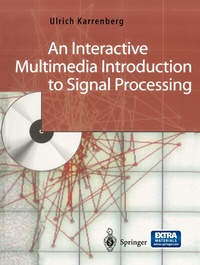
An Interactive Multimedia Introduction to Signal Processing
Description

This innovative book and CD-ROM learning system offers students and teachers a hands-on, interactive tool that makes the concepts and tools of modern, computer-based signal processing immediately understandable. Built around interactive software (DASYLab) and supported by 240 illustrations, Karrenberg's self-tutorial emphasizes the underlying principles of signals and systems while avoiding mathematical models and equations. This approach makes the material more accessible to readers who may lack mathematical and programming sophistication yet need to use or instruct others in the skills. The CD contains all programs, videos, manuals, and the complete text. The S-version of DASYLab for Windows provides an interactive development environment for the graphic programming of signal processing systems, and, more generally, microelectronics systems. Through active links, block diagrams, a pc sound card, and a microphone, users perform signal processing of real signals, attaining a visceral knowledge of the concepts and methods. More than 200 pre-programmed systems and transparencies are included.
Interactive Multimedia Introduction to Signal Processing has been awarded a prestigious digita2002 award. Digita awards are one of the most important multimedia prizes in Germany's educational market. They are awarded annually to the best educational software in various categories.
Reviews / Votes
From the reviews:
"I recently came across the book 'A Multimedia Interactive Introduction to Signal Processing.' It was uplifting to see a book that truly 'communicates' to the reader and provides the reader with a vision that '...stretches to infinity.' Congratulations to Prof. Karrenberg and thanks for sharing this gift." (Prof. Kevin Fynn, CEO, Western Australian Telecommunications Research Institute)
"...I am really impressed with your explanations and examples in DASYlab. It makes the math behind signal processing so much easier to understand..." (Gustavo E. Herrera, CenSSIS, Northern University, Boston, MA)
"Using a multimedia approach, the author helps new signal processing readers to remove the 'difficult' part of signal processing by providing readers with an interactive base. . An Interactive Multimedia Introduction to Signal Processing is a welcome read to all those new to signal processing and to professionals working in this field. This book will be of practical use to university lecturers, students of engineering sciences interested in learning signal processing, and recent electrical engineering graduates." (Dharmendra Lingaiah, IEEE Circuits & Devices Magazine, Vol. 20 (5), 2004)
"This book is written principally for undergraduate students. . It is easy to operate and offers an effective instrument for developing, modifying and optimising the design of entire systems and their applications. . As recognition for this, the book was awarded the 2002 Digita award (presented annually to the best education software). . With the software, it is fun to invent, check, modify, etc. signal processing applications and I enjoyed it . . " (Giovanni Sicuranza, IEE Proceedings - Vision, Image and Signal Processing, September, 2003)
From the reviews of the second edition:
"The presented book and provided CD-ROM form a learning system that supports both investigative studies and thevisualization of complex processes. It is written principally for undergraduate students. . There are numerous introduction-videos, one for every chapter and more than 250 high-quality pictures. . This innovative book and CD-ROM learning system offers students and teachers a hands-on, interactive tool that makes the concepts and tools of modern, computer-based signal processing immediately understandable." (Tzvetan Semerdjiev, Zentralblatt MATH, Vol. 1145, 2008)
More details
Other editions
New editions
Additional editions