

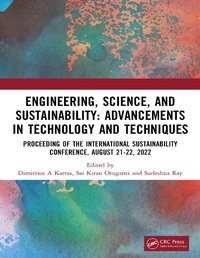
Engineering, Science, and Sustainability
Advancements in Technology and Techniques
1st Edition
Published on 28. September 2023
282 pages
978-1-003-81953-0 (ISBN)
Description

ISC 2022 is dedicated to the Niti Aayog policies to promote sustainability through exchange of ideas emerging out of the academia. The ISC is an annual conference that is held in virtual mode until COVID restrictions on travel exist. The vision of the conference is to capacitate Academia with the necessary ideas that provide insights of the grassroot level development to various stakeholders of the Niti-Aayog policies. Towards this goal, the conference creates a conjunction of various stakeholders of Niti-Aayog policies that include- academic institutions, government bodies, policy makers and industry.
The ISC organizers make concerted efforts to promote academic research that would technological, scientific, management & business practices, and insights into policy merits & disruptions. The framework of exchange of ideas is geared towards adoption of deep technologies, fundamental sciences & engineering, energy research, energy policies, advances in medicine & related case studies.
This framework enables the round table discussions between the academia, industry and policy makers through its range of plenary and keynote speakers.
The ISC organizers make concerted efforts to promote academic research that would technological, scientific, management & business practices, and insights into policy merits & disruptions. The framework of exchange of ideas is geared towards adoption of deep technologies, fundamental sciences & engineering, energy research, energy policies, advances in medicine & related case studies.
This framework enables the round table discussions between the academia, industry and policy makers through its range of plenary and keynote speakers.
More details
Edition
1. Auflage
Language
English
Place of publication
London
United Kingdom
Publishing group
Taylor & Francis Ebooks
Target group
College/higher education
ISBN-13
978-1-003-81953-0 (9781003819530)
Copyright in bibliographic data and cover images is held by Nielsen Book Services Limited or by the publishers or by their respective licensors: all rights reserved.
Schweitzer Classification
Other editions
Additional editions
Dimitrios A. Karras | Sai Kiran Oruganti | Sudeshna Ray
Engineering, Science, and Sustainability
Advancements in Technology and Techniques
Book
09/2023
1st Edition
CRC Press
€61.50
Shipment within 10-20 days
Persons
Dimitrios A. Karras received his Diploma and M.Sc. Degree in Electrical and Electronic Engineering from the National Technical University of Athens (NTUA), Greece in 1985 and the Ph. Degree in Electrical Engineering, from the NTUA, Greece in 1995, with honors. From 1990 and up to 2004 he collaborated as visiting professor and researcher with several universities and research institutes in Greece. Since 2004, after his election, he has been with the Sterea Hellas Institute of Technology, Automation Dept., Greece as associate professor in Intelligent Systems-Decision Making Systems, Digital Systems, Signal Processing, till 12/2018, as well as with the Hellenic Open University, Dept. Informatics as a visiting professor in Communication Systems (the latter since 2002 and up to 2010). Since 1/2019 is Associate Prof. in Intelligent Systems-Decision Making Systems, Digital Systems and Signal Processing, in National & Kapodistrian University of Athens, Greece, School of Science, Dept. General as well as Adjunct Assoc. Prof. Dr. with the EPOKA university, Computer Engineering Dept., Tirana (1/10/2018-25/9/2020). He has published more than 70 research refereed journal papers in various areas of intelligent and distributed/multiagent systems, Decision Making, pattern recognition, image/signal processing and neural networks as well as in bioinformatics and more than 185 research papers in International refereed scientific Conferences. His research interests span the fields of intelligent and distributed systems, Decision Making Systems, multiagent systems, pattern recognition and computational intelligence, image and signal processing and systems, biomedical systems, communications and networking as well as security. He has served as program committee member as well as program chair and general chair in several international workshops and conferences in the fields of intelligent Systems-Decision Making Systems, signal, image, communication and automation systems. He is, also, former editor in chief (2008-2016) of the International Journal in Signal and Imaging Systems Engineering (IJSISE), academic editor in the TWSJ, ISRN Communications and the Applied Mathematics Hindawi journals as well as associate editor in various scientific journals, including CAAI, IET. He has been cited in more than 2220 research papers (https://scholar.google.com/citations?user=IxQurTMAAAAJ&hl=en), (Google Scholar) and 1626 (ResearchGate Index, after recent recounting based only on ResearchGate database, with more than 9105 ResearchGate Index Reads metric ) citations, as well as in more than 1101 citations in Scopus peer reviewed research database, with H/G indexes 20/48 (Google Scholar), Scopus-H index 15, RG-index 30.96 and RG-Research Interest index 886.1 ( https://www.researchgate.net/profile/Dimitrios_Karras2/).
Prof. Dr. Sai Kiran Oruganti is with the School of Electrical and Automation Engineering, Jiangxi University of Science and Technology, Ganzhou, People's Republic of China as a full Professor since October 2019. He is responsible for establishing an advanced wireless power transfer technology laboratory as a part of the international specialists team for the Center for Advanced Wireless
Technologies. Between 2018-2019, he served as a senior researcher/Research Professor at Ulsan National Institute of Science and Technology. Previously, his PhD thesis at Ulsan National Institute of Science and Technology, South Korea, led to the launch of an University incubated enterprise, for which he served as a Principal Engineer and Chief Designer in 2017-2018. After his PhD in 2016, he served Indian Institute of Technology, Tirupati in the capacity of Assistant Professor (Electrical Engineering) between 2016-2017. His prime research focus is in the development of Wireless Power Transfer(WPT) for applications- Internet of Things (IoT) device charging, Agriculture, Electric Vehicle Charging, Biomedical device charging, Electromagnetically induced transparancy techniques for military and
defence applications, Secured shipping containers, Nano Energy Generators. Prof. Dr. Oruganti has more than 21 patents pending on his credit and with several of those patent applications passing the NoC stage. As of 2021, 16 of 21 patents have been granted. He is credited with the pioneering work in the field of Zenneck Waves based Wireless Power Transfer system. Most notably, he has been regarded as one of the only few researchers in the field of WPT to be able to conduct power and signal transmission across partial Faraday shields. His recent paper accepted by Nature Scientific Reports has generated a lot of interest and excitement in the field. International Union of Radio Science(URSI) recognized his research efforts and awarded him Young Scientist Award in 2016. He is also recipient of IEEE sensors council letters of appreciation.
Dr. Sudeshna Ray's research at the interface of Chemistry and Material Science is focused on the development of Novel Inorganic based Luminescent materials for the application in white Light Emitting Diodes (LEDs) and as Spectral Converters in Solar Cell. The novel materials can be a single composition multi-centred phosphor or near UV/blue excitable blue, green, yellow and red emitting phosphor. The utilization of 'Green' solution based Synthesis Methodology for the precise control of the composition of the phosphors and achievement of a homogenous distribution of small amounts of activators in the host compounds is the main paradigm of my Research. In addition, to my previous focus on Synthesis, Characterization and Optical studies of size and shape tuned nanocrystalline Y2O3, YVO4 and YPO4 based phosphors, I am extensively involved into the research for the development of Advanced Luminescence Materials so called Quantum Cutters for the application in Solar Cell. A unifying theme of my research is the compositional tuning of the properties of extended solids through solid solution; sometimes referred to as the game of x and y, as, for example, in Sr2(1-x-y/2)Eu2xLaySi1-yAlyO4. Design of New phosphor for LEDs and fabrication of LEDs using the phosphors is an integral part of my Research. Currently, I am involved in the synthesis of Persistent Phosphors for the fabrication of Glow Bullet for Defense Application. RESEARCH INTERESTS * Exploration of New Phosphors by Mineral Inspired Methodology * Development of water soluble silicon compound by alkoxy group exchange reaction * Synthesis of Eu2+ and Ce3+ doped silicate phosphors using water soluble silicon compound * Solution Synthesis of 'Size' and 'shape' tuned Nanomaterials * Characterization of Nanocrystalline phosphors by XRD, TEM, FE-SEM and Raman spectroscopic measurement. * Study of 'Up-conversion', 'Down-conversion', 'Down-shifting' phenomena by steady state photoluminescence and lifetime measurement and analysis. * Measurement of 'Quantum Efficiency' and Thermal stability of phosphors. * Development and optical study of 'Quantum Cutting' Materials as Spectral Converter for Solar cell
Prof. Dr. Sai Kiran Oruganti is with the School of Electrical and Automation Engineering, Jiangxi University of Science and Technology, Ganzhou, People's Republic of China as a full Professor since October 2019. He is responsible for establishing an advanced wireless power transfer technology laboratory as a part of the international specialists team for the Center for Advanced Wireless
Technologies. Between 2018-2019, he served as a senior researcher/Research Professor at Ulsan National Institute of Science and Technology. Previously, his PhD thesis at Ulsan National Institute of Science and Technology, South Korea, led to the launch of an University incubated enterprise, for which he served as a Principal Engineer and Chief Designer in 2017-2018. After his PhD in 2016, he served Indian Institute of Technology, Tirupati in the capacity of Assistant Professor (Electrical Engineering) between 2016-2017. His prime research focus is in the development of Wireless Power Transfer(WPT) for applications- Internet of Things (IoT) device charging, Agriculture, Electric Vehicle Charging, Biomedical device charging, Electromagnetically induced transparancy techniques for military and
defence applications, Secured shipping containers, Nano Energy Generators. Prof. Dr. Oruganti has more than 21 patents pending on his credit and with several of those patent applications passing the NoC stage. As of 2021, 16 of 21 patents have been granted. He is credited with the pioneering work in the field of Zenneck Waves based Wireless Power Transfer system. Most notably, he has been regarded as one of the only few researchers in the field of WPT to be able to conduct power and signal transmission across partial Faraday shields. His recent paper accepted by Nature Scientific Reports has generated a lot of interest and excitement in the field. International Union of Radio Science(URSI) recognized his research efforts and awarded him Young Scientist Award in 2016. He is also recipient of IEEE sensors council letters of appreciation.
Dr. Sudeshna Ray's research at the interface of Chemistry and Material Science is focused on the development of Novel Inorganic based Luminescent materials for the application in white Light Emitting Diodes (LEDs) and as Spectral Converters in Solar Cell. The novel materials can be a single composition multi-centred phosphor or near UV/blue excitable blue, green, yellow and red emitting phosphor. The utilization of 'Green' solution based Synthesis Methodology for the precise control of the composition of the phosphors and achievement of a homogenous distribution of small amounts of activators in the host compounds is the main paradigm of my Research. In addition, to my previous focus on Synthesis, Characterization and Optical studies of size and shape tuned nanocrystalline Y2O3, YVO4 and YPO4 based phosphors, I am extensively involved into the research for the development of Advanced Luminescence Materials so called Quantum Cutters for the application in Solar Cell. A unifying theme of my research is the compositional tuning of the properties of extended solids through solid solution; sometimes referred to as the game of x and y, as, for example, in Sr2(1-x-y/2)Eu2xLaySi1-yAlyO4. Design of New phosphor for LEDs and fabrication of LEDs using the phosphors is an integral part of my Research. Currently, I am involved in the synthesis of Persistent Phosphors for the fabrication of Glow Bullet for Defense Application. RESEARCH INTERESTS * Exploration of New Phosphors by Mineral Inspired Methodology * Development of water soluble silicon compound by alkoxy group exchange reaction * Synthesis of Eu2+ and Ce3+ doped silicate phosphors using water soluble silicon compound * Solution Synthesis of 'Size' and 'shape' tuned Nanomaterials * Characterization of Nanocrystalline phosphors by XRD, TEM, FE-SEM and Raman spectroscopic measurement. * Study of 'Up-conversion', 'Down-conversion', 'Down-shifting' phenomena by steady state photoluminescence and lifetime measurement and analysis. * Measurement of 'Quantum Efficiency' and Thermal stability of phosphors. * Development and optical study of 'Quantum Cutting' Materials as Spectral Converter for Solar cell
Content
1.Comprehensive Survey on Artificial Intelligence-Based Malware Analysis and Detection Methods 2.Integrated Artificial Intelligence-Based Traffic Light Detection System forAutonomous Vehicle 3. Identification and Authentication of SSR Markers for Purity of Hybrids in Sesame (Sesamum indicum L.) 4. Detection of Specular Reflection on the Smart Colposcopy Images Using Fine-Tuned U-Net Model 5. Mapout a Crop Protection System Against Forest Animals Using Internet of Things 6. Patrolling Robot for Fugitive Emissions in Industries 7. Investigation of Antioxidant and Photo Catalysis of Natural Honey and Cow Urine-Doped CeO2 Nanoparticles Fabricated by Reflux Method 8. Assessment of Reactive Oxygen Species, Antioxidant in Mercury-Induced Freshwater Cyprinus Carpio 9. (MIIAl-CO3) Based Layered Double Hydroxides: Synthesis and Photocatalytic Efficiency Against Anionic Dye 10. Millimeter Wave Communication in Autonomous Vehicles 11. Designing an Enhanced Self-Supported Transition Metal Complexes Based on Electrocatalysts for Hydrogen Evolution Reaction 12. Study of Self-Resilient Cloud Server Using Machine Learning Techniques for Local Area Networks 13. Performance Study of Dual Rotor Induction Motor: Simulation Study 14. Hausdorff Measures in Caratheodary Construction, Vital Covering Theorem, Steiner Symmetrization & Isodiametric Inequality 15. Heuristic for Symmetric Euclidean TSP with 3/2-approximation Ratio 16. New Approach to Solve COVID-19 Via Fuzzy Mathematical Model 17. Machine Learning Strategies for Understanding Autistic Neuro Images
18. Solution Synthesis, Characterization, Photoluminescence and Afterglow Studies of Y2O3:Eu3+, Ho3+ Phosphor 19. A Comprehensive Review of the Forensic Significance Toxic Medicinal Plants 20. Investigation on SIDO Quadratic Buck Converter for Battery Charging and LED Driver Applications 21. Secure RSA based Text File Encryption and Decryption using LabVIEW 22. OPAL-RT-Based Implementation of a Power Controller for a PV-Fed Grid-Connected Inverter 23. Extraction of Essential Oils From Medicinal and Aromatic Plants in Oman Using Solar Energy 24. A Review on Multi-Modal Classification for Emotional Intelligence 25. Factors Regulating the Human Microbiome 26. Citrus indica: Characterization and Potential as a Nutraceutical 27. Evaluating Impact of Clotrimazole on Inhibition of Candida Albicans and Surface Roughness in Permanent Soft-Liners 28. Identification of Road Surface Deficiencies Using Convolutional Neural Network 29. Analysis of Road Surface Deformation Using Radar Image 30. A Deep Dive into Motor Imagery EEG Classification with Transfer Learning Approach Using DenseNet-121 Model 31. Realistic Method of Domestic Power Management System 32. Performance Evaluation of High Voltage Gain Bidirectional DC-DC
Converter for Modern Electric Vehicles 33. Zagreb Index In Various Signed Graphs 34. Domination-Chromatic Number in Operations on Fuzzy Graphs 35. Special Dio - Triples Involving Primes 36. On The Non-isolated Resolving Number of Product Graphs and Some Families of Graphs 37. Entropy and Distance Measures of Bipolar Pythagorean Neutrosophic Soft Set 38. Mastitis Disease Diagnosis in Dairy Cattle Using Artificial Neural Networks 39. Upper Vertex Square Free Detour Number of a Graph 40. AI-Driven Proctoring System 41. Preliminary Research for Adhesive Peeling Device
42. Guidelines for Material Selection for Brackets to Treat Orthodontic Patients 43. An Efficient Prediction of Kidney Disease Using Machine Learning Algorithms 44. Prediction of Liver Diseases at Earliest Using Machine Learning Algorithms 45. Detection of Lung Cancer Using Deep Learning Techniques 46.Brain-Computer Interface Based Home Automation 47. Defect Exposure in Vegetables and Fruits Using Machine Learning Algorithms 48.Design of Remote Controlled Feeding and Smart Monitoring System for Aquaculture 49. Hospital Data Security Using Blockchain and AI 50. MIMO Antenna for 5G Communication Using HFSS 51. Multiple Biometric Authentication Through Image Assessment
Using Machine Learning 52. Skin Cancer Detection Using CNN
18. Solution Synthesis, Characterization, Photoluminescence and Afterglow Studies of Y2O3:Eu3+, Ho3+ Phosphor 19. A Comprehensive Review of the Forensic Significance Toxic Medicinal Plants 20. Investigation on SIDO Quadratic Buck Converter for Battery Charging and LED Driver Applications 21. Secure RSA based Text File Encryption and Decryption using LabVIEW 22. OPAL-RT-Based Implementation of a Power Controller for a PV-Fed Grid-Connected Inverter 23. Extraction of Essential Oils From Medicinal and Aromatic Plants in Oman Using Solar Energy 24. A Review on Multi-Modal Classification for Emotional Intelligence 25. Factors Regulating the Human Microbiome 26. Citrus indica: Characterization and Potential as a Nutraceutical 27. Evaluating Impact of Clotrimazole on Inhibition of Candida Albicans and Surface Roughness in Permanent Soft-Liners 28. Identification of Road Surface Deficiencies Using Convolutional Neural Network 29. Analysis of Road Surface Deformation Using Radar Image 30. A Deep Dive into Motor Imagery EEG Classification with Transfer Learning Approach Using DenseNet-121 Model 31. Realistic Method of Domestic Power Management System 32. Performance Evaluation of High Voltage Gain Bidirectional DC-DC
Converter for Modern Electric Vehicles 33. Zagreb Index In Various Signed Graphs 34. Domination-Chromatic Number in Operations on Fuzzy Graphs 35. Special Dio - Triples Involving Primes 36. On The Non-isolated Resolving Number of Product Graphs and Some Families of Graphs 37. Entropy and Distance Measures of Bipolar Pythagorean Neutrosophic Soft Set 38. Mastitis Disease Diagnosis in Dairy Cattle Using Artificial Neural Networks 39. Upper Vertex Square Free Detour Number of a Graph 40. AI-Driven Proctoring System 41. Preliminary Research for Adhesive Peeling Device
42. Guidelines for Material Selection for Brackets to Treat Orthodontic Patients 43. An Efficient Prediction of Kidney Disease Using Machine Learning Algorithms 44. Prediction of Liver Diseases at Earliest Using Machine Learning Algorithms 45. Detection of Lung Cancer Using Deep Learning Techniques 46.Brain-Computer Interface Based Home Automation 47. Defect Exposure in Vegetables and Fruits Using Machine Learning Algorithms 48.Design of Remote Controlled Feeding and Smart Monitoring System for Aquaculture 49. Hospital Data Security Using Blockchain and AI 50. MIMO Antenna for 5G Communication Using HFSS 51. Multiple Biometric Authentication Through Image Assessment
Using Machine Learning 52. Skin Cancer Detection Using CNN
