

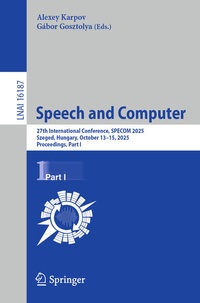
Speech and Computer
Description

This two-set volume LNAI 16187 and 16188 constitutes the refereed proceedings of the 27th International Conference on Speech and Computer SPECOM 2025 held in Szeged, Hungary, during October 13-15, 2025.
The 47 full papers and 1 invited paper included in this book were carefully reviewed and selected from 77 submissions. The papers are organized in the following topical sections:
Part I- Invited Paper; Speech Perception and Synthesis; Computational Paralinguistics; Speech Processing for Healthcare; Speech and Language Resources; Speaker Recognition.
Part II- Automatic Speech Recognition; Speech Processing for Under-Resourced Languages; Digital Speech Processing; Natural Language Processing; Multimodal Systems.
More details
Other editions
Additional editions
Content
.- Invited Paper.
.- Towards Responsible Multimodal Modeling for Mental Healthcare.
.- Speech Perception and Synthesis.
.- When Voice Matters: Evidence of Gender Disparity in Positional Bias of SpeechLLMs.
.- WhiSQA: Non-Intrusive Speech Quality Prediction using Whisper Encoder Features.
.- Prompting the Mind: EEG-to-Text Translation with Multimodal LLMs and Semantic Contro.
.- Effectiveness of Tacotron2 for Intonation Model Synthesis in Russian.
.- Enhancing Sinhala Text-to-Speech with End-to-End VITS Architecture.
.- Computational Paralinguistics.
.- Spoken Emotion Recognition using Soft Labels.
.- NAMTalk: From Muscle Vibrations to Emotional Speech.
.- What Do LLMs Know about Human Emotions? The Russian Case Study.
.- Emotions Manifestation by Adolescents with Intellectual Disabilities.
.- Retention-Augmented Voice Assistant: A Lightweight Architecture for Stateful Interaction with Comprehensive Evaluation and Privacy-Preserving Design.
.- Speech Processing for Healthcare.
.- Investigation of Explainable Multimodal Methods for Detecting Mental Disorders.
.- Attention Deficit Hyperactivity Disorder: Identifying Approaches for Early Diagnosis, a Pilot Study.
.- Text-to-Dysarthric-Speech Generation for Dysarthric Automatic Speech Recognition: Is Purely Synthetic Data Enough?.
.- Colour Preferences in Schizophrenic Speech.
.- Automated Assessment of Phrase Intelligibility for Russian Speech Based on Esophageal Voice.
.- Speech and Language Resources.
.- Subtle Changes in L1 Stops of Late Salento Italian-French Bilinguals: An Acoustic Study using AutoVOT Adapted for Italian and French.
.- Sound and Colour in Phonosemantics: Perceptual and Acoustic Correlates of Mongolian Vowels.
.- Rhythmic Diglossia Based on Discourse Types and Dialects of English: Australian and New Zealand Corpora.
.- Automatic Annotation of Discourse and Speech Formulas in Internet Communication: A Telegram Comment Corpus.
.- Speaker Recognition.
.- Effect of Spoof Speech on Forensic Voice Comparison using Deep Speaker Embeddings.
.- Source Vendor Tracing of Audio Deepfakes.
.- Language-Specific Adaptation Strategies for Speaker Recognition using MobileNet.
.- Enhancing Audio Replay Attack Detection with Silence-based Blind Channel Impulse Response Estimation.
