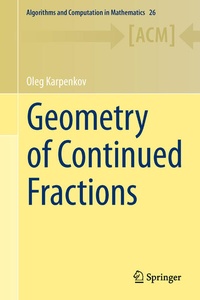
Geometry of Continued Fractions
Description

Traditionally a subject of number theory, continued fractions appear in dynamical systems, algebraic geometry, topology, and even celestial mechanics. The rise of computational geometry has resulted in renewed interest in multidimensional generalizations of continued fractions. Numerous classical theorems have been extended to the multidimensional case, casting light on phenomena in diverse areas of mathematics. This book introduces a new geometric vision of continued fractions. It covers several applications to questions related to such areas as Diophantine approximation, algebraic number theory, and toric geometry.
The reader will find an overview of current progress in the geometric theory of multidimensional continued fractions accompanied by currently open problems. Whenever possible, we illustrate geometric constructions with figures and examples. Each chapter has exercises useful for undergraduate or graduate courses.
Reviews / Votes
"Throughout the book many theorems are accompanied by constructive algorithms. Due to its rich content and connections to several parts of mathematics this volume will be of interest to graduate students and researchers not only in number theory and discrete geometry." (C. Baxa, Monatshefte für Mathematik, Vo. 180, 2016)
"Karpenkov . begins with a distinctive treatment of continued fraction foundations emphasizing lattice geometry. One-dimensional continued fractions connect to two-dimensional lattices--very apt for illustration. . Summing Up: Recommended. Upper-division undergraduates through researchers/faculty." (D. V. Feldman, Choice, Vol. 51 (10), June, 2014)
"The book is well written and is easy to read and navigate. . The book features a number of helpful illustrations and tables, a detailed index, and a large bibliography.This text is likely to become a valuable resource for researchers and students interested in discrete geometry and Diophantine approximations, as well as their rich interplay and many connections." (Lenny Fukshansky, zbMATH, Vol. 1297, 2014)
More details
Other editions
New editions
Additional editions