

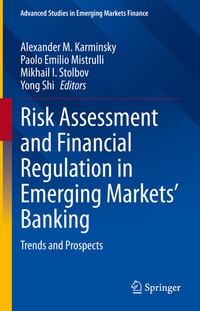
Risk Assessment and Financial Regulation in Emerging Markets' Banking
Description

This book describes various approaches in modelling financial risks and compiling ratings. Focusing on emerging markets, it illustrates how risk assessment is performed and analyses the use of machine learning methods for financial risk assessment and measurement. It not only offers readers insights into the differences between emerging and developed markets, but also helps them understand the development of risk management approaches for banks. Highlighting current problems connected with the evaluation and modelling of financial risks in the banking sector of emerging markets, the book presents the methodologies applied to credit and market financial risks and integrated and payment risks, and discusses the outcomes. In addition it explores the systemic risks and innovations in banking and risk management by analyzing the features of risk measurement in emerging countries. Lastly, it demonstrates the aggregation of approaches to financial risk for emerging financial markets, comparing the experiences of various countries, including Russia, Belarus, China and Brazil.
More details
Other editions
Additional editions
Persons
Alexander M. Karminsky is a trained mathematician and Doctor of Economics and Technics. After 25 years in the banking sector, Dr. Karminsky is currently employed as Professor of Finance and Head of the Research Center of Banking and Risks at the National Research University Higher School of Economics, Moscow (HSE). Alexander Karminsky is on the editorial boards of several scientific journals in Russia and abroad. He is the author of 30+ books and 200+ articles on banking, risk management, econometrics as well as on operational research, IT and controlling.
Paolo Emilio Mistrulli, PhD, is principal economist at the Bank of Italy. He works on various themes related to empirical banking and has a number of papers published in leading international peer-reviewed journals, including the Review of Financial Studies, Journal of Financial Stability, Journal of Banking & Finance, etc.
Professor Mikhail I. Stolbov chairs the Department of Applied Economics at MoscowState Institute of International Relations (MGIMO University). His research focuses on macrofinancial issues, including global financial stability, finance-growth nexus, financial innovations. He has authored a number of studies published in international refereed journals, such as International Economics, Annals of Finance, Empirical Economics, etc.
Yong Shi is Professor and the Executive Deputy Director, Chinese Academy of Sciences Research Center on Fictitious Economy & Data Science and a professor of Information Technology, College of Information Science and Technology, Peter Kiewit Institute, University of Nebraska. He has published more than 15 books and over 200 papers in numerous MCDM-related journals and conference proceedings.
