


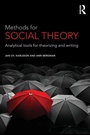
Methods for Social Theory
Analytical tools for theorizing and writing
Published on 15. December 2016
184 pages
978-1-317-09700-6 (ISBN)
Description

This book constitutes a practical guide to the important skills of both theorizing and writing in social scientific scholarship, focusing on the importance of identifying relations between concepts that are useful for explaining social entities and of producing a text that convincingly advances the theory that has been constructed. Taking as its point of departure the distinction between the research process and the reporting process - between clarifying one's ideas to oneself and writing to express these ideas clearly to others - this volume concentrates on writing when theorizing as a way of thinking, emphasizing the series of relations that exist between ontology, epistemology and rhetoric upon which successful theoretical writing depends.
Richly illustrated with practical examples, the book is divided into two parts, the first of which presents techniques for theorizing based upon visualized and logical connections of ideas, concepts and empirical patterns in both free and systematic ways, and the second part providing techniques for structuring and presenting arguments in essays, papers, articles or books.As such, Methods for Social Theory offers a toolbox for the development and presentation of social thought, which will prove essential for students and teachers across the social sciences.
Richly illustrated with practical examples, the book is divided into two parts, the first of which presents techniques for theorizing based upon visualized and logical connections of ideas, concepts and empirical patterns in both free and systematic ways, and the second part providing techniques for structuring and presenting arguments in essays, papers, articles or books.As such, Methods for Social Theory offers a toolbox for the development and presentation of social thought, which will prove essential for students and teachers across the social sciences.
Reviews / Votes
'This book will be an indispensable and accessible guide for students and researchers in social theory. It provides analytical and practical tools for both theorizing and writing in a very pedagogical way. The book inspires to creative analyses and provides guidelines on how to bring order and systematics into an often complex research process. In short, this book is a vital contribution in constructing and presenting social theory.' - Professor Kristina Hakansson, Gothenburg University, Sweden'This remarkable book explores the development and use of social theory in ways that have seldom been attempted before. Far from being an endeavour that only the minority can and should engage with, everyone, from students to professors can and should theorise. Indeed with the help of the (relatively simple) expedients and tools recommended in this book it should be easy to develop social theory and to use it in the presentation of research findings. Strongly recommended to students - and indeed to fellow professionals - this book embodies the message that making, developing and using concepts is and should be central to the practice of social science.' - Professor Stephen Ackroyd, Lancaster University, U.K
More details
Language
English
Place of publication
London
United Kingdom
Publishing group
Taylor & Francis Ltd
Target group
College/higher education
Illustrations
52 Tables, black and white; 53 Line drawings, black and white; 53 Illustrations, black and white
File size
1,62 MB
ISBN-13
978-1-317-09700-6 (9781317097006)
Copyright in bibliographic data and cover images is held by Nielsen Book Services Limited or by the publishers or by their respective licensors: all rights reserved.
Schweitzer Classification
Other editions
Additional editions
Book
12/2016
1st Edition
Routledge
€72.00
Shipment within 10-20 days
Book
12/2016
1st Edition
Routledge
€217.50
Shipment within 10-20 days
Persons
Jan Ch. Karlsson is Professor of Organization, Faculty of Business, Languages, and Social Sciences, Ostfold University College, Norway.
Ann Bergman is Professor of Working Life Science at Karlstad University, Sweden.
Ann Bergman is Professor of Working Life Science at Karlstad University, Sweden.
Content
List of figures
List of tables
Preface
Acknowledgements
Chapter 1 Theorizing and writing social theory
Social theory
Theorizing
Writing
Writing in the research process
Writing in the reporting process
Outline of the book
References
PART I Tools for theorizing in social science
Graphic representations
Displays and property spaces as preliminary endpoints
References
Chapter 2 Basics of displays
What is a display?
Building blocks of displays
Putting a display together
Summary
References
Chapter 3 The use of displays in theorizing
Theorizing by extending
Theorizing by mapping interaction
Stepwise theorizing
Summary
References
Chapter 4 Basics of property spaces
Constructing a property space
Hidden property spaces
Housekeeping
Labelling the types: terms
Developing existing terminology
Summary
References
Chapter 5 Reduction of property spaces in theorizing
Rescaling
Indexing
Logic reduction
Empirical reduction
Theoretical reduction
Pragmatic reduction
Summary
References
Chapter 6 Expansion of property spaces in theorizing
Substruction
More properties of existing dimensions
More dimensions
Combining property spaces
Inserting process arrows
Creating scales
Summary
References
PART II Tools for writing social science
References
Chapter 7 The Model of Argumentation: chain of reasoning, chains of argument and arguments
The rhetorical situation
Purpose
Persona
Audience
Tone
The subject matter
The model
Summary
References
Chapter 8 Examples of using the Model of Argumentation
The process of writing a social science text: an example
The (preliminarily) finished structure of a text: an example
The structure of Chapter 4, 'Basics of property spaces'
Constructing a property space
Housekeeping
Moving the model down one level
Summary
References
Chapter 9 Theorizing and writing
Research process and reporting process
Displays
Property spaces
Writing
Summary
References
Appendix: from Bergman, Ann, Jan Ch. Karlsson and Jonas Axelsson (2010) 'Truth Claims and Explanatory Claims - an Ontological Typology of Futures Studies', Futures, 42(8): 857-65
Index
List of tables
Preface
Acknowledgements
Chapter 1 Theorizing and writing social theory
Social theory
Theorizing
Writing
Writing in the research process
Writing in the reporting process
Outline of the book
References
PART I Tools for theorizing in social science
Graphic representations
Displays and property spaces as preliminary endpoints
References
Chapter 2 Basics of displays
What is a display?
Building blocks of displays
Putting a display together
Summary
References
Chapter 3 The use of displays in theorizing
Theorizing by extending
Theorizing by mapping interaction
Stepwise theorizing
Summary
References
Chapter 4 Basics of property spaces
Constructing a property space
Hidden property spaces
Housekeeping
Labelling the types: terms
Developing existing terminology
Summary
References
Chapter 5 Reduction of property spaces in theorizing
Rescaling
Indexing
Logic reduction
Empirical reduction
Theoretical reduction
Pragmatic reduction
Summary
References
Chapter 6 Expansion of property spaces in theorizing
Substruction
More properties of existing dimensions
More dimensions
Combining property spaces
Inserting process arrows
Creating scales
Summary
References
PART II Tools for writing social science
References
Chapter 7 The Model of Argumentation: chain of reasoning, chains of argument and arguments
The rhetorical situation
Purpose
Persona
Audience
Tone
The subject matter
The model
Summary
References
Chapter 8 Examples of using the Model of Argumentation
The process of writing a social science text: an example
The (preliminarily) finished structure of a text: an example
The structure of Chapter 4, 'Basics of property spaces'
Constructing a property space
Housekeeping
Moving the model down one level
Summary
References
Chapter 9 Theorizing and writing
Research process and reporting process
Displays
Property spaces
Writing
Summary
References
Appendix: from Bergman, Ann, Jan Ch. Karlsson and Jonas Axelsson (2010) 'Truth Claims and Explanatory Claims - an Ontological Typology of Futures Studies', Futures, 42(8): 857-65
Index
