

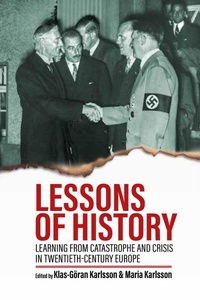
Lessons of History
Description

Historical lessons are useful or even necessary for our guidance and orientation in time. These lessons, however, have often been overlooked in historical reflections on watershed moments, such as genocides, treaties, and global movements. Focusing on how cataclysmic events, primarily within Central and Eastern Europe, have been transmitted across borders and generations, this volume interrogates how the theory of historical lessons has evolved, ultimately providing a useful framework for understanding contemporary conflicts and issues. Spanning topics from the mediation of history within film to the influence of historical oppression on student activism, this volume re-evaluates historiography's potential for analyzing the past and engaging with the present.
More details
Other editions
Additional editions
Persons
Klas-Göran Karlsson is Professor of History at Lund University. Throughout his career, he has led large research projects, including the on-going project Lessons of Communist and Nazi History: A Genealogical Approach and, from 2001-2008, The Holocaust and European Historical Cultures. A specialist in Russian and Soviet history, genocide history, and the uses of history in Europe, his recent publications include; Perspectives on the Entangled History of Communism and Nazism (co-editor, Lexington 2015) and Lessons of History: The Holocaust and Soviet Terror as Borderline Events (Academic Studies Press, 2024).
Content
List of Illustrations
Acknowledgments
Introduction: Understanding Historical Lessons
Klas-Göran Karlsson and Maria Karlsson
Chapter 1. On Historical Lessons: Theoretical and Analytical Perspectives
Klas-Göran Karlsson
Chapter 2. Phronesisand Historical Lessons: Ethics, Politics, Praxis
Björn Badersten
Chapter 3. "Historylessness" as a Lack of Historical Learning: A Conceptual Approach
Johan Stenfeldt
Chapter 4. Christianity and Crisis: Religion and Ideology in Modern Europe
Jayne Svenungsson
Available open access under a Creative Commons Attribution-NonCommercial-NoDerivatives 4.0 International License (CC BY-NC-ND 4.0) with support from Riksbankens Jubileumsfond (M22-0018).
Chapter 5. Representing Rivalling States, Remembering Munich:Learning from History in Diplomacy
Christer Jönsson
Chapter 6. Topographies of Terror: Or How to Read Landscapes in Twentieth-Century East Central Europe
Karl Schlögel
Chapter 7. The Reparative Quest: Can "Doing History" Further Reconciliation in Post-Soviet Russia?
Nanci Adler
Chapter 8. Dark Lessons: The Holocaust between Dilemmas of Representation and Learning from the Past
Maria Karlsson
Chapter 9. Mediating the Darkest Lessons of History on Film: The Case of the Polish Film "Hatred"
Barbara Törnquist-Plewa
Chapter 10. "We Are Appalled to Have These False Beliefs Associated with Our Campus": Holodomor, Trigger Warnings, and Free Speech at the University of Alberta
Per Anders Rudling
Chapter 11. Bandera Reaffirmed: Scrutinizing Lessons of a Nationalist Symbol in Struggling Ukraine
Eleonora Narvselius
Conclusion: Historical Lessons in History and History Culture
Klas-Göran Karlsson and Maria Karlsson
Index
