

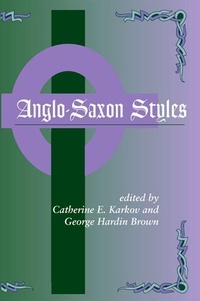
Anglo-Saxon Styles
Description

Art historian Meyer Schapiro defined style as "the constant form-and sometimes the constant elements, qualities, and expression-in the art of an individual or group." Today, style is frequently overlooked as a critical tool, with our interest instead resting with the personal, the ephemeral, and the fragmentary. Anglo-Saxon Styles demonstrates just how vital style remains in a methodological and theoretical prism, regardless of the object, individual, fragment, or process studied. Contributors from a variety of disciplines-including literature, art history, manuscript studies, philology, and more- consider the definitions and implications of style in Anglo-Saxon culture and in contemporary scholarship. They demonstrate that the idea of style as a "constant form" has its limitations, and that style is in fact the ordering of form, both verbal and visual. Anglo-Saxon texts and images carry meanings and express agendas, presenting us with paradoxes and riddles that require us to keep questioning the meanings of style.
Catherine E. Karkov is Professor of Art at Miami University and the author of Text and Picture in Anglo-Saxon England: Narrative Strategies in the Junius 11 Manuscript, the editor of Basic Readings in Anglo-Saxon Archaeology, and the coeditor (with Robert T. Farrell and Michael Ryan) of The Insular Tradition, also published by SUNY Press. George Hardin Brown is Professor of English at Stanford University and the author of Bede the Venerable and Bede the Educator.
More details
Other editions
Additional editions
Persons
Catherine E. Karkov is Professor of Art at Miami University and the author of Text and Picture in Anglo-Saxon England: Narrative Strategies in the Junius 11 Manuscript, the editor of Basic Readings in Anglo-Saxon Archaeology, and the coeditor (with Robert T. Farrell and Michael Ryan) of The Insular Tradition, also published by SUNY Press. George Hardin Brown is Professor of English at Stanford University and the author of Bede the Venerable and Bede the Educator.
Content
Abbreviations
Introduction
1. Encrypted Visions: Style and Sense in the Anglo-Saxon Minor Arts, A.D. 400-900
LESLIE WEBSTER
2. Rethinking the Ruthwell and Bewcastle Monuments: Some Deprecation of Style; Some Consideration of Form and Ideology
FRED ORTON
3. Iuxta Morem Romanorum: Stone and Sculpture in Anglo-Saxon England
JANE HAWKES
4. Beckwith Revisited: Some Ivory Carvings from Canterbury
PERETTE E. MICHELLI
5. Style in Late Anglo-Saxon England: Questions of Learning and Intention
CAROL FARR
6. House Style in the Scriptorium, Scribal Reality, and Scholarly Myth
MICHELLE P. BROWN
7. Style and Layout of Anglo-Saxon Manuscripts
WILLIAM SCHIPPER
8. What We Talk about When We Talk about Style
NICHOLAS HOWE
9. "Either/And" as "Style" in Anglo-Saxon Christian Poetry
SARAH LARRATT KEEFER
10. Eating People Is Wrong: Funny Style in Andreas and its Analogues
JONATHAN WILCOX
11. Aldhelm's Jewel Tones: Latin Colors through Anglo-Saxon Eyes
CARIN RUFF
12. The Discreet Charm of the Old English Weak Adjective
ROBERTA FRANK
13. Rhythm and Alliteration: Styles of Aelfric's Prose up to the Lives of Saints
HARUKO MOMMA
14. Both Style and Substance: The Case for Cynewulf
ANDY ORCHARD
List of Contributors
Index
Index of Manuscripts Cited
