

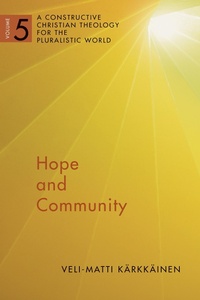
Hope and Community
A Constructive Christian Theology for the Pluralistic World, vol. 5
Published on 23. October 2017
457 pages
978-1-4674-4874-1 (ISBN)
Description

The culmination of Kärkkäinen's multivolume magnum opus This fifth and final volume of Veli-Matti Kärkkäinen's ambitious five-volume systematic theology develops a constructive Christian eschatology and ecclesiology in dialogue with the Christian tradition, with contemporary theology in all its global and contextual diversity, and with other major living faiths-Judaism, Islam, Buddhism, and Hinduism. In Part One of the book Kärkkäinen discusses eschatology in the contexts of world faiths and natural sciences, including physical, cosmological, and neuroscientific theories. In Part Two, on ecclesiology, he adopts a deeply ecumenical approach. His proposal for greater Christian unity includes the various dimensions of the church's missional existence and a robust dialogical witness to other faith communities.
More details
Other editions
Additional editions
Veli-Matti Karkkainen
Hope and Community
A Constructive Christian Theology for the Pluralistic World, vol. 5
Book
10/2017
William B Eerdmans Publishing Co
€54.20
Shipment within 15-20 days
Content
- Intro
- Title Page
- Copyright
- Contents
- Abbreviations
- Preface
- Introduction: In Search of a New Methodological Vision for Constructive Theology
- Part I: Hope
- 1. Introduction: On the Possibility and Conditions of a Constructive Christian Eschatology
- The (Omni)Presence of Eschatology
- On the Conditions and Requirements of a Comprehensive Eschatology
- Orientation to Part 1
- 2. The "End" of the Cosmos and Life in Natural Sciences' Conjectures
- The Origins of the Universe in Light of Contemporary Science
- Big Bang Cosmologies
- Scientific Predictions about the "Future" of the Universe
- Sciences and Theology in Critical Mutual Dialogue about "Eschatology"
- 3. Eschatological Visions and Symbols among Religions
- On the Propriety and Conditions of Speaking of Religions' "Eschatologies"
- Jewish Eschatology
- Islamic Eschatology
- "End-Time" Visions and Symbols in Hindu Traditions
- Buddhist Visions of End and "Release"
- 4. A Trinitarian Theology of Hope
- For Orientation: Creation, Providence, and Final Consummation as the Joint Work of the Triune God
- God of Hope
- The Resurrection of the Son as the Basis of Hope
- The Perfecting Work of the Spirit
- 5. The Transition from Time to Eternity and New Creation
- Introduction: The Power of Anticipation
- Time-Space and Eternity
- The Transition from Time to Eternity: The Dynamic of Continuity and Discontinuity
- Judgment, Purification, and Reconciliation
- 6. Resurrection as the Destiny of the Cosmos and Humanity
- The Cosmic Significance of Jesus' Resurrection
- Death-the "Last Enemy"
- Resurrection as Human Destiny
- Competing Views of the Afterlife
- 7. The Flourishing of Nature and Humanity in the Perspective of New Creation
- Liberating Eschatology
- The Flourishing of Nature and Eschatological Hope
- 8. Overcoming Evil and Defeating Violence
- Theodicy in Christian Theology: A Need for Revision and Reassessment
- Overcoming Evil as the Ultimate Eschatological Hope
- Evil and Suffering among Religions: The Challenge to Abrahamic Traditions
- Defeating Violence and Establishing Peace in the Eschaton
- 9. A Christian Theology of Religious Ends in the Pluralistic World
- The Traditional Theology of Two Destinies and Its Rebuttals
- The Appeal and Problems of Universalisms
- 10. The Consummation: "New Heavens and New Earth"
- "The End Is Nigh": The Ambivalence and Dynamic of the Imminent Return of Christ
- The Critical and Inspiring Role of the Millennium as the Penultimate Earthly Hope
- A Theological Rediscovery of "Heaven"
- Part II: Community
- 11. Introduction: The Christian Church and Ecclesiology in the Matrix of Secularism(s) and Religious Pluralism(s)
- How to Do Ecclesiology in the Beginning of the Third Millennium
- The Many Facets of the "Globalization" of the Christian Church
- Continuing Transformations and Changes in Ecclesial Life and Structures in the Global Church
- Religious Pluralism(s) and Secularism(s) as Ecclesiological Challenges
- Brief Orientation to Part 2
- 12. Visions of Community among Religions
- Synagogue-the Jewish Community
- Ummah-the Islamic Community
- Hindu Spiritual Life and Community
- The Buddhist Sangha and Spiritual Pursuit
- 13. Community after the Trinity
- The Trinitarian "Foundation" of the Church
- The Church as the Image of the Trinity
- The Church of the Triune God as an Eschatological Anticipation of the Kingdom
- 14. The Ecclesiality of the Church: An Ecumenical Proposal and Appeal
- What Is at Stake in the Discussion of Ecclesiality?
- Toward a Mutual Recognition of the Ecclesiality of the Church: A Constructive Proposal
- The Four Marks of the Church in Action
- 15. Church as Communion of Communions
- Trinitarian Communion as the Source of Ecclesial Communion
- The Rich and Multidimensional Nature of Koinonia
- The Communion of Communions
- The Wider Context of the "Communion of Saints" in Relation to the Deceased and Ancestors
- Identity, Alienation, and Belonging: Communion Ecclesiology as "Contextual Theology" for the Postmodern World
- 16. The Church as Mission
- Mission in the New Context(s)
- The Missional Nature of the Church
- Multidimensional Mission in the Service of the Coming of God's Kingdom
- 17. Missional Existence as the Sacramental and Liturgical Celebration
- Liturgy and Worship at the Heart of the Church's Missional Existence
- The Sacramental Life of the Missional Communion in a Theological Outlook
- Baptism
- Eucharist
- 18. Missional Existence as the Charismatic-Diaconal Ministry
- The People of God as the Missional Minister
- The Charismatic Structure of the Church
- The Missional Organization of the Community Structures
- Ordained Ministers in the Service of the Community
- 19. Missional Existence as the Pursuit of the Diversified and Plural Unity of the Church
- The Task and Landscape in the Search for the Unity of the Church
- Toward Mutual Recognition of Churches
- Further New Resources and Fresh Perspectives on the Way toward Recognition and Unity
- 20. Missional Existence as Hospitable Dialogue: The Church among Religious Communities and Secularisms
- A Methodological Orientation: Christian Theology as Comparative Theology
- Religious Pluralisms in a Theological Assessment
- A Trinitarian Theology of Interfaith Hospitality of Witness and Dialogue
- The Church and the Synagogue
- Church and Ummah
- The Church and Hindus
- The Church and Buddhists
- Christian Church and Ecclesiology in the "Secular City"
- Epilogue: In the End-the Beginning
- The Trinitarian Unfolding of Divine Economy
- In Search of a Proper Confidence Rather Than Indubitable Certainty
- Bibliography
