

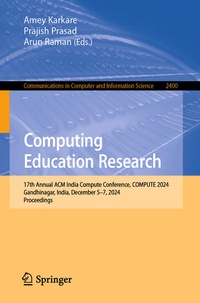
Computing Education Research
Description

This book constitutes the refereed proceedings of the 17th Annual ACM India Compute Conference on COMPUTE 2024, held in Gandhinagar, India, during December 5-7, 2024.
The 12 full papers and 3 short papers included in this book were carefully reviewed and selected from 35 submissions. They were organized in topical sections as follows: India-specific Computing Education Research Issues; Assessment and Evaluation; Interactive Tools, Visualizations and Learning Analytics; and Beyond CS1: Computing Education Research in Upper Level Courses.
More details
Other editions
Additional editions

Content
.- India-specific Computing Education Research Issues.
.- Explain in Plain Language Questions with Indic Languages: Drawbacks, Affordances, and Opportunities.
.- HinglishEval: Evaluating the Effectiveness of Code-generation Models on Hinglish Prompts.
.- Challenges and Outcomes of Organizing an Open Discussion Forum for Building the CSEd Research Community.
.- Exploring the Effectiveness of a Multilingual Generative AI Programming Chatbot for Vernacular Medium CS Students.
.- Assessment and Evaluation.
.- Scaling Evaluation of Non-Objective Assessments using AI-based Solutions.
.- Leveraging ChatGPT-3.5 for Automated Evaluation of Time Complexity in Programming Assignments.
.- RECE: A Family of Explainable Rubrics for Autograding Refute Problems.
.- Interactive Tools, Visualizations and Learning Analytics.
.- JestViz : Towards Supporting Novice Web Developers Debug JavaScript.
.- An Interactive Lambda Calculus Interpreter and Visualization Tool.
.- Exploring Recursion Pedagogies: Innovative Strategies and Their Effects on Engineering Students (Short Paper).
.- Enhancing and analyzing log generation for Collaborative Problem-Solving activities: Video analysis and OCR techniques (Short paper).
.- Beyond CS1: Computing Education Research in Upper Level Courses.
.- Identifying the Root Cause of a Cyber Attack through Log Data Analysis: An Overview of the Challenges faced by Novice Learners.
.- Teaching NLP in the age of Large Language Models: Challenges and Strategies for Indian Universities.
.- Bridging Ethics and Code: A PBL Framework for Digital Citizenship in CS.
.- Mapping Challenges in Teaching-Learning Software Testing: Limitations and Unaddressed Issues in Contemporary Research (Short paper).
