

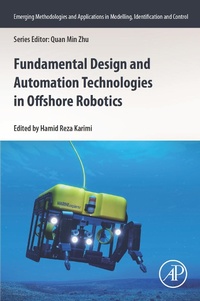
Fundamental Design and Automation Technologies in Offshore Robotics
Published on 6. October 2020
360 pages
978-0-12-820272-2 (ISBN)
Description

Fundamental Design and Automation Technologies in Offshore Robotics introduces technological design, modelling, stability analysis, control synthesis, filtering problem and real time operation of robotics vehicles in offshore environments.
The book gives numerical and simulation results in each chapter to reflect the engineering practice yet demonstrate the focus of the developed analysis and synthesis approaches. The book is ideal to be used as a reference book for senior and graduate students. It is written in a way that the presentation is simple, clear, and easy to read and understand which would be appreciated by graduate students. Researchers working on marine vehicles and robotics would be able to find reference material on related topics from the book.
The book could be of a significant interest to the researchers within offshore and deep see society, including both academic and industrial parts.
- Provides a series of latest results in, including but not limited to, motion control, robotics, and multi-vehicle systems towards offshore environment
- Presents recent advances of theory, technological aspects, and applications of robotics in offshore environment
- Offers a comprehensive and up-to-date references, which plays an indicative role for further study of the reader
More details
Other editions
Additional editions
Hamid Reza Karimi
Fundamental Design and Automation Technologies in Offshore Robotics
Book
10/2020
Academic Press
€163.50
Shipment within 15-20 days
Content
1. Introduction to fundamental design and automationtechnologies in offshore robotics 2. Continuous system integration and validation for underwaterperception in offshore inspection and intervention tasks3. Azimuth thruster single lever type remote control system4. Autonomous environment and target perception of underwateroffshore vehicles5. Autonomous control of underwater offshore vehicles6. Development of hybrid control architecture for a smallautonomous underwater vehicle7. Adaptive sliding mode control based on local recurrent neuralnetworks for an underwater robot8. Thruster fault reconstruction for autonomous underwater vehiclebased on terminal sliding mode observer9. Robust sampled-data control for dynamic positioning shipsbased on T-S fuzzymodel10. Finite-time control of autonomous surface vehicles11. Way-point tracking control of underactuated USV based on GPCpath planning12. ESO-based guidance law for distributed path maneuveringof multiple autonomous surface vehicles with a time-varyingformation13. Finite-time extended state observer based fault tolerant outputfeedback control for UAV attitude stabilization under actuatorfailures and disturbances
