

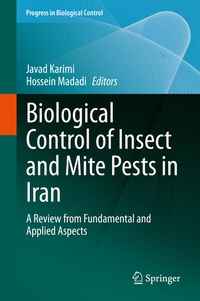
Biological Control of Insect and Mite Pests in Iran
Description

The book provides a reference to biological control of arthropod pests in agriculture and of public health importance in Iran. A quick glance over the literature shows a long history of biocontrol attempts in the country. Some historically important events highlighting the interest of Iranian academic, research and extension fields to the natural enemies and their applied aspects are provided. Iran, with an exception of the former USSR, was a pioneer in both basic and applied biocontrol in West Asia. The book consists of four parts: three parts for predators, parasitoids and pathogens, and last part for other approaches and analyses of the current state of biological control in Iran. The book provides the most up-to-date information on pest control and related topics of entomology in Iran. The chapters are written by scholars from major Universities and research centers in Iran.
More details
Other editions
Additional editions
Persons
Javad Karimi is an associate professor of insect pathology in the Ferdowsi University of Mashhad (FUM) (2008- now) which graduated from the University of Tehran (2007). His academic teaching and research interest focuses on insect pathogens as biocontrol agents with special reference to entomopathogenic nematodes (EPNs) (including their symbiotic bacteria) and insect parasitic nematodes.
Hossein Madadi got his PhD degree of Agricultural Entomology at 2005 from University of Tehran and now working as associate professor of Agricultural Entomology at the Bu-Ali Sina Univ. Hamedan, Iran. His dissertation was about the role of host plants on interactions among predator-pest species.
His special research field of interests is biological control of plant pests within greenhouses, Ecology of Predators (focusing on mites, bugs and beetles) and interactions among natural enemies and their hosts/Prey.
Content
Preface.- Chapter 1 : Introduction.- Chapter 2 : History of pest control and entomology in Iran.- Chapter 3: Predators.- Part 3.1. Ladybirds.- Part 3.2. Heteropterans.- Part 3.3. Other predator groups including.- Lacewings, Syrphids, Midges.- Chapter 4: Insect Pathogens.- Part 4.1. Bacterial entomopathogens.- Part 4.2. Fungal entomopathogens.- Part 4.3. Entomopathogenic and insect parasitic nematodes.- Part 4.4. Other entomopathogenic groups including viruses, protistans and Wolbachia.- Part 5.1. Parasitic wasps Chalcidoidea Ichneumonoidea.- Part 5.2. Superfamily Platygastroidea, Natural enemies of true bugs, moths, spiders and other insects.- Part 5.3. Egg parasitoids of Iran, Superfamily Chalcidoidea, with particular emphasis on Trichogrammatidae.- Part 5.4. Biological control in pomegranate orchards.- Part 5.5. Aphids Parasitoids : Aphidinae.- Part 5.6.Parasitic flies.- Chapter 6: Biological Control of mite pests in Iran.- Chapter 7: Biological control of some medically important flies in Iran.- Chapter 8: Final comments and conclusions.- Limitation of biocontrol program in Iran.- Future of Biocontrol in Iran.- Subject Index.
