

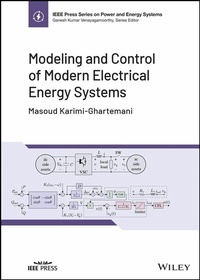
Modeling and Control of Modern Electrical Energy Systems
Description

A step-by-step approach to the modeling, analysis, and control of modern electronically controlled energy systems
In Modeling and Control of Modern Electrical Energy Systems, distinguished researcher Dr. Masoud Karimi-Ghartemani delivers a comprehensive discussion of distributed and renewable energy resource integration from a control system perspective. The book explores various practical aspects of these systems, including the power extraction control of renewable resources and size selection of short-term storage components.
The interactions of distributed energy resources (DERs) with the rest of the electric power system are presented, as is a discussion of the ability of the DER to ride through grid voltage faults and frequency swings. Readers will also discover how to derive mathematical models of different types of energy systems and build simulation models for those systems.
Modeling and Control of Electrical Energy Systems provides end-of chapter examples and problems, as well as:
* A thorough introduction to power electronic conversion, including power electronics and standard power electronic converters
* An in-depth treatment of feedback control systems, including frequency-domain (transfer function) approaches and time-domain (state space) approaches
* Comprehensive discussions of direct current DERs and single-phase alternating current DERs
* Fulsome explorations of three-phase distributed energy resources
Perfect for researchers, practitioners, and professors with an interest in electronically interfaced modern energy systems, Modeling and Control of Modern Electrical Energy Systems will also earn a place in the libraries of senior undergraduate and graduate students of electrical engineering.
More details
Other editions
Additional editions
Person
Masoud Karimi-Ghartemani, PhD, is a Professor in the Power and Control Group with the Electrical and Computer Engineering Department at Mississippi State University. He is a Senior Member of the IEEE and the author of Enhanced Phase-Locked Looped (EPLL) Structures for Power and Energy Applications.
Content
Author Biography xv
Preface xvii
Acknowledgments xix
Acronyms xxi
Symbols xxv
Introduction xxvii
Part I Power Electronic Conversion 1
1 Power Electronics 3
1.1 Power Electronics Based Conversion 3
1.2 Power Electronic Switches 4
1.3 Types of Power Electronic Converters 6
1.4 Applications of Power Electronics in Power Engineering 6
1.5 Summary and Conclusion 8
2 Standard Power Electronic Converters 11
2.1 Standard Buck Converter 11
2.2 Standard Boost Converter 20
2.3 Standard Inverting Buck-Boost Converter 24
2.4 Standard Four-Switch Buck-Boost Converter 26
2.5 Standard Bidirectional Converter 29
2.6 Single-Phase Half-Bridge VSC 30
2.7 Full-Bridge VSC 37
2.8 Three-Phase VSC 40
2.9 Modeling of Converter Delays 43
2.10 Summary and Conclusion 44
Part II Feedback Control Systems 49
3 Frequency-Domain (Transfer Function) Approach 51
3.1 Key Concepts 51
3.2 Open-Loop Control 56
3.3 Closed-Loop (or Feedback) Control 57
3.4 Some Feedback Loop Properties 67
3.5 Summary and Conclusion 69
4 Time-Domain (State Space) Approach 73
4.1 State Space Representation and Properties 73
4.2 State Feedback 76
4.3 State Estimator 78
4.4 Optimal Control 81
4.5 Summary and Conclusion 89
Part III Distributed Energy Resources (DERs) 93
5 Direct-Current (dc) DERs 95
5.1 Introduction 95
5.2 Overview of a Solar PV Conversion System 97
5.3 Power Control via Current Feedback Loop 100
5.4 Grid Voltage Support 113
5.5 Analysis ofWeak Grid Condition 133
5.6 Load Voltage Control 135
5.7 Grid-Forming Converter Controls 142
5.8 Control Scenarios in a PV Converter 152
5.9 LCL Filter 167
5.10 Summary and Conclusion 179
6 Single-Phase Alternating-Current (ac) DERs 181
6.1 Power Balance in a dc/ac System 181
6.2 Power Control Method via Current Feedback Loop (CFL) 183
6.3 Grid-Supportive Controls 204
6.4 dc Voltage Control and Support 219
6.5 Load Voltage Control and Support 235
6.6 DERs in a Hybrid ac/dc Network 243
6.7 Summary and Conclusion 244
7 Three-Phase DERs 249
7.1 Introduction 249
7.2 Three-Phase PLL 255
7.3 Vector Current Control in Stationary Domain 262
7.4 Vector Current Control in Synchronous Reference Frame 277
7.5 Grid-Supportive Controls 297
7.6 dc Side Voltage Control and Support 307
7.7 Load Voltage Control and Support 318
7.8 Summary and Conclusion 334
Problems 335
References 338
8 Summary and Conclusion 341
Index 345
Introduction
I.1 Electric Power System and the Need for Change
Electric power system (EPS) is the infrastructure to generate, transmit, and distribute electricity. The existing EPS is the largest and most complex man-made system. The bulk electricity is generated in large power plants in the form of alternating current (ac) using synchronous generators (or alternators). The ac voltage is then boosted using transformers and transmitted via long transmission lines. After transmission, the voltage levels are decreased and the electricity is used for various industrial, commercial, and residential applications. Electrification has been the greatest engineering achievement of the twentieth century [1].
I.1.1 Review of Operational Principles of EPS
The existing EPS has a hierarchical structure with central power plants generating the electricity and sending to users through the transmission system. The power flow is unidirectional from Generation to Distribution via Transmission.
- Generation
- A Power Plant is an industrial plant to generate bulk electric power.
- Dominant sources of bulk electric energy are fossil fuels (coal, natural gas, petroleum), nuclear reaction, and stored water. Corresponding turbine types are steam (for fossil fuels and nuclear) and hydro turbines.
- Popular generator is the three-phase synchronous generator (ac, 50 or 60 Hz).
- Unit Transformer steps up the voltage at the power plant.
- Transmission
- High-voltage overhead lines (ac voltage is boosted using transformers).
- Meshed network to increase reliability.
- Voltage is stepped down at transmission substations.
- Distribution
- Voltage is further lowered at distribution substations.
- Medium to low-voltage transmission lines; radial feeder topology; pole transformers (three-phase and single-phase low voltage end users).
- Industrial, commercial, and residential users.
- Residential applications: cooling; heating; lighting; refrigerating; washing; drying; entertainment; cooking; etc.
The EPS is highly interconnected: many generation and transmission systems are connected together to form a large pool of energy resulting in a highly reliable system. Maintenance of such a large interconnected ac system in terms of synchronized, stable operation, and protection of all components while preventing cascading failures is the everyday challenge of electric utility companies.
I.1.2 Problems with the Existing EPS
According to US Energy Information Administration (EIA) [2], about kWh of electricity was generated in United States in the year 2016.1 This caused a total emission of kg.2 Every kWh of electricity caused about 0.44 kg of emission. An average house in United States consumes about 900 kWh of electricity per month which corresponds to release of about 13 kg of per day, about 400 kg per month and about 4800 kg per year. This is a major problem with the existing EPS among several others summarized as follows.3
- Environmental impacts ( emission, impacts on nature, green-house effect)
- Unsustainable (ever increasing energy demand versus limited resources; dependence on oil market)
- Low generation efficiency (typical efficiency of coal, petroleum, and nuclear power plants being around 30% and that of natural gas plants around 40%)
- Transmission losses (amount to 5-10% of the total transmitted power)
- Maintenance (synchronization, stability, protection, and cascading failures in a large interconnected ac system in addition to the cost of infrastructure).
I.2 A Potential Solution: Renewable Integration
Renewable energy4 (from sources such as sun, wind, moving or stored water, etc.) can be converted to electricity. Only a small portion of the total energy in the solar rays reached to the earth is sufficient to supply our total energy demand [4, 5].
Dispersed or distributed generation systems are small generators interfaced with the distribution (low-voltage) or sub-transmission (medium-voltage) lines.
I.2.1 Examples of Distributed Generation Systems
- Renewable: Solar photovoltaic (dc), solar thermal, wind, tidal, micro hydro5
- Nonrenewable: Micro-turbines, diesel generators (DGs)6
Geothermal generators tap to the earth heat at locations that are susceptible for it.
Biomass generators burn biological materials from nature to generate steam.
Fuel Cell technology uses chemical reactions to generate electricity (dc).
I.2.2 Additional Benefits of Deploying Distributed Generation
- Reduce transmission loss.
- Reduce/defer transmission system expansions.
- Recovering the heat loss (combined heat power, CHP, systems).
- Participation of consumers in market (producing consumers: prosumers!).
- Autonomous (or islanded) operation of a section of distribution system: increased reliability and resilience.
- Offering ancillary services to the grid.
- Keeping the oil and gas prices more stable and lower for longer time.
- Lower dependence of power industry on oil and gas industry changes/uncertainties.
I.2.3 Technical Challenges with this Solution
Technical challenges arise when high level of distributed generation is integrated.
- Bidirectional power flow can substantially change the voltage profile. This will cause malfunctioning of voltage regulating devices. The transformer-based voltage regulators, capacitor banks, and protection equipment need to be properly upgraded and/or modified.
- The system's responses to faults change. This will require readjustment (of settings) and rearrangement (of locations) of relays and other protection devices.
- Grid stability problems due to uncertain and variable nature of renewable sources.
- Grid-scale battery energy storage (BES) systems may be required to address variable and uncertain nature of the renewable resources because the conventional generators have limited ramp up/down rates and cannot respond to those variations. The BES technology is not yet fully an economical and environmental-friendly technology at large.
- Islanding prevention (when the local EPS is unavailable, the distributed generators should not energize it).
- Coordination and control of high number of distributed generators.
There are also the regulatory and policy-related challenges which are not discussed here. For example, the regulation of possible ancillary services that the distributed generators can provide to the grid, given the wide range and variety of services that can be possible, is an ongoing challenge.
I.3 Microgrid
A microgrid (G) is a cluster of distributed energy resources (DERs) and loads that is connected to the grid at a single location [6]. The G can operate in grid-connected (GC) and in islanded mode. It may also operate in isolated mode without a grid connection. From our technical discussions, islanded and isolated conditions are often similar. Thus, the term standalone (SA) is used to describe this mode.
DER includes distributed generator, distributed storage, and distributed load [7].7 The G concept may be the key concept to address the aforementioned challenges.
I.3.1 Properties and Advantages of G
- When connected to the grid, the G performs as a controllable entity with controlled interaction with the rest of the grid. This interaction may be characterized as follows.
- Real and reactive power exchange
- Harmonic filtering
- Fault ride through and grid support (and ride through grid frequency swings)
- Grid stability support and improvement, frequency response
- Power quality aspects: harmonics, unbalance, flickers
- In SA mode, the G supplies power to its own loads. Major aspects are as follows.
- Voltage quality and stability
- Power management and power sharing
- The G makes seamless transition from GC to islanded and vice versa.
- The G concept can help realizing the smart grid functionalities such as demand response (DR) management.
Low rotating inertia of distributed generators is a possible concern. This will reduce the total inertia of the EPS and makes it susceptible to larger frequency swings. Low over-current capability and low over-load limit of power electronic switches are other issues that must be respected. For instance, a conventional induction motor requires high level of current to start.
In order to smooth down the variable generation of renewable sources, certain amount of nonrenewable distributed generation (such as diesel and gas turbine generators) and distributed storage resources should be included in a G. Distributed storage technologies include battery, ultra-capacitor, flywheel, pumped hydro, stored hydrogen, etc. Electronically controlled loads (e.g. active rectifiers and motor drives) may be considered among DERs as they can actively...
