

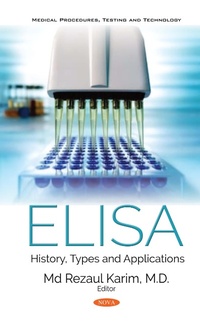
ELISA: History, Types and Applications
History, Types and Applications
Published on 1. October 2018
241 pages
978-1-5361-4394-2 (ISBN)
Description

ELISA: History, Types and Applications contains unique combinations of chapters in which the abstract of each chapter defines the work considered for the entire chapter. One of the essential goals of this book is to delineate vital information about different types of ELISA and their applications. The beginning chapter describes the history and background of enzyme-linked immunosorbent assay (ELISA), as well as the remarkable changes that were brought about by this technique. The chapter also describes the commercial application techniques used in food and diagnostic industries. The second chapter, on the other hand, describes various types of ELISA and their steps to perform ELISA. The third chapter discusses the practical applications and their mechanisms from theory. It also discusses possible multiple sources of error which can exist at each stage of the process; how to minimize the error; and the principles of data analysis. The fourth chapter discusses the applications of ELISA in various fields, which also include the uses of ELISA in the diagnosis of infectious diseases, parasitic diseases, and non-communicable disease caused by a variety of pathogenic microorganisms. While Chapters One to Four describe a detailed history, a variety of ELISA, their steps, their sources of application error, their solutions and their applications in different fields, the remaining chapters discuss more specific issues, including: The role of ELISA in advanced glycerin end products and their cell surface receptors in metabolic diseases, indirect ELISA for the diagnosis of Brucella Canis, ELISA based detection in cancer research, etc.
More details
Other editions
Additional editions

Book
09/2018
Nova Science Publishers Inc
€276.30
Shipment within 15-20 days
Content
- Intro
- Contents
- Preface
- Acknowledgments
- Acronyms
- Chapter 1
- Chapter 2
- Chapter 3
- Chapter 4
- Chapter 5
- Chapter 6
- Chapter 7
- Chapter 8
- Chapter 1
- The History and Background of Enzyme-Linked Immunosorbent Assay
- Abstract
- Introduction
- Methods
- History and Background
- Coating/Capture
- Plate Blocking
- Probing/Detection
- Signal Measurement
- Immunoassay
- Competitive and Noncompetitive
- Homogenous and Heterogeneous
- Important Components in Immunoassay
- Antibody (Antiserum)
- Antigen and Hapten
- Polyclonal Antibody and Monoclonal Antibody
- Typical Steps of an ELISA
- Indirect Detection
- Signal Output and Assay Performance
- Factors Affecting Assembly of the Immune Complex
- Types of Plate and Coupling Options
- Antibodies
- Blocking Buffer
- Target Antigen
- Enzyme Conjugate
- Washing the Plate
- Substrates and Signal Detection
- Quantitative
- Qualitative
- Semi-Quantitative
- References
- Chapter 2
- Types of Enzyme-Linked Immunosorbent Assays
- Abstract
- 1. Introduction
- 2. Methods
- 2.1. Classification
- 2.1.1. Classification According to the Solid-Phase Carrier Material
- 2.1.1.1. Microplate ELISA
- 2.1.1.2. Double Antibody Sandwich Method
- 2.1.1.3. Two-Site One-Step Method
- 2.1.1.4. Double Sandwich ELISA
- 2.1.1.5. Double-Antigen Sandwich Method
- 2.1.1.6. Competition ELISA
- 2.1.1.7. Capture Method
- 2.1.1.8. Blocking Method
- 2.2. Dot-ELISA
- 2.3. Cloth-ELISA (C-ELISA)
- 3. Classification Based on Reaction Process
- 3.1. The Direct Method
- 3.2. Indirect Method
- 4. ELISA Coupled with Other Techniques
- 4.1. ELISA Using Avidin and Biotin
- 4.2. PCR-ELISA
- 4.3. Monoclonal Antibody Capture ELISA
- References
- Chapter 3
- ELISA: From Theory to Practice
- Abstract
- Introduction
- Methods
- Theory to Practice
- Choosing an ELISA Type
- Direct ELISA
- Indirect ELISA
- Sandwich ELISA
- Competitive ELISA
- ELISA Components and Considerations
- Plates
- Buffers
- Coating Buffer
- Washing Buffer
- Blocking Buffer
- Antibodies
- Antibody-Antigen Complexes
- Monoclonal Antibodies and Matched Pairs
- Polyclonal Antibodies
- Sampling, Handling, Preparation
- Dilution
- Washing
- Enzyme-Substrate Combinations
- ELISA Optimisation
- Coating Buffer
- Blocking Buffer
- Sample Concentration
- Detection Antibody
- Enzyme Conjugate
- Troubleshooting
- References
- Chapter 4
- Application of Enzyme-Linked Immunosorbent Assay
- Abstract
- Introduction
- Methods
- Application
- ELISA and Clinical Medicine
- ELISA Detection of Antigens and Haptens
- ELISA Detection Antibody
- ELISA and Veterinary Medicine
- ELISA and Animal Epidemic Disease Detection
- ELISA and Veterinary Drug Residue Detection
- Tetracycline Drug Detection
- Chloramphenicol Drug Detection
- Nitrofurans Drug Detection
- Detection of Sulfonamides
- Hormone Drug Detection
- ELISA and Plant Resources
- ELISA and Food Safety
- Detecting Pesticide Residues in Food
- Detection of Pathogenic Microorganisms in Food
- Detecting Biological Toxins in Food
- Detecting Illegally Added Substances in Food
- Detection of Transgenic Foods
- Detection of Allergens
- ELISA and Basic Medicine
- ELISA and Environmental Testing
- References
- Chapter 5
- Enzyme-Linked Immunoassay, Advanced Glycation End Products, and their Cell Surface Receptor in Metabolic Diseases
- Abstract
- Introduction
- Methods
- Enzyme-Linked Immunoassay in an AGE/RAGE Axis
- AGEs and Their Formation
- Dietary AGEs
- AGE Damage Mechanism
- Receptor-Independent Mechanism
- Receptor-Dependent Damage
- ELISA as the Main Technique for AGE Assay in Clinical Research
- dAGE Measurement
- AGE Role in Metabolic Diseases
- Healthy Subjects
- Cross-Sectional Studies
- Clinical Trials
- Renal Disease
- Diabetes Mellitus
- Subjects with Obesity and Cardiometabolic Risk
- Conclusion
- References
- Chapter 6
- The Development of an Indirect ELISA Test for the Diagnosis of Brucella canis
- Abstract
- Introduction
- Methods
- Development of Indirect-ELISA test
- Preparation of Antigen
- Indirect Enzyme-Linked Immunosorbent Assay (I-ELISA)
- Determination of Cut-Off Value
- Blood Serum Sample
- Testing of Developed I-ELISA Test
- References
- Chapter 7
- The Key Role of Immunoassay Based Detection in Cancer Research
- Abstract
- Introduction
- Methods
- Immunoassay Based Detection in Cancer Research
- Immunomolecular Markers for Hematologic Malignancies
- Acute Lymphoblastic Leukemia
- Circulating Ki-67 for Prognosis
- Circulating Soluble LR11 Levels are Highly Increased in Acute Leukemias
- Acute Myeloid Leukemia
- Soluble Urokinase Plasminogen Activator Receptor (suPAR) for Diagnosis and Monitoring of Treatment in Patients with Hematologic Malignancies
- Chronic Lymphocytic Leukemia
- CD44 and IFN-?
- Progranulin
- Hodgkin Lymphoma
- CD83 As a New Potential Biomarker and Therapeutic Target for Hodgkin Lymphoma
- ARg-1
- Galectin-1, Tumor Burden and Adverse Clinical Features
- Non-Hodgkin Lymphoma
- Soluble Interleukin-2 Receptor Levels in Serum of Patients with Hematological or Non-Hematological Malignancies
- Multiple Myeloma
- Angiopoietin-2
- Conclusion
- Immunoassay Approaches in Solid Tissue Malignancies
- Breast Cancer
- Serum Markers
- Hepatocellular Carcinoma
- Serum Markers
- Pancreatic Cancer
- Serum Markers
- Gastric Cancer
- Serum Markers
- Esophageal Cancer
- Serum Markers
- Colorectal Cancer
- Serum Markers
- Future Trends: Mass Spectrometry and ELISA
- References
- Chapter 8
- Enzyme-Linked Immunosorbent Assay for the Detection of Helicobacter pylori
- Abstract
- Introduction
- Methods
- Detection of Helicobacter pylori
- References
- About the Editor
- Index
- Blank Page
