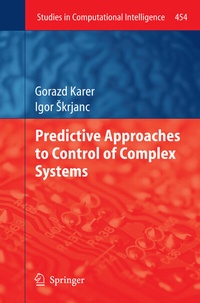
Predictive Approaches to Control of Complex Systems
Description

A predictive control algorithm uses a model of the controlled system to predict the system behavior for various input scenarios and determines the most appropriate inputs accordingly. Predictive controllers are suitable for a wide range of systems; therefore, their advantages are especially evident when dealing with relatively complex systems, such as nonlinear, constrained, hybrid, multivariate systems etc. However, designing a predictive control strategy for a complex system is generally a difficult task, because all relevant dynamical phenomena have to be considered. Establishing a suitable model of the system is an essential part of predictive control design. Classic modeling and identification approaches based on linear-systems theory are generally inappropriate for complex systems; hence, models that are able to appropriately consider complex dynamical properties have to be employed in a predictive control algorithm.
This book first introduces some modeling frameworks, which can encompass the most frequently encountered complex dynamical phenomena and are practically applicable in the proposed predictive control approaches. Furthermore, unsupervised learning methods that can be used for complex-system identification are treated. Finally, several useful predictive control algorithms for complex systems are proposed and their particular advantages and drawbacks are discussed. The presented modeling, identification and control approaches are complemented by illustrative examples. The book is aimed towards researches and postgraduate students interested in modeling, identification and control, as well as towards control engineers needing practically usable advanced control methods for complex systems.
Reviews / Votes
"The book deals with the theoretical background of predictive control approaches for complex systems, as well, as for application of developed control methods to batch reactors. . The book is dedicated to both researchers and practitioners working on advanced control methods for complex systems who are interested in the application of soft computing methods in the framework of predictive control." (Krzysztof Galkowski, zbMATH 1311.93001, 2015)
More details
Other editions
Additional editions