

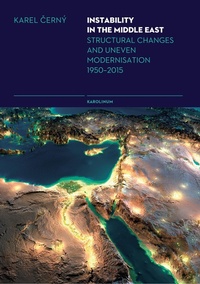
Instability in the Middle East
Structural Causes and Uneven Modernisation 1950-2015
Published on 15. October 2019
224 pages
978-80-246-3191-2 (ISBN)
Description

Middle Eastern instability is manifest externally in many ways: by crises afflicting governing regimes, the rise of political Islam, terrorism, revolution, civil war, increased migration, and the collapse of many states. This book examines the roots of this instability using a theoretically original and empirically supported historical-sociological comparative analysis. Countering common interpretations of postcolonial Middle Eastern development, Instability in the Middle East focuses on the highly uneven and unsynchronized pace of change in individual sociodemographic, economic, and political dimensions of modernization. Drawing on the theory of multiple modernities, Cerný investigates the broader cultural, religious, and international political context of uneven modernization in the Middle East and tests his model using a time series of dozens of indicators over the past fifty years, revealing a long-term trend of cumulative change across the region.
More details
Other editions
Additional editions
Book
11/2017
Karolinum,Nakladatelstvi Univerzity Karlovy,Czech Republic
€29.00
Available (delivery time upon request)
Persons
Content
- Cover
- CONTENTS
- INTRODUCTION: CHRONIC INSTABILITY IN THE MIDDLE EAST
- Modernisation as the cause of instability in the Middle East - too slow or too fast?
- Creating an alternative theoretical model: uneven modernisation and its context
- A new theoretical model of modernisation in the Middle East
- Four possible macro comparisons of the Middle Eastern pattern of modernisation
- Operationalisation of the model of uneven modernisation and sources of empirical data
- From the macro-level of structures to the micro-level of actors and their actions: mechanisms of destabilisation
- Methodological, terminological and personal observations
- POLITICAL MODERNISATION: WEAK AND AUTHORITARIAN STATES
- Frozen political modernisation in an international comparison: the democratic deficit
- Regional comparison: the democratic deficit of Middle Eastern regimes
- The second dimension of political modernisation: a weak state and a governance deficit
- The character of Middle East regimes and the character of political repertoires of contention
- Political regimes and political repertoires: a weak authoritarian state, revolution and terrorism
- (1) The birth of political actors: mass political participation and rigid political systems
- (2) The discrepancy between preferences and reality: the desire for democracy, prosperity and conservative morals
- (3) The discrediting of unscrupulous dictators, the invention of tradition and the moralising drive of Islam
- (5) The current conflict as a continuation of history
- (6) The decline of secular doctrines: an ideological vacuum and Islam as an alternative
- (7) The chronic crisis of the legitimacy of regimes: the career of Middle Eastern ideologies
- (8) The turn to religion: official Islam and the risky strategy of regimes
- (9) Domesticated clerics and the decline of the traditional religious authorities
- (10) Oil rent, the power pyramid and the socio-economic alienation of regimes
- (11) The cultural alienation of westernised regimes: cultural decolonisation
- (12) Clientelism and the alienation of the regime from the rest of the population
- (13) Military clientele: co-opting of the army, polarisation of society
- (14) Terrorism as the continuation of politics by other means
- ECONOMIC MODERNISATION: VOLATILE AND DISTORTED
- Oil rent and distorted economic development: the Dutch disease
- International comparison: the Middle East and other macroregions
- Regional comparison of Middle Eastern countries: a two-speed region
- Rapid economic development as a possible factor in political destabilisation
- The model's application to the post-colonial Arab world: oil rent versus neoliberal reforms
- The international context: the food crisis and political destabilisation
- POPULATION EXPLOSION: THE MIDDLE EAST AND ITS ABANDONED YOUNG PEOPLE
- International comparison: the Middle East and other world macroregions
- Regional comparison: a comparison of Middle Eastern countries
- Young people caught in the trap of uneven modernisation: divergence in the rate of demographic, economic and political change
- A historical comparison of the demographic revolution: Europe past and the Middle East present
- (1) Rebellious youth: identity crisis, intergenerational conflict and adolescence
- (2) The leisure of the "Arab street": a blessing or a curse?
- (3) The attitudes and aspirations of young people on the eve of revolution: the conflict between hopes and reality
- (4) A lost generation: the population dynamic versus a collapsing labour market
- (5) Demographic marginalisation and the marriage crisis
- (6) The generational alienation of the power elite: the old cadres versus the young population
- (7) The uneven population growth of different groups within a heterogeneous state
- THE MEDIA REVOLUTION: THE MIDDLE EAST AS A RELIGIOUS MARKETPLACE
- The media revolution: an international and regional comparison
- The media revolution: a historical comparison. Modernisation in the era of the global village
- (1) The birth of public opinion: the masses discover politics
- (2) The mobilisation and coordination of collective action: the case of the Arab Spring
- (3) A shrinking world I: consumer aspirations and the revolution of growing expectations
- (4) A shrinking world II: visible domestic inequality
- (5) A shrinking world III: the Turkish model and other reference countries
- (6) The shrinking Arab world: the democratising effect of Al-Jazeera and the revolutionary domino
- (7) The media at the service of opposition political Islam
- (8) The religious market and the erosion of traditional authorities: the struggle over how to interpret Islam
- (9) Pluralism and fundamentalism
- THE EXPANSION OF EDUCATION: THE MIDDLE EAST AND THE "LUMPENINTELLIGENTSIA"
- The development of education: an international comparison
- Regional comparison of the development of education in Middle Eastern countries
- (1) Educational problems: poor quality and growing inequality as evidence of the failure of regimes
- (2) The awakening of political awareness and the failing Middle Eastern panopticon
- (3) The boomerang effect of religious education: the Islamic revival and a culture of interpretation
- (4) Secondary school political chemistry: the reaction of disgruntled teachers and students
- (5) Universities as centres of opposition
- (6) The battle over the interpretation of Islam: the loss of the monopoly of traditional authorities and the arrival of new interpreters
- (7) Counter-productive reactions on the part of regimes: I speak in the name of Islam - I have power
- (8) The westernised mindset and the creolisation of Islam: Western ideology and the invention of tradition
- (9) Growth in aspirations and the unemployed "lumpen-intelligentsia"
- (10) The alienation and radicalisation of the intelligentsia
- THE BOOM IN MEGACITIES: A WHIRLWIND OF URBANISATION IN THE MIDDLE EAST
- Urbanisation Middle Eastern-style: international and historical comparison
- Urbanisation and uneven modernisation
- Urbanisation and (non)secularisation: European past, Middle Eastern present
- (1) Unmanageable urbanisation: discredited regimes and their doctrine of development
- (2) Spatial concentration: the potential for political agitation, organisation and mobilisation
- (3) Urban unemployment: voluntary simplicity instead of revolution?
- (4) Shrinking of the social world: visible inequality and the resistance of socially sensitive Islam
- (5) Urban and rural poverty: new reference groups, new aspirations
- (6) Islamic charity and civil society: the urban middle classes and the poor as clients
- (7) The crisis of the overburdened urbanised family: the conservative reaction
- (8) A threatening urban environment and Islamic feminism
- (9) Intergenerational alienation: the decline in the authority of rural parents and the search for surrogates
- (10) Radicalisation of the second and third generation of migrants
- (11) The city as the modern jahiliyyah: the epitome of moral turpitude
- (12) The traditional bipolarity of urban and rural Islam: a disturbed balance
- (13) Peasants into Islamists: socialising functions and surrogate rural communities
- (14) From folk to political Islam: ideological functions and an orientation for the disoriented
- CONCLUSION
- Four macro-comparisons of modernisation patterns and chronic instability in the Middle East
- Mechanisms of destabilisation: from macro to micro, from structures to actors
- REFERENCES
- LIST OF FIGURES AND TABLES
- INDEX
