

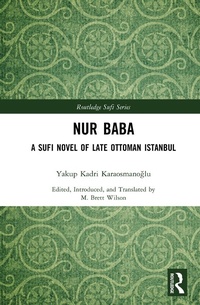
Nur Baba
A Sufi Novel of Late Ottoman Istanbul
1st Edition
Published on 23. June 2023
136 pages
978-1-000-87618-5 (ISBN)
Description

This first-ever English translation of Nur Baba - a classic of modern Turkish literature written by Yakup Kadri Karaosmanoglu - offers a unique window into Sufi lodges, social dilemmas, and intellectual life in early twentieth-century Istanbul.
Inspired by Karaosmanoglu's personal experiences with Islamic mystical orders, it is a story of illicit romance and spiritual inquiry, depicting a colourful lodge of Sufi dervishes led by a charismatic, yet morally suspect, spiritual master named Nur Baba. The plot follows his attempts to seduce an attractive married woman from an elite family and recounts her dramatic experiences in the life of a Sufi community. The setting shuttles between the grand mansions of Istanbul's elite families and a Sufi lodge where rich and poor intermingle. Exploring questions of gender, morality, and religious bias throughout, it captures the zeitgeist of early twentieth-century modernist thinkers who criticised Sufism for impeding social progress and debated the public roles of women in a rapidly modernising society.
Alongside the editor's meticulous translation, the volume includes a scholarly introduction, maps, and images, as well as explanatory footnotes that will aid both students and scholars alike. The novel will be of particular interest to those studying world literature, Sufi studies, and Ottoman-Turkish history.
Inspired by Karaosmanoglu's personal experiences with Islamic mystical orders, it is a story of illicit romance and spiritual inquiry, depicting a colourful lodge of Sufi dervishes led by a charismatic, yet morally suspect, spiritual master named Nur Baba. The plot follows his attempts to seduce an attractive married woman from an elite family and recounts her dramatic experiences in the life of a Sufi community. The setting shuttles between the grand mansions of Istanbul's elite families and a Sufi lodge where rich and poor intermingle. Exploring questions of gender, morality, and religious bias throughout, it captures the zeitgeist of early twentieth-century modernist thinkers who criticised Sufism for impeding social progress and debated the public roles of women in a rapidly modernising society.
Alongside the editor's meticulous translation, the volume includes a scholarly introduction, maps, and images, as well as explanatory footnotes that will aid both students and scholars alike. The novel will be of particular interest to those studying world literature, Sufi studies, and Ottoman-Turkish history.
Reviews / Votes
"Brett Wilson's skillful translation of Yakup Kadri's Nur Baba, a rather orgiastic and sensational story of temptation, love, and betrayal that unfolds around an Istanbul dervish convent, provides us with an exquisite example of late-Ottoman-Turkish Orientalism. Accompanied by an insightful introduction to the text and its author, it offers a critical gaze into the modernist perspective of its nationalist author. Students of modern Turkish history, Sufism, Religious as well as Islamic studies will be thankful for this book."Markus Dressler, Heisenberg Professor for Modern Turkish Studies at the Institute for the Study of Religion, University of Leipzig, Germany
"It has long been known to specialists that the novel Nur Baba provided a unique window onto the world of late Ottoman Sufism, not only as an expression of its inner culture, but also as an expose made more sensational by its realistic treatment. This tale of Bektashi dervishes is said to have encouraged Mustafa Kemal's crackdown that banned Sufi lodges throughout the new secular nation of Turkey in 1925. Brett Wilson has provided the first English translation of this important text, a carefully crafted version which will be welcomed by new audiences today."
Carl Ernst, Kenan Distinguished Professor Emeritus, University of North Carolina at Chapel Hill, United States
"A delight to the eye, Nur Baba is also a feast for the mind. Translated into English for the first time by a skilled Ottomanist, this modern classic of Turkish literature reveals critiques about Sufism but also gives context to persistent stereotypes about religious minorities in turn-of-the-century Istanbul. With useful footnotes in abundance, Brett Wilson has produced a lively text ideal for the classroom, whether the topic is Turkish history, Ottoman literature or Sufi orders at once under threat yet resilient."
Bruce Lawrence, Nancy and Jeffrey Marcus Humanities Distinguished Professor Emeritus of Religion, Duke University, United States
"With this demanding translation, enriched with an introduction and annotations, Brett Wilson gives for the first time the English-speaking reader access to a central text of early twentieth-century Turkish literature. He thus offers access to a source that allows us to understand how an author from the very end of the Ottoman era works on the question of Sufism in a rapidly changing and nationalizing Ottoman-Turkish society, through the prisms of gender and emotions. An important work in many aspects for Ottoman-Turkish studies, as well as for Sufi studies."
Natalie Clayer, Professor, CETOBaC, CNRS-EHESS-College de France, France
More details
Series
Edition
1. Auflage
Language
English
Place of publication
London
United Kingdom
Publishing group
Taylor & Francis Ltd
Target group
College/higher education
Product notice
Reflowable
Illustrations
7 Halftones, black and white; 7 Illustrations, black and white
ISBN-13
978-1-000-87618-5 (9781000876185)
Copyright in bibliographic data and cover images is held by Nielsen Book Services Limited or by the publishers or by their respective licensors: all rights reserved.
Schweitzer Classification
Other editions
Additional editions
Yakup Kadri Karaosmanoglu | M. Brett Wilson (Editor and Translator)
Nur Baba
A Sufi Novel of Late Ottoman Istanbul
Book
11/2024
1st Edition
Routledge
€62.60
Shipment within 10-20 days
Yakup Kadri Karaosmanoglu | M. Brett Wilson (Editor and Translator)
Nur Baba
A Sufi Novel of Late Ottoman Istanbul
Book
06/2023
1st Edition
Routledge
€195.50
Shipment within 10-20 days
Persons
Yakup Kadri Karaosmanoglu (1889-1974) figures among the most prominent Turkish novelists and writers of the twentieth century. Born in Cairo to a prestigious family, Karaosmanoglu lived through the turbulent transition from empire to nation-state in the early twentieth century and emerged as a prominent author with an uncanny ability to capture the zeitgeist through fiction. His early novels probe the social crises and tensions of the late Ottoman Empire and the early years of the Turkish republic. In addition to being a prominent public intellectual, he served several terms as a member of parliament and worked for the Ministry of Foreign Affairs at a number of diplomatic postings.
M. Brett Wilson is Associate Professor of History at Central European University and the Director of the Center of Eastern Mediterranean Studies. He is the author of Translating the Qur'an in an Age of Nationalism: Print Culture and Modern Islam in Turkey (Oxford University Press, 2014).
M. Brett Wilson is Associate Professor of History at Central European University and the Director of the Center of Eastern Mediterranean Studies. He is the author of Translating the Qur'an in an Age of Nationalism: Print Culture and Modern Islam in Turkey (Oxford University Press, 2014).
Content
Introduction 1. How is the candle put out in a Bektashi lodge? 2. How is a Bektashi Shaykh Raised? 3. How is an outsider guided in? (Part I) 4. How is an outsider guided in? (Part II) 5. Two White Moths Circling around Haji Bektash's Candle 6. An Unprecedented Ceremony in the Lodge of Nur Baba (Part I) 7. An Unprecedented Ceremony in the Lodge of Nur Baba (Part II) 8. The Second Period of Guidance 9. Completely Smitten by Muhabbet 10. The Woman with No Voice 11. That World, Yet Again 12. The Beloved Asked for the Soul
