

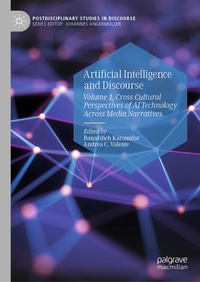
Artificial Intelligence and Discourse
Description

This book is the first volume in the two-volume set Artifical Intelligence and Discourse . It examines how Artificial Intelligence (AI) is represented, debated, and imagined across diverse cultural contexts and global media. With contributions from eight countries, it explores how language, images, and stories shape public understanding of AI, professional identities, and visions of the future. Organised into three sections, the chapters move beyond utopian and dystopian views, analysing AI through metaphors, symbolic narratives, and collective imaginaries in news, literature, education, and the job market, while interrogating power, ideology, and governance. Case studies range from Australian moral panics in education to Brazilian radical ideologies, Romanian science-fiction legacies, Irish media framings, and the utopian construction of the "prompt engineer". Using methods from the humanities and social sciences-critical discourse analysis, multimodal analysis, and comparative studies-this volume offers perspectives for researchers, educators, and students interested in technology, media, culture, and society.
Reviews / Votes
"This volume offers a unique, cross-cultural approach to AI representations. Contributors show how myths and metaphors influence global imaginaries of AI through case studies ranging from Australian media debates to Brazilian radical ideologies and Romanian science-fiction legacies. Using critical discourse analysis, multimodal analysis, and comparative studies, contributors highlight cultural specificity while questioning reductive utopia/dystopia frameworks. This volume is a valuable resource for researchers and students in media, communication, and discourse studies." (Razvan Saftoiu, Universitatea Transilvania din Bra?ov, Romania)
More details
Other editions
Additional editions
Persons
Banafsheh Karamifar is Assistant Professor of Linguistics and French as a Second Language at Laurentian University, Canada, and Adjunct Professor at the University of Ottawa, Canada. Her research bridges critical discourse analysis, semantics, cultures and societies, with a current focus on AI and Generative AI as discursive and socio-technical artefacts.
Andrea C. Valente is an educator, researcher, and consultant in higher education as well as a Lecturer in the Faculty of Education at York University, Canada. Her work sits at the intersection of neuro-humanities, pedagogy, applied linguistics, and generative AI, examining how emerging technologies transform teaching, learning, and knowledge production.
Content
Introduction.- Section I: AI through Metaphorical and Symbolic Narratives.- Chapter 1: Generative Artificial Intelligence in Education: Media Discourses in Australian Media (Renee Morison).- Chapter 2: Antigone facing machine power. Figurative representations of threats and expectations to AI in Estonian context (Marge Käsper, Anneil Saro & Merje Miliste).- Chapter 3: AI Through a Bilingual Lens: Unveiling Metaphorical Narratives in Italian and English AI Discourses (Barbara Gabriella Renzi).- Section II: AI Governmentality, Ideologies and Cultural Discourses.- Chapter 4: Artificial Intelligence, what rhetoric of prudence in AI discourse? (Karine Colette).- Chapter 5: Radical Ideologies in Brazil as Discourses Enhancing Toxic Biases and Anti-Democratic Values in GenAI (Paulo Quadros).- Chapter 6: Narrative Construction and Discursive Representation of Artificial Intelligence in Romanian (Onoriu Colacel).- Chapter 7: Mapping the Discursive Landscape: A Critical Discourse Analysis of AI Perspectives in Irish Journals (Najla Lilya Jaballah).- Section III: AI and Collective Imaginaries.- Chapter 8: Modern Mythologies: Construction of Contemporary Mass Media Representations of the Artificial Intelligence (AI) (Ionel Barbalau).- Chapter 9: Time and Artificial Intelligence: the construction of future by newsmagazines (Emília Araújo, & Pedro Eduardo Ribeiro).- Chapter 10: Liberal Arts Wizards: The utopian construction of prompt engineer as dream job in 2023 media (Theodore Bonnah).- Conclusion.
