

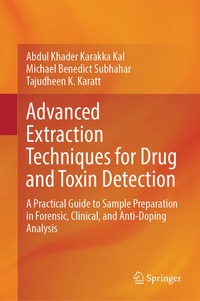
Advanced Extraction Techniques for Drug and Toxin Detection
Description

Advanced Extraction Techniques: Anti-Doping & Forensic Approaches for Drug Testing delivers a comprehensive and practical guide to the modern extraction strategies essential for detecting drugs and toxic agents in complex biological matrices. Emphasizing the foundational role of sample preparation, this book shows how carefully optimized extraction methods shape the accuracy, sensitivity, and legal defensibility of toxicological results across forensic, clinical, and anti-doping environments.
The book explores a broad range of biological specimens, from routine matrices such as blood, urine, and plasma to alternative samples including hair, oral fluid, nails, vitreous humor, and meconium. It also addresses key analytical challenges such as matrix effects, protein binding, phospholipid interference, and analyte instability. Readers gain clear insight into how extraction influences downstream performance in LC-MS/MS and other related techniques.
Key highlights include:
· Comprehensive discussion of liquid-liquid extraction, solid-phase extraction, microextraction techniques etc.
· Practical guidance for enhancing detection of amphetamines, antihistamines, NSAIDs, corticosteroids, anabolic steroids, peptides, bisphosphonates, ITPP, and quaternary ammonium drugs
· Detailed workflows that connect extraction decisions to robust analytical outcomes.
· Focused coverage of anti-doping applications aligned with international testing and accreditation standards.
Ideal for forensic toxicologists, analytical chemists, pharmacologists, anti-doping specialists, and graduate students, this volume bridges scientific principles with applied practice. By demonstrating how optimized extraction boosts analytical reliability, reduces variability, and extends detection windows, the book strengthens the scientific foundation of forensic investigations, clinical diagnostics, public health monitoring, and sports medicine.
More details
Other editions
Additional editions
Persons
Dr. Abdul Khader Karakka Kal is a senior researcher and Head of the Scientific Research Section at the Equine Forensic Unit, Central Veterinary Research Laboratory, Dubai. He holds a Ph.D. in Chemistry and brings nearly twenty years of experience in analytical chemistry, forensic toxicology, discovery chemistry, and anti-doping science. His work focuses on improving the detection of drugs and emerging performance-enhancing substances in biological samples. Dr. Karakka Kal has authored over 40 peer-reviewed publications in high-impact journals, several of which have been recognized as Top Cited Articles. His research includes the development of advanced extraction methods, mass spectrometric applications, and metabolic investigations of novel performance-enhancing substances. His expertise uniquely positions him to bridge the gap between method development and real-world forensic and anti-doping applications. By combining deep technical knowledge with practical laboratory leadership, Dr. Kal brings a comprehensive perspective to advancing extraction techniques for forensic and clinical toxicology.
Dr. Michael Subhahar serves as Chief Analyst at the Equine Forensic Unit, Central Veterinary Research Laboratory, Dubai, bringing over 30 years of expertise in forensic racing chemistry. He earned his Ph.D. in Forensic Science from the University of Central Lancashire, U.K., and specializes in method development, screening, detection, and confirmatory analysis of performance-enhancing substances in horses and camels. Dr. Subhahar manages a team analyzing more than 13,500 racehorse samples annually using advanced LC/MS, GC/MS, ICP/MS, and QTOF-MS platforms. He has been instrumental in establishing anti-doping laboratories, including the Camel Forensic Laboratory, and has led pioneering research on metabolic studies in race animals. His scholarly contributions include over 25 peer-reviewed publications in Rapid Communications in Mass Spectrometry , Drug Testing and Analysis , and Journal of Analytical Toxicology . A Fellow of the Association of Biomedical Scientists and a member of the Association of Official Racing Chemists, Dr. Subhahar is internationally recognized for advancing doping control in veterinary sports.
Dr. Tajudheen K. Karatt is an accomplished scientist with over 19 years of expertise in Racing Chemistry and Discovery Drug Chemistry. He currently serves as Deputy Technical Manager at the Equine Forensic Unit, Central Veterinary Research Laboratory, Dubai, where he oversees technical and scientific operations, and leads analytical method development, validation, and forensic research. Dr. Karatt holds a Ph.D. in Chemistry from Bharathidasan University, India and has a distinguished academic record, earning First Rank and Gold Medals in both his bachelor and master degree in Industrial Chemistry. His professional journey includes significant roles at Biocon- Bristol Myers Squibb Research Center in India, where he specialized in medicinal and synthetic chemistry before transitioning to forensic analytical science in the UAE. Dr. Karatt is a Professional Member of the Association of Official Racing Chemists (AORC) and has contributed to over 30 research publications in reputed international journals. His career is marked by numerous awards, international trainings, and certifications, making him a recognized leader in his field.
Content
Chapter 1 Introduction.- Chapter 2 Forensic Toxicology: Bridging Science, Law, and Public Health.- Chapter 3 Doping In Sport: History, Regulation, and Global Governance.- Chapter 4 The Prohibited Framework: Ensuring Safety and Fair Competition.- Chapter 5 Introduction to Biological Matrices in Forensic Science.- Chapter 6 Extraction Techniques In Forensic Toxicology.- Chapter 7 Comparative Case Studies On Extraction Methods For LC-MS and GC-MS Detection In Forensic Doping Control.
