

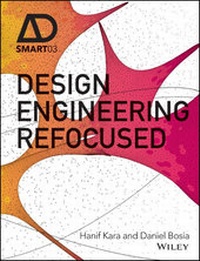
Design Engineering Refocused
Description

More details
Other editions
Additional editions
Persons
Hanif Kara is Design Director and co-founder of AKT II, the award-winning London-based firm of structural and civil engineering consultants. Hanif combines practice with teaching. He is Professor in Practice of Architectural Technology at the Harvard Graduate School of Design. He is a fellow of the RIBA, ICE, RAE and IStrcutE. He is on the board of trustees of the Architecture Foundation, member of the BCO Technical Affairs Committee and formerly a CABE Commissioner.
Daniel Bosia is Director at AKT II, where he heads up the specialist team P.art® (parametric applied research team), which develops bespoke software programs to manipulate and test forms and structures. Daniel is a qualified structural engineer with an MSc in Structural and Bridge Engineering and a Masters in Architecture. He was formerly head of the Advanced Geometry Unit at Arup. He is Diploma Unit Tutor at the Architectural Association in London and Honorary Professor at the Department of Architecture and Media Technology in Aalborg.
Content
1 THE PINK NOISE' OF DESIGN ENGINEERING
HANIF KARA
The boundary and border of architecture and structural engineering have traditionally been defined by a linear and hierarchical correspondence between the two disciplines. Professionalisation of both disciplines has created a pre-articulated routinisation of the practices and distinct processes where the architect develops insights in design, while the structural engineer is granted exclusivity to react only once the design is developed. Today both are required to develop new skills and competences if they are to survive. In response to cultural and technological developments in the last twenty years, this relationship has evolved significantly, changing economic orders (where rising wealth has increased the importance of aesthetics) and, more recently, presenting new opportunities to question 'planned obsolescence' of buildings through the reshaping of design disciplines.
1 AKT II, birth of the structural engineer (c 1800).
Birth of the structural engineer and their position in the wider spectrum of architectural design discipline and history (which transcends our discipline).
The complex, changing relationship between the two disciplines cannot be explained easily, and any historical appraisal of the shifts could start in many places; we must therefore select the starting point of such a narrative carefully. Over the last century, the most compelling spark to questions concerning the dichotomy between 'architect' and 'engineer' as designers came from Le Corbusier in 1927, when many believe he asserted that the process of engineering should drive the development of architecture:
'Engineers make architecture, since they use calculations that issue from the laws of nature, and their works make us feel HARMONY. So there is an aesthetic of the engineer, because when doing calculations, it is necessary to qualify certain terms of the equation, and what intervenes is taste. Now when one does calculations, one is in a pure state of mind and, in that state of mind, taste follows reliable paths.'1
While one cannot agree with all of the implications inherent in Le Corbusier's prescient statement, it was a strong encapsulation of the prevailing feelings of the time, and we can clearly trace their trajectory and legacy through the Modern and Post-Modern architectural movements, as exemplified by influential figures such as Ludwig Mies van der Rohe, Louis Kahn, Tadao Ando and Team 4 (Norman Foster, Richard Rogers, Su Brumwell and Wendy Cheesman), who each pushed for greater parity and collaboration between the two disciplines.
In subsequent decades, this cultural realignment was reinforced by profound changes in the field of structural analysis. Despite the crippling effects of the Second World War slowing progress in many areas of construction, a significant turning point occurred with the birth of the first threads of 'limit state methods'. Driven by the greatly reduced availability of materials post-war, early experimental work in structural engineering conclusively demonstrated that analysis of stresses computed with simple elastic theory was far removed from how structures behaved, and from this emerged the concept of 'plastic limit states' that would erode and, in some instances, decompose factors of safety.
2 AKT II, evolution of reinforced-concrete design codes of practice. These codes have evolved since 1930, they assess how factors of safety, combined with new analysis, allow the reuse of old structures.
Though the gulf between the design of steelwork and reinforced-concrete structures remained, limit state methods advanced both materials. Notably in the UK between 1936 and 1948, the engineer John F Baker developed plastic theory for the design of steelwork, indeed it was used for the design of Morrison shelters during the war. While these methods are no longer used for simple structures today, the principles can be used for any buildings.
Meanwhile, in 1955 in the USSR, Professor NS Streleski developed methods of limit state design2 that led to the introduction of the first codes in reinforced-concrete design using ultimate limit state method to reduce safety factors in concrete states (Figure 2). And, though not widely used until 1965, this has led to economical structural designs.
Such advances inspired new confidence that can be seen in the work of a long line of engineers since then; people such as Ove Arup, Ted Happold, Felix Samuely, Tony Hunt and Fazlur Khan, Cecil Balmond, Mike Schlaich, Jürg Conzett, Klaus Bollinger, William Baker and Peter Rice, all went on to broaden this incipient trend in the hope of spreading the value of a 'creative collaboration'. Most significantly, Rice famously urged engineers to 'imagine' and temper the use of pragmatism to escape the characterisation of engineers as 'Iagos'.3
The Present Condition and Redefinition of Design Engineering
Today's fertile atmosphere provides a novel condition for the specific relationship between architects and structural engineers, as both disciplines try, breathlessly, to keep up with the pace of change. During the early 1990s, newly awakened powers of observation and increased skill in representation encouraged both disciplines to 'peek' into each other's work again in search of perennial reinvention. At the height of this period, the boundary between uniquely human creativity and machines' capacity for pattern-recognition and complex communication marked a new confidence, offering freer movement between the two disciplines, and between design fabrication and construction. As both platforms and protagonists, leading structural engineering design offices, design schools and educators play a big part in this dance of the disciplines. What was noticeable in the first 'wave' (1990-2000) is that architects, in response to the popular imaginations of their consumers, were increasingly expected to exemplify with each project a 'newness', 'cheapness', 'particularity' or 'uniqueness' for the production of 'one-off' creations (often formerly unimaginable forms) that avoided universality. Meanwhile, other abundant productions of architecture, such as housing in emerging markets, continued - due to rapid urbanisation - with very little design and often without architects.
At the height of this trend, in his controversial thesis of 2002, Stephen Wolfram even stretched the traditional approach of computation, through mathematics and engineering, to empirically investigate computation for its own sake. Though seen by many as an 'abrasive approach', it did give valuable insights and observations: 'Whenever one sees behaviour that is not obviously simple - in essentially any system - it can be thought of as corresponding to a computation of equivalent sophistication.'4
The opportunities for structural engineers and technologists to support the endeavours of architects expanded in response. It is clear that initially, to a greater or lesser degree, even structural engineers were guilty of being stuck in a tectonic discourse, often using the same technologies to produce inanimate aesthetics driven by the latest software, prestige and abundance of resources, sometimes fuelled (in part) by undiscerning constructions in developing economies.
Simultaneously, this expanded opportunity allowed some engineers to grow their own disciplines freely, encouraged by the extraordinary freedom to ransack the software chest in search of the thinnest glass, shallowest curve, longest span, and so on. While such expansion has to be tolerated, in many cases it resulted in architects and structural engineers working in an atmosphere of unclear thought and sensory profusion, encouraging the self-sabotage, gimmickry and posturing of so-called 'archineers' and 'engitects' (Figure 3). At the start of any new-found freedom is a 'big bang' effect, setting free a certain amount of pent-up demand. The Beijing Olympic Stadium is an example of this; looking back at this new structural wonder, one has to question its provocative deception in the use of steelwork - a 60 mm x 2 mm strip that could wrap around the globe three times. In hindsight, we believe this approach failed to engage with the larger, more fundamental behavioural changes on offer to us as designers.
3 AKT II, prism.
In present-day practice, technology and specialisation have proliferated the process of design to an extremely 'thin slicing' of architecture. We hark back to previous traditions in the work shown here.
The Design Engineer as Practitioner
To be most productive in this new paradigm, we chose to synthesise the making of buildings at one extreme, and engagement in the discourse of design at the other, allowing us to practise our own 'behavioural design engineering' that incorporates aesthetic, linguistic and technological spaces within practice. This approach takes on a more comprehensive and universalist interpretation of design than that circumscribed by normative disciplinary behaviour of the structural engineer, while keeping in mind preceding successes and failures. Building a practice that can tune in to this behaviour has encouraged significant creative achievements.
On the subject of aesthetics, for...
