

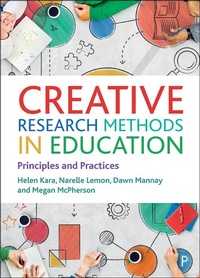
Creative Research Methods in Education
Principles and Practices
1st Edition
Published on 16. March 2021
208 pages
978-1-4473-5708-7 (ISBN)
Description

Co-authored by an international team of experts across disciplines, this important book is one of the first to demonstrate the enormous benefit creative methods offer for education research.
You do not have to be an artist to be creative, and the book encourages students, researchers and practitioners to discover and consider new ways to explore the field of education. It illustrates how using creative methods, such as poetic inquiry, comics, theatre and animation, can support learning and illuminate participation and engagement. Bridging academia and practice, the book offers:
* practical advice and tips on how to use creative methods in education research;
* numerous case studies from around the world providing real-life examples of creative research methods in education practice;
* reflective discussion questions to support learning.
You do not have to be an artist to be creative, and the book encourages students, researchers and practitioners to discover and consider new ways to explore the field of education. It illustrates how using creative methods, such as poetic inquiry, comics, theatre and animation, can support learning and illuminate participation and engagement. Bridging academia and practice, the book offers:
* practical advice and tips on how to use creative methods in education research;
* numerous case studies from around the world providing real-life examples of creative research methods in education practice;
* reflective discussion questions to support learning.
Reviews / Votes
"Bursting with case studies and practical advice, this book is an important source of inspiration and guidance for early career researchers and students seeking to use creative methods in education research." Helen Lomax, Sheffield Hallam UniversityMore details
Edition
First Edition
Language
English
Place of publication
Bristol
United Kingdom
Publishing group
Bristol University Press
Target group
Professional and scholarly
College/higher education
Illustrations
Not illustrated
File size
4,72 MB
ISBN-13
978-1-4473-5708-7 (9781447357087)
Copyright in bibliographic data and cover images is held by Nielsen Book Services Limited or by the publishers or by their respective licensors: all rights reserved.
Schweitzer Classification
Other editions
Additional editions
Helen Kara | Narelle Lemon | Dawn Mannay
Creative Research Methods in Education
Principles and Practices
Book
03/2021
1st Edition
Policy Press
€96.80
Shipment within 15-20 days
Helen Kara | Narelle Lemon | Dawn Mannay
Creative Research Methods in Education
Principles and Practices
Book
03/2021
1st Edition
Policy Press
€46.50
Shipment within 15-20 days
Persons
Helen Kara has been an independent researcher since 1999 and writes and teaches on research methods and ethics. She is the author of Research Ethics in the Real World: Euro-Western and Indigenous Perspectives (Policy Press, 2018) and Creative Research Methods: A Practical Guide (2nd edn, Policy Press, 2020). She is also an Honorary Senior Research Fellow at the University of Manchester. In 2015 Helen was the first fully independent researcher to be conferred as a Fellow of the Academy of Social Sciences.
Narelle Lemon is an educator, researcher, writer and creative having studied classical music and visual arts. She currently works as an Associate Professor in Education at Swinburne University of Technology, Melbourne, Australia and supports the development of future teachers. Narelle's overarching research area is focused on participation and engagement. She explores this through a variety of avenues including social media use for learning and professional development; creativity and arts education; and positive psychology specifically focused on mindfulness.
Dawn Mannay is a Reader in Social Sciences (Psychology) at Cardiff University, Wales, UK. Her research interests include class, gender, education and inequality, and she employs visual, creative and participatory methods in her work with communities. Dawn's publications include Visual, Narrative and Creative Research Methods: Application, Reflection and Ethics (Routledge, 2015), Emotion and the Researcher: Sites, Subjectivities, and Relationships (Emerald, 2018), Children and Young People 'Looked After'? Education, Intervention and the Everyday Culture of Care in Wales (University of Wales Press, 2019); and The SAGE Handbook of Visual Research Methods (SAGE, 2019).
Megan McPherson is a practising artist, a Research Fellow at the Research Unit for Indigenous Arts and Cultures, and an academic at The Wilin Centre for Indigenous Arts and Cultural Development at The Victorian College of The Arts, the University of Melbourne. Her research focuses on the learning experiences of artists and the spaces these practices are enacted with agency and justice. Megan has exhibited artworks since 1988. She has published in the areas of scholarship of learning and teaching in higher education; subjectivities, agency and affect in the university studio; and social media use in academia.
Narelle Lemon is an educator, researcher, writer and creative having studied classical music and visual arts. She currently works as an Associate Professor in Education at Swinburne University of Technology, Melbourne, Australia and supports the development of future teachers. Narelle's overarching research area is focused on participation and engagement. She explores this through a variety of avenues including social media use for learning and professional development; creativity and arts education; and positive psychology specifically focused on mindfulness.
Dawn Mannay is a Reader in Social Sciences (Psychology) at Cardiff University, Wales, UK. Her research interests include class, gender, education and inequality, and she employs visual, creative and participatory methods in her work with communities. Dawn's publications include Visual, Narrative and Creative Research Methods: Application, Reflection and Ethics (Routledge, 2015), Emotion and the Researcher: Sites, Subjectivities, and Relationships (Emerald, 2018), Children and Young People 'Looked After'? Education, Intervention and the Everyday Culture of Care in Wales (University of Wales Press, 2019); and The SAGE Handbook of Visual Research Methods (SAGE, 2019).
Megan McPherson is a practising artist, a Research Fellow at the Research Unit for Indigenous Arts and Cultures, and an academic at The Wilin Centre for Indigenous Arts and Cultural Development at The Victorian College of The Arts, the University of Melbourne. Her research focuses on the learning experiences of artists and the spaces these practices are enacted with agency and justice. Megan has exhibited artworks since 1988. She has published in the areas of scholarship of learning and teaching in higher education; subjectivities, agency and affect in the university studio; and social media use in academia.
Content
Introduction
Research Design
Context-Setting
Data Gathering Using Two Dimensional and Technological Methods - Research With Children and Young People
Data Gathering Using Three Dimensional and Online Methods - Research With Adults
Data Analysis
Writing/Reporting
Presentation
Dissemination
Where to Next With Creative Research Methods
Research Design
Context-Setting
Data Gathering Using Two Dimensional and Technological Methods - Research With Children and Young People
Data Gathering Using Three Dimensional and Online Methods - Research With Adults
Data Analysis
Writing/Reporting
Presentation
Dissemination
Where to Next With Creative Research Methods
