

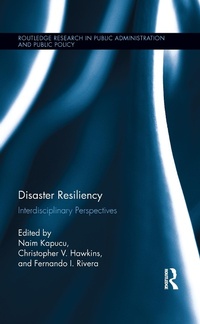
Disaster Resiliency
Interdisciplinary Perspectives
1st Edition
Published on 2. May 2013
436 pages
978-1-136-23996-0 (ISBN)
Description

Natural disasters in recent years have brought the study of disaster resiliency to the forefront. The importance of community preparedness and sustainability has been underscored by such calamities as Hurricane Katrina in 2005 and the Japanese tsunami in 2011. Natural disasters will inevitably continue to occur, but by understanding the concept of resiliency as well as the factors that lead to it, communities can minimize their vulnerabilities and increase their resilience.
In this volume, editors Naim Kapucu, Christopher V. Hawkins, and Fernando I. Rivera gather an impressive array of scholars to provide a much needed re-think to the topic disaster resiliency. Previous research on the subject has mainly focused on case studies, but this book offers a more systematic and empirical assessment of resiliency, while at the same time delving into new areas of exploration, including vulnerabilities of mobile home parks, the importance of asset mapping, and the differences between rural and urban locations. Employing a variety of statistical techniques and applying these to disasters in the United States and worldwide, this book examines resiliency through comparative methods which examine public management and policy, community planning and development, and, on the individual level, the ways in which culture, socio-economic status, and social networks contribute to resiliency. The analyses drawn will lead to the development of strategies for community preparation, response, and recovery to natural disasters.
Combining the concept of resiliency, the factors that most account for the resiliency of communities, and the various policies and government operations that can be developed to increase the sustainability of communities in face of disasters, the editors and contributors have assembled an essential resource to scholars in emergency planning, management, and policy, as well as upper-level students studying disaster management and policy.
In this volume, editors Naim Kapucu, Christopher V. Hawkins, and Fernando I. Rivera gather an impressive array of scholars to provide a much needed re-think to the topic disaster resiliency. Previous research on the subject has mainly focused on case studies, but this book offers a more systematic and empirical assessment of resiliency, while at the same time delving into new areas of exploration, including vulnerabilities of mobile home parks, the importance of asset mapping, and the differences between rural and urban locations. Employing a variety of statistical techniques and applying these to disasters in the United States and worldwide, this book examines resiliency through comparative methods which examine public management and policy, community planning and development, and, on the individual level, the ways in which culture, socio-economic status, and social networks contribute to resiliency. The analyses drawn will lead to the development of strategies for community preparation, response, and recovery to natural disasters.
Combining the concept of resiliency, the factors that most account for the resiliency of communities, and the various policies and government operations that can be developed to increase the sustainability of communities in face of disasters, the editors and contributors have assembled an essential resource to scholars in emergency planning, management, and policy, as well as upper-level students studying disaster management and policy.
Reviews / Votes
"Disaster Resiliency is a very important collection of essays on what has become not only a theory of disasters but also an organizing principle around which research and practice are conducted. This book is essential reading for those new to the idea of resiliency, as well as experienced researchers for whom this compendium of essays, written by top scholars in the field, will be very useful."-Thomas Birkland, North Carolina State University
"The concept of resilience has become increasingly important in motivating practice in applied settings. This book is an exceptional contribution to this development: it provides a great many insights into what resilience means to the management of risk and hazard vulnerability. It does so across an impressive range of topics from whole community and social capital perspectives to planning and inter-organizational coordination issues. I expect it to be a widely-used book for classroom instruction and for general readers interested in hazards and disasters-and most deservedly so!"
-Brian J. Gerber, University of Colorado Denver
More details
Series
Language
English
Place of publication
London
United Kingdom
Publishing group
Taylor & Francis Ltd
Target group
College/higher education
File size
3,75 MB
ISBN-13
978-1-136-23996-0 (9781136239960)
Copyright in bibliographic data and cover images is held by Nielsen Book Services Limited or by the publishers or by their respective licensors: all rights reserved.
Schweitzer Classification
Other editions
Additional editions
Naim Kapucu | Christopher V. Hawkins | Fernando I. Rivera
Disaster Resiliency
Interdisciplinary Perspectives
Book
09/2014
1st Edition
Routledge
€74.80
Shipment within 10-20 days
Naim Kapucu | Christopher V. Hawkins | Fernando I. Rivera
Disaster Resiliency
Interdisciplinary Perspectives
Book
11/2012
1st Edition
Routledge
€233.10
Shipment within 15-20 days
Persons
Naim Kapucu is a Professor at the School of Public Administration at the University of Central Florida (UCF). He is the founding director of the Center for Public and Nonprofit Management (CPNM) at UCF (2008-2011). He has developed Emergency Management and Homeland Security graduate certificate and undergraduate minor programs at UCF. Dr. Kapucu has published widely in areas of public policy and administration, crisis leadership, nonprofit management, and disaster management.
Christopher Hawkins is an Assistant Professor in the School of Public Administration at the University of Central Florida. His research has focused on metropolitan governance, local economic development, smart growth, sustainability and application of network analysis to understanding planning and policy decisions
Fernando I. Rivera is an Associate Professor of Sociology at the University of Central Florida. His research interests and activities fall under staple areas of sociology, primarily the sociology of mental health, race and ethnicity, medical sociology and sociology of disasters.
Christopher Hawkins is an Assistant Professor in the School of Public Administration at the University of Central Florida. His research has focused on metropolitan governance, local economic development, smart growth, sustainability and application of network analysis to understanding planning and policy decisions
Fernando I. Rivera is an Associate Professor of Sociology at the University of Central Florida. His research interests and activities fall under staple areas of sociology, primarily the sociology of mental health, race and ethnicity, medical sociology and sociology of disasters.
Content
Foreword Kathleen Tierney and Siva Sureshwaran 1. Introduction: Disaster Resiliency: Interdisciplinary Perspectives, Naim Kapucu, Christopher V. Hawkins, and Fernando I. Rivera Part I: Introduction to Conceptual Insights and Applications of Resilience, Christine A. Bevc 2. All Hazards, Whole Community: Creating Resiliency, Frances L. Edwards 3. Sociological Insights on the Role of Social Capital in Disaster Resilience, Fernando I. Rivera & Marc R. Settembrino 4. Understanding Hurricane Vulnerability: Lessons from Mobile Home Communities, Margarethe Kusenbach & Gabriela Christmann 5. Building Collaborative Capacity for Disaster Resiliency, Beth Gazley 6. Resilient Rural Communities: Housing Recovery Patterns Following Hurricane Katrina, Nazife Emel Ganapati, Shaoming Cheng, & Sukumar Ganapati Part II: Taking Action in Uncertain Environments: Connecting Resilience to Hazards, Ann-Margaret Esnard 7. Public Risks and Disaster Resilience: Rethinking Public and Private Sector Roles, Peter J. May 8. Networks, Collaborative Planning, and Perceived Quality of Comprehensive Plans, Christopher Hawkins 9. Examining Environmental Factors Contributing to Community Resilience along the Gulf of Mexico Coast, Samuel D. Brody & Joshua R. Gunn 10. Resilience Planning in the Face of Uncertainty: Adapting to Climate Change Effects on Coastal Hazards, Robert E. Deyle & William H. Butler 11. Incorporating Resilience of Rural Communities for Pro-active Risk Reduction in Shikoku, Japan, Rajib Shaw Part III: Improving Community Resilience through Networks, Maureen (Mary) Brown 12. The Role of Responder Networks in Promoting Community Resilience: Toward a Measurement Framework of Network Capacity, Branda Nowell & Toddi Steelman 13. Coping with Catastrophe: "Black Swan" in Northeastern Japan, March 11, 2011, Louise Comfort & Aya Okada 14. Enhancing Community Resilience: A Matter of Multi-Level Framework, Mixed Methods, and Multi-Sectoral Tools, Louise Lemyre & Tracey O'Sullivan 15. Management Capacity and Rural Community Resilience, William L. Waugh, Jr. 16. Inter-Organizational Coordination: Analysis of 2011 Van Earthquake, Suleyman Celik & Sitki Corbacioglu 17. Community Capacity and Interorganizational Networks for Disaster Resilience: Comparison of Rural and Urban Counties, Fatih Demiroz, Naim Kapucu, & Rebecca Dodson 18. Emerging Research in Disaster Resiliency: Implications for Policy and Practice, Naim Kapucu, Christopher Hawkins, & Fernando Rivera
