
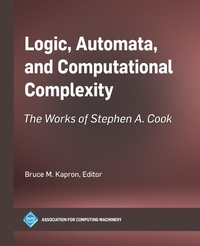
Logic, Automata, and Computational Complexity
Description
Alles über E-Books | Antworten auf Fragen rund um E-Books, Kopierschutz und Dateiformate finden Sie in unserem Info- & Hilfebereich.
Professor Stephen A. Cook is a pioneer of the theory of computational complexity. His work on NP-completeness and the P vs. NP problem remains a central focus of this field. Cook won the 1982 Turing Award for "his advancement of our understanding of the complexity of computation in a significant and profound way." This volume includes a selection of seminal papers embodying the work that led to this award, exemplifying Cook's synthesis of ideas and techniques from logic and the theory of computation including NP-completeness, proof complexity, bounded arithmetic, and parallel and space-bounded computation. These papers are accompanied by contributed articles by leading researchers in these areas, which convey to a general reader the importance of Cook's ideas and their enduring impact on the research community. The book also contains biographical material, Cook's Turing Award lecture, and an interview. Together these provide a portrait of Cook as a recognized leader and innovator in mathematics and computer science, as well as a gentle mentor and colleague.

More details
System requirements
File format: ePUB
Copy protection: Watermark-DRM (Digital Rights Management)
System requirements:
- Computer (Windows; MacOS X; Linux): Use a reading software that can process the file format ePUB: e.g., Adobe Digital Editions or FBReader – both free (see eBook Help).
- Tablet/Smartphone (Android; iOS): Before downloading, install the free app Adobe Digital Editions (see eBook Help).
- E-reader: Bookeen, Kobo, Pocketbook, Sony, Tolino and many more (not Kindle).
The file format ePUB works well for novels and non-fiction books – i.e., „flowing” text without complex layout. On an e-reader or smartphone, line and page breaks automatically adjust to fit the small displays.
This eBook uses Watermark-DRM, a „soft” copy protection. This means that there are no technical restrictions to prevent illegal distribution. However, there is a personalised watermark embedded in the eBook that can be used to identify the purchaser of the eBook in the event of misuse and to provide evidence for legal purposes.
For more information, see our eBook Help page.