

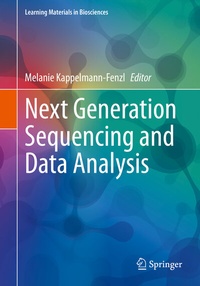
Next Generation Sequencing and Data Analysis
Description

More details
Other editions
Additional editions
Person
Melanie Kappelmann-Fenzl is Professor of Applied Life Sciences in at the Deggendorf Institute of Technology (DIT), Germany. She studied Biology, specialized on Human Genetics and Molecular Biology, at the University of Vienna and received her PhD in Molecular Pathology from the University of Regensburg, Germany. Later, she continued with her postdoctoral research at the Emil-Fischer Center, Institute of Biochemistry, University of Erlangen-Nuremberg, Germany, focusing on transcriptional regulation in cancer development, progression and metastasis. Dr. Kappelmann-Fenzl has published original peer-reviewed publications and reviews in high-ranked journals of the field. She attended to Advanced Sequencing Technologies & Applications at Cold Spring Harbor Laboratory, New York, USA, and other courses focusing on Bioinformatics and Big Data Analysis. Moreover, her expertise in NGS data analysis is demonstrated bycertificates in R Programming, Statistics in R, Statistical Interference and Modeling for High-throughput Experiments, Data Analysis for the Life Sciences , etc. Her current work is focused on Next Generation Sequencing Experiments and the associated data analysis, such as Differential Expression and Gene Set Enrichment analysis of RNA-Seq data, as well as the analysis of cis-regulatory genomic regions and Motif discovery of ChIP-Seq data, to only mention a few. She has attended to various international conferences in many different countries (the USA, Germany, Italy, etc.), presenting and discussing here research achievements with renowned colleagues specialized on this topic. Dr. Kappelmann-Fenzl is member of the Society for Melanoma Research , New York, USA, Society for Molecular Biology and Biochemistry (GBM) and the Student Council of Bioinformatics (FaBi), Germany. At the Deggendorf Institute of Technology (DIT)she developed and established the Master study program Life Science Informatics focusing on NGS Data Analysis (https://www.th-deg.de/lsi-m-en). This course of study is designed to enable both natural scientists and computer scientists with a corresponding Bachelor's degree to professionally analyze and interpret the data generated by NGS in all (biomedical) research areas or molecular diagnostics.
