

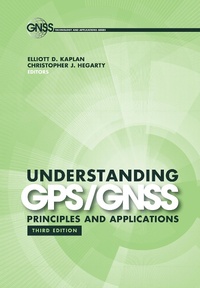
Understanding GPS/GNSS
Principles and Applications, Third Edition
Published on 1. January 2017
1064 pages
978-1-63081-442-7 (ISBN)
Description

This thoroughly updated third edition of an Artech House bestseller brings together a team of leading experts providing a current and comprehensive treatment of global navigation satellite systems (GNSS) that readers won't find in other resources. Packed with brand new material, this third edition includes new chapters on the system engineering details of GPS, European Galileo system, Chinese Beidou systems, GLONASS, and regional systems, such as Quasi-Zenith Satellite System (QZSS) and Navigation with Indian Constellation (NavIC). Readers also find new coverage of GNSS receivers, disruptions, errors, stand-alone GNSS performance, differential and precise point positioning. This single-source reference provides both a quick overview of GNSS essentials and an in-depth treatment of advanced topics and explores all the latest advances in technology, applications, and systems. Readers are guided in the development of new applications and on how to evaluate their performance. It explains all the differential GNSS services available to help decide which is best for a particular application. The book discusses the integration of GNSS with other sensors and network assistance. Readers learn how to build GNSS receivers and integrate them into navigational and communications equipment. Moreover, this unique volume helps determine how technology is affecting the marketplace and where best to invest in a company's resources.
More details
Other editions
Additional editions
Elliott Kaplan | Christopher Hegarty
Understanding GPS/GNSS: Principles and Applications
Book
05/2017
3rd Edition
Artech House Publishers
€140.50
Shipment within 10-20 days
Content
- Cover
- Title page
- Copyright
- Contributors
- Contents
- Preface to the Third Edition
- Third Edition Acknowledgments
- 1 Introduction
- 1.1 Introduction
- 1.2 GNSS Overview
- 1.3 Global Positioning System
- 1.4 Russian GLONASS System
- 1.5 Galileo Satellite System
- 1.6 Chinese BeiDou System
- 1.7 Regional Systems
- 1.8 Augmentations
- 1.9 Markets and Applications
- 1.10 Organization of the Book
- 2 Fundamentals of Satellite Navigation
- 2.1 Concept of Ranging Using Time-of-Arrival Measurements
- 2.2 Reference Coordinate Systems
- 2.3 Fundamentals of Satellite Orbits
- 2.4 GNSS Signals
- 2.5 Positioning Determination Using Ranging Codes
- 2.6 Obtaining User Velocity
- 2.7 Frequency Sources, Time, and GNSS
- 3 Global Positioning System
- 3.1 Overview
- 3.2 Space Segment Description
- 3.3 Control Segment Description
- 3.4 User Segment
- 3.5 GPS Geodesy and Time Scale
- 3.6 Services
- 3.7 GPS Signals
- 3.8 GPS Ephemeris Parameters and Satellite Position Computation
- 4 GLONASS
- 4.1 Introduction
- 4.2 Space Segment
- 4.3 Ground Segment
- 4.4 GLONASS User Equipment
- 4.5 Geodesy and Time Systems
- 4.6 Navigation Services
- 4.7 Navigation Signals
- 5 Galileo
- 5.1 Program Overview and Objectives
- 5.2 Galileo Implementation
- 5.3 Galileo Services
- 5.4 System Overview
- 5.5 Galileo Signal Characteristics
- 5.6 Interoperability
- 5.7 Galileo Search and Rescue Mission
- 5.8 Galileo System Performance
- 5.9 System Deployment Completion up to FOC
- 5.10 Galileo Evolution Beyond FOC
- 6 BeiDou Navigation Satellite System (BDS)
- 6.1 Overview
- 6.2 BDS Space Segment
- 6.3 BDS Control Segment
- 6.4 Geodesy and Time Systems
- 6.5 The BDS Services
- 6.6 BDS Signals
- 7 Regional SATNAV Systems
- 7.1 Quasi-Zenith Satellite System
- 7.2 Navigation with Indian Constellation (NavIC)
- 8 GNSS Receivers
- 8.1 Overview
- 8.2 Antennas
- 8.3 Front End
- 8.4 Digital Channels
- 8.5 Acquisition
- 8.6 Carrier Tracking
- 8.7 Code Tracking
- 8.8 Loop Filters
- 8.9 Measurement Errors and Tracking Thresholds
- 8.10 Formation of Pseudorange, Delta Pseudorange, and Integrated Doppler
- 8.11 Sequence of Initial Receiver Operations
- 8.12 Data Demodulation
- 8.13 Special Baseband Functions
- 9 GNSS Disruptions
- 9.1 Overview
- 9.2 Interference
- 9.3 Ionospheric Scintillation
- 9.4 Signal Blockage
- 9.5 Multipath
- 10 GNSS Errors
- 10.1 Introduction
- 10.2 Measurement Errors
- 10.3 Pseudorange Error Budgets
- 11 Performance of Stand-Alone GNSS
- 11.1 Introduction
- 11.2 Position, Velocity, and Time Estimation Concepts
- 11.3 GNSS Availability
- 11.4 GNSS Integrity
- 11.5 Continuity
- 12 Differential GNSS and Precise Point Positioning
- 12.1 Introduction
- 12.2 Code-Based DGNSS
- 12.3 Carrier-Based DGNSS
- 12.4 Precise Point Positioning
- 12.5 RTCM SC-104 Message Formats
- 12.6 DGNSS and PPP Examples
- 13 Integration of GNSS with Other Sensors and Network Assistance
- 13.1 Overview
- 13.2 GNSS/Inertial Integration
- 13.3 Sensor Integration in Land Vehicle Systems
- 13.4 A-GNSS: Network Based Acquisition and Location Assistance
- 13.5 Hybrid Positioning in Mobile Devices
- 14 GNSS Markets and Applications
- 14.1 GNSS: A Complex Market Based on Enabling Technologies
- 14.2 Civil Applications of GNSS
- 14.3 Government and Military Applications
- 14.4 Conclusions
- Appendix A: Least Squares and Weighted Least Squares Estimates
- Appendix B: Stability Measures for Frequency Sources
- B.1 Introduction
- B.2 Frequency Standard Stability
- B.3 Measures of Stability
- Appendix C: Free-Space Propagation Loss
- C.1 Introduction
- C.2 Free-Space Propagation Loss
- C.3 Conversion Between Power Spectral Densities and Power Flux Densities
- About the Authors
- Index
