

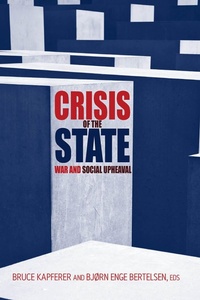
Crisis of the State
Description

Analyzing both historical contexts and geographical locations, this volume explores the continuous reformation of state power and its potential in situations of violent conflict. The state, otherwise understood as an abstract and transcendent concept in many works on globalization in political philosophy, is instead located and analyzed here as an embedded part of lived reality. This relationship to the state is exposed as an integral factor to the formation of the social - whether in Africa, the Middle East, South America or the United States. Through the examination of these particular empirical settings of war or war-like situations, the book further argues for the continued importance of the state in shifting social and political circumstances. In doing so, the authors provide a critical contribution to debates within a broad spectrum of fields that are concerned with the future of the state, the nature of sovereignty, and globalization.
More details
Other editions
Additional editions
Persons
Bruce Kapferer is Professor of Anthropology at the University of Bergen. He has held academic positions in Zambia, Manchester, Adelaide, London and Queensland and carried out extensive fieldwork in Zambia, Sri Lanka, India, Australia and South Africa. His major publications include The Feast of the Sorcerer (University of Chicago Press) and Legends of People, Myths of State (Smithsonian Institution Press).
Content
Acknowledgements
Introduction: The Crisis of Power and Reformations of the State in Globalizing Realities
Bruce Kapferer and Bjørn Enge Bertelsen
SECTION I: TRANSFORMATIONS OF SOVEREIGNTY, EMPIRE, STATE
Chapter 1. The Military Industrial Complex and the U.S. Empire
June Nash
Chapter 2. Post-Soviet Formation of the Russian State and the War in Chechnya. Chaotic Form of Sovereignty
Jakob Rigi
Chapter 3. Market Forces, Political Violence and War. The End of Nation-states, the Rise of Ethnic and Global Sovereignties?
Caroline Ifeka
SECTION II: WAR ZONE
Chapter 4. Rebel Ravages in Bundibugyo, Uganda's Forgotten District
Kirsten Alnaes
Chapter 5. The Fear of the Midnight Knock. State Sovereignty and Internal Enemies in Uganda
Sverker Finnström
Chapter 6. Scales of Confrontations, or the Pastoral Staff
Frode Storaas
SECTION III: SOVEREIGN LOGICS
Chapter 7. The Sovereign as Savage. The Pathos of Ethno-nationalist Passion
Christopher Taylor
Chapter 8. The Paramilitary Function of Transparency in Latin America and Beyond
Staffan Löfving
Chapter 9. Sorcery and Death Squads. Transformations of State, Sovereignty and Violence in Postcolonial Mozambique
Bjørn Enge Bertelsen
Chapter 10. Collective Violence and Counter State-building. Algeria 1954-1962
Rasmus Boserup
Chapter 11. Malignant Organisms. Continuities of State-run Violence in Rural Liberia
Mats Utas
Chapter 12. Israel's Wall and the Logic of Encystation. Sovereign Exception or Wild Sovereignty?
Glenn Bowman
Notes on contributors
Bibliography
Index
