

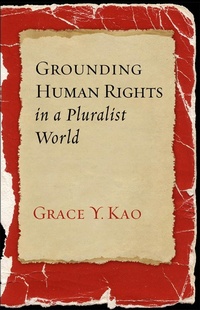
Grounding Human Rights in a Pluralist World
Description

In 1948 the General Assembly of the United Nations adopted the Universal Declaration of Human Rights which declared that every human being, without "distinction of any kind," possesses a set of morally authoritative rights and fundamental freedoms that ought to be socially guaranteed. Since that time, human rights have arguably become the cross-cultural moral concept and evaluative tool to measure the performance-and even legitimacy-of domestic regimes. Yet questions remain that challenge their universal validity and theoretical bases.
Some theorists are "maximalist" in their insistence that human rights must be grounded religiously, while an opposing camp attempts to justify these rights in "minimalist" fashion without any necessary recourse to religion, metaphysics, or essentialism. In Grounding Human Rights in a Pluralist World, Grace Kao critically examines the strengths and weaknesses of these contending interpretations while also exploring the political liberalism of John Rawls and the Capability Approach as proposed by economist Amartya Sen and philosopher Martha Nussbaum.
By retrieving insights from a variety of approaches, Kao defends an account of human rights that straddles the minimalist-maximalist divide, one that links human rights to a conception of our common humanity and to the notion that ethical realism gives the most satisfying account of our commitment to the equal moral worth of all human beings.
More details
Other editions
Additional editions
Person
Grace Y. Kao is an associate professor of ethics at Claremont School of Theology and an associate professor of religion at Claremont Graduate University.
Content
Introduction
1. Prolegomena to Any Philosophical Defense of Human Rights
Cultural Relativism
Ethnocentrism
2. The Maximalist Challenge to Human Rights Justification
Maximalist Approaches in Human Rights Declarations and Documents
Why Human Rights Needs Religion: A Sampling of Four Theoretical Accounts
A Preliminary Assessment of the Maximalist Challenge
Rising to the Maximalist Challenge
3. An Enforcement-Centered Approach to Human Rights, With Special Reference to John Rawls
A Primer on Rawls's Conception of Global Justice
Human Rights in the Law of Peoples Compared to International Human Rights Law
Rawlsian Human Rights: An Assessment
Conclusion
4. Consensus-Based Approaches to Human Rights
Obtaining a Cross-Cultural Consensus on Human Rights
Option 1: Consensus-Producing New Universal Human Rights Standards
Option 2: Consensus-Encouraging Plural Foundations for Human Rights
Beyond Shared Norms: returning to the Original Sources of Inspiration
5. The Capability Approach to Human Rights
What Is the Capability Approach? A Primer
Comparing the Capability Approach to the Human Rights Framework
Justifying Human Capabilities and Human Rights
Enhancing Human Rights through the Framework of Capabilities
Revisiting the Question of Justification
6. Grounding Human Rights in a Pluralist World
Assessing and Retrieving Minimalist Strategies of Justification
Assessing and Retrieving Maximalist Approaches to Justification
Grounding Human Rights in a Pluralist World by Straddling the Minimalist-Maximalist Divide
Conclusion
References
