

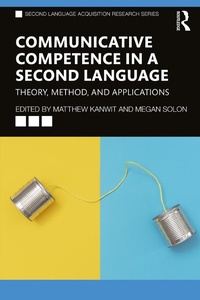
Communicative Competence in a Second Language
Theory, Method, and Applications
1st Edition
Published on 30. December 2022
240 pages
978-1-000-83030-9 (ISBN)
Description

Communicative competence is an essential language skill, the ability to adjust language use according to specific contexts and to employ knowledge and strategies for successful communication.
This unique text offers a multidisciplinary, critical, state-of-the-art research overview for this skill in second language learners. Expert contributors from around the world lay out the history of the field, then explore a variety of theoretical perspectives, methodologies, and empirical findings, and authoritatively set the agenda for future work.
With a variety of helpful features like discussion questions, recommended further reading, and suggestions for practice, this book will be an invaluable resource to students and researchers of applied linguistics, education, psychology, and beyond.
This unique text offers a multidisciplinary, critical, state-of-the-art research overview for this skill in second language learners. Expert contributors from around the world lay out the history of the field, then explore a variety of theoretical perspectives, methodologies, and empirical findings, and authoritatively set the agenda for future work.
With a variety of helpful features like discussion questions, recommended further reading, and suggestions for practice, this book will be an invaluable resource to students and researchers of applied linguistics, education, psychology, and beyond.
Reviews / Votes
"This volume achieves unprecedented levels of coherence, epistemological complementarity, and currency in the exploration of communicative competence. It offers a vibrant tour de force through theories, methods, and diverse spheres of application. A must read for all interested in understanding this construct at the heart of the field of second language acquisition!"Lourdes Ortega, Georgetown University, USA
"The notion of communicative competence is so deeply entrenched in our collective understanding of L2 development. Yet many of us, if prompted on the topic, might respond like the fish that asks "What is water?". Flounder no longer! Kanwit and Solon bring together in this volume works by a world-class cast of contributors that deftly address the theory-methods-practice trifecta as it pertains to communicative competence. The editors' and authors' various takes on this topic are as refreshing as they are informed, as current as they are diverse in perspective."
Luke Plonsky, Northern Arizona University, USA
"This engaging, original, scholarly, and insightful book updates the concept of communicative competence, clarifying and deepening the definition, description, and analysis of this crucial concept in second language acquisition. It covers a multiplicity of aspects of the area and deftly and authoritatively presents theories, methodologies, and applications. This is a significant contribution to the field, and a must read for both established scholars and those new to the field, with contributions from distinguished researchers from a wide variety of research areas."
Vera Regan, University College Dublin, Ireland
More details
Series
Edition
1. Auflage
Language
English
Place of publication
London
United Kingdom
Publishing group
Taylor & Francis Ltd
Target group
College/higher education
Illustrations
5 Tables, black and white; 5 Line drawings, black and white; 5 Illustrations, black and white
ISBN-13
978-1-000-83030-9 (9781000830309)
Copyright in bibliographic data and cover images is held by Nielsen Book Services Limited or by the publishers or by their respective licensors: all rights reserved.
Schweitzer Classification
Other editions
Additional editions
Matthew Kanwit | Megan Solon
Communicative Competence in a Second Language
Theory, Method, and Applications
Book
12/2022
1st Edition
Routledge
€207.60
Shipment within 15-20 days
Matthew Kanwit | Megan Solon
Communicative Competence in a Second Language
Theory, Method, and Applications
Book
12/2022
1st Edition
Routledge
€61.00
Shipment within 15-20 days
Persons
Matthew Kanwit is Associate Professor in the Department of Linguistics at the University of Pittsburgh, USA. His research on communicative competence and functional approaches to L2 acquisition has appeared in Applied Linguistics, Studies in Second Language Acquisition, Language Learning, The Modern Language Journal, and the Routledge Handbook of Second Language Acquisition and Sociolinguistics.
Megan Solon is Lecturer in the Department of Spanish and Portuguese at Indiana University, USA. She researches the acquisition of phonetics/phonology, including sociolinguistically variable features. She is co-editor of the Issues in Hispanic and Lusophone Linguistics book series and co-author of The Acquisition of Spanish as a Second Language: Foundations and New Developments.
Megan Solon is Lecturer in the Department of Spanish and Portuguese at Indiana University, USA. She researches the acquisition of phonetics/phonology, including sociolinguistically variable features. She is co-editor of the Issues in Hispanic and Lusophone Linguistics book series and co-author of The Acquisition of Spanish as a Second Language: Foundations and New Developments.
Content
Table of Contents
List of contributors
Acknowledgements
1. Introduction: Historical overview, key constructs, and recent developments in the study of communicative competence
Matthew Kanwit and Megan Solon
Part 1: Theoretical overviews of communicative competence
2. Generative considerations of communicative competence
Alan Juffs
3. Sociolinguistic approaches to communicative competence
Kimberly L. Geeslin and Stacey Hanson
4. Sociocultural considerations of communicative competence
Matthew E. Poehner
Part II: Methodological tools for researching communicative competence
5. Investigating communicative competence in ethnographic research
Rebecca Lurie Starr
6. Real-time psycholinguistic measures of communicative competence
Jill Jegerski and Sara Fernandez Cuenca
7. Corpus-linguistic and computational methods for analyzing communicative competence: contributions from usage-based approaches
Stefan Th. Gries
Part III: Applications: How do learners show communicative competence?
8. Interlanguage pragmatics as communicative competence
Minh Thi Thuy Nguyen
9. Applying a communicative competence framework to the study and teaching of second language writing
Charlene Polio and D. Philip Montgomery
10. Computer-assisted language learning and communicative competence
Glenn Stockwell and Yurika Ito
11. Assessing communicative competence
Luke Harding, Susy Macqueen, and John Pill
12. Looking forward: Future directions in the study of communicative competence
Megan Solon and Matthew Kanwit
Index
List of contributors
Acknowledgements
1. Introduction: Historical overview, key constructs, and recent developments in the study of communicative competence
Matthew Kanwit and Megan Solon
Part 1: Theoretical overviews of communicative competence
2. Generative considerations of communicative competence
Alan Juffs
3. Sociolinguistic approaches to communicative competence
Kimberly L. Geeslin and Stacey Hanson
4. Sociocultural considerations of communicative competence
Matthew E. Poehner
Part II: Methodological tools for researching communicative competence
5. Investigating communicative competence in ethnographic research
Rebecca Lurie Starr
6. Real-time psycholinguistic measures of communicative competence
Jill Jegerski and Sara Fernandez Cuenca
7. Corpus-linguistic and computational methods for analyzing communicative competence: contributions from usage-based approaches
Stefan Th. Gries
Part III: Applications: How do learners show communicative competence?
8. Interlanguage pragmatics as communicative competence
Minh Thi Thuy Nguyen
9. Applying a communicative competence framework to the study and teaching of second language writing
Charlene Polio and D. Philip Montgomery
10. Computer-assisted language learning and communicative competence
Glenn Stockwell and Yurika Ito
11. Assessing communicative competence
Luke Harding, Susy Macqueen, and John Pill
12. Looking forward: Future directions in the study of communicative competence
Megan Solon and Matthew Kanwit
Index
