

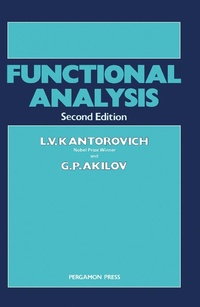
Functional Analysis
2nd Edition
Published on 18. May 2014
604 pages
978-1-4831-4774-1 (ISBN)
Description

Functional Analysis examines trends in functional analysis as a mathematical discipline and the ever-increasing role played by its techniques in applications. The theory of topological vector spaces is emphasized, along with the applications of functional analysis to applied analysis. Some topics of functional analysis connected with applications to mathematical economics and control theory are also discussed. Comprised of 18 chapters, this book begins with an introduction to the elements of the theory of topological spaces, the theory of metric spaces, and the theory of abstract measure spaces. Many results are stated without proofs. The discussion then turns to vector spaces, normed spaces, and linear operators and functionals. Subsequent chapters deal with the analytic representation of functionals; sequences of linear operators; the weak topology in a Banach space; and compact and adjoint operators. The last section focuses on functional equations, including the adjoint equation and functional equations of the second kind. This monograph is intended for students specializing in mathematical analysis and computational mathematics.
More details
Other editions
Additional editions

L.V. Kantorovich | G.P. Akilov
Functional Analysis
Book
07/1982
2nd Edition
Pergamon
€54.47
Article exhausted; check different version
Previous edition
E-Book
10/1990
1st Edition
Academic Press
€54.95
Available for download
Content
Preface to the Second EditionFrom the Preface to the First EditionPart I Linear Operators and Functionals Chapter I. Topological and Metric Spaces § 1. General Information on Sets. Ordered Sets § 2. Topological Spaces § 3. Metric Spaces § 4. Completeness and Separability. Sets of the First and Second Categories § 5. Compactness in Metric Spaces § 6. Measure Spaces Chapter II. Vector Spaces § 1. Basic Definitions § 2. Linear Operators and Functional § 3. Convex Sets and Seminorms § 4. The Hahn-Banach Theorem Chapter III. Topological Vector Spaces § 1. General Definitions § 2. Locally Convex Spaces § 3. Duality Chapter IV. Normed Spaces § 1. Basic Definitions and Simplest Properties of Normed Spaces § 2. Auxiliary Inequalities § 3. Normed Spaces of Measurable Functions and Sequences § 4. Other Normed Spaces of Functions § 5. Hilbert Space Chapter V. Linear Operators and Functionals § 1. Spaces of Operators and Dual Spaces § 2. Some Functionals and Operators on Specific Spaces § 3. Linear Functionals and Operators on Hilbert Space § 4. Rings of Operators § 5. The Method of Successive Approximations § 6. The Ring of Operators on a Hilbert Space § 7. The Weak Topology and Reflexive Spaces § 8. Extensions of Linear Operators Chapter VI. The Analytic Representation of Functionals § 1. Integral Representations for Functionals on Spaces of Measurable Functi § 2. The Spaces Lp(T,S,µ) § 3. A General Form for Linear Functionals on the Space C(K) Chapter VII. Sequences of Linear Operators § 1. Basic Theorems § 2. Some Applications to the Theory of Functions Chapter VIII. The Weak Topology in a Banach Space § 1. Weakly Bounded Sets § 2. Eberlein-Shmul'yan Theory § 3. Weak Convergence in Specific Spaces § 4. The Problem of Translocation of Mass and the Normed Space it Generates Chapter IX. Compact and Adjoint Operators § 1. Compact Sets in Normed Spaces § 2. Compact Operators § 3. Adjoint Operators § 4. Compact Self-Adjoint Operators on Hilbert Space § 5. Integral Representations of Self-Adjoint Operators Chapter X. Ordered Normed Spaces § 1. Vector Lattices § 2. Linear Operators and Functionals § 3. Normed Lattices § 4. KB-Spaces § 5. Convex Sets that are Closed with Respect to Convergence in Measure Chapter XI. Integral Operators § 1. Integral Representations of Operators § 2. Operators on Sequence Spaces § 3. Integral Operators on Function Spaces § 4. Sobolev's Embedding TheoremsPart II Functional Equations Chapter XII. The Adjoint Equation § 1. Theorems on Inverse Operators § 2. The Connection Between an Equation and its Adjoint Chapter XIII. Functional Equations of the Second Kind § 1. Equations with Compact Kernels § 2. Complex Normed Spaces § 3. The Spectrum § 4. Resolvents § 5. The Fredholm Alternative § 6. Applications to Integral Equations § 7. Invariant Subspaces of Compact Operators. The Approximation Problem Chapter XIV. A General Theory of Approximation Methods § 1. A General Theory for Equations of the Second Kind § 2. Equations Reducible to Equations of the Second Kind § 3. Applications to Infinite Systems of Equations § 4. Applications to Integral Equations § 5. Applications to Ordinary Differential Equations § 6. Applications to Boundary-Value Problems for Equations of Elliptic Type Chapter XV.
