

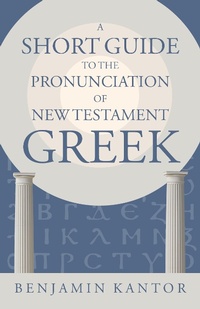
Short Guide to the Pronunciation of New Testament Greek
Published on 13. July 2023
112 pages
978-1-4674-6277-8 (ISBN)
Description

What did the apostles' Greek sound like?How should New Testament Greek be pronounced in our classrooms? Often students are taught Erasmian pronunciation, which does not even reproduce Erasmus's own pronunciation faithfully, let alone that of the New Testament authors. But if we want to process the language of the New Testament the same way its original authors and readers did, we should use their pronunciation. In his new book, Benjamin Kantor breaks a path toward an authentic pronunciation of Koine Greek at the time of the New Testament, seeking to improve students' reading proficiency.A Short Guide to the Pronunciation of New Testament Greek distills Kantor's new monograph, The Pronunciation of New Testament Greek, with an eye toward practical instruction. The first comprehensive phonological and orthographic study of Judeo-Palestinian Koine Greek, The Pronunciation of New Testament Greek surveys thousands of inscriptions and papyri to determine historical pronunciation. A Short Guide gives students an overview of the basics of phonology before explaining the pronunciation of each Greek letter and phoneme individually. Perfect for classroom use, this guide explains Kantor's cutting-edge research accessibly and includes sample texts for reading practice.
More details
Other editions
Additional editions
Benjamin Kantor
A Short Guide to the Pronunciation of New Testament Greek
Book
07/2023
William B Eerdmans Publishing Co
€18.50
Shipment within 15-20 days
Content
- Intro
- Title Page
- Copyright
- Dedication
- Contents
- List of Symbols and Abbreviations
- So You Want to Read (Pronounce) Biblical Greek
- 1 How Has Greek Been Pronounced in the Classroom Since Erasmus?
- 1.1 Introduction
- 1.2 The Early Renaissance Period
- 1.3 Erasmus's Generation
- 1.4 Erasmus and His Fable
- 1.5 The Aftermath of Erasmus's Fable
- 1.6 "Erasmian" Pronunciation in the Present Day
- 1.7 Back to Byzantium: Neohellenic (Modern) and "Living Koiné"
- 1.8 Reflections
- 2 How Do We Know How Koine Greek Was Pronounced?
- 2.1 Spelling "Mistakes"
- 2.2 Greek Loanwords in Hebrew and Aramaic
- 3 Do I Need to be a Linguist?
- 3.1 Introduction
- 3.2 The International Phonetic Alphabet (IPA)
- 3.3 Phonology and Phonetics: The Phoneme and the Allophone
- 3.4 Historical Linguistics
- 4 How Was Koine Greek Pronounced Historically?
- 4.1 Consonants
- 4.1.1 ? (PNTG §7.1.1)
- 4.1.2 ß (PNTG §7.1.2)
- 4.1.3 d (PNTG §7.1.3)
- 4.1.4 ? (PNTG §7.2.1)
- 4.1.5 f (PNTG §7.2.2)
- 4.1.6 ? (PNTG §7.2.3)
- 4.1.7 ? Rough Breathing (Spiritus Asper) (PNTG §7.3.1)
- 4.1.8 ? (PNTG §7.4.1)
- 4.1.9 p (PNTG §7.4.2)
- 4.1.10 t (PNTG §7.4.3)
- 4.1.11 µ (PNTG §7.5.1)
- 4.1.12 ? (PNTG §7.5.2-3)
- 4.1.13 ? (PNTG §7.6.1)
- 4.1.14 ? (PNTG §7.6.2)
- 4.1.15 s (PNTG §7.7.1)
- 4.1.16 ? (PNTG §7.7.2)
- 4.1.17 ? (PNTG §7.8.1)
- 4.1.18 ? (PNTG §7.8.2)
- 4.1.19 Consonant Gemination (PNTG §7.9)
- 4.2 Diphthongs
- 4.2.1 a?, e?, and ?? (PNTG §§8.1.4-5
- 8.2.4-5)
- 4.2.2 ?? (PNTG §8.2.3)
- 4.3 Vowels
- 4.3.1 ?-e? (PNTG §8.3.1-4)
- 4.3.2 ?-?? (PNTG §§8.2.2
- 8.3.5)
- 4.3.3 ?-?? (?) (PNTG §§8.1.2
- 8.3.6)
- 4.3.4 e-a? (PNTG §§8.2.1
- 8.3.7)
- 4.3.5 a-a? (?) (PNTG §§8.1.1
- 8.3.8)
- 4.3.6 ?-?-?? (?) (PNTG §§8.1.3
- 8.3.9-10)
- 4.3.7 ?? (PNTG §8.3.11)
- 4.3.8 Vowel Length (PNTG §8.6.1)
- 4.3.9 Accents and Stress (PNTG §8.6.2)
- 4.4 Summary of Historical Koine Greek Pronunciation
- 5 How Should Greek be Pronounced in the Classroom Tomorrow?
- 5.1 Introduction: Does Pronunciation Really Matter?
- 5.2 If Pronunciation Doesn't Matter, Then Language Doesn't Matter
- 5.3 Vocabulary Acquisition and Retention
- 5.4 Fluent Reading: "It Just Sounds More Like a Real Language"
- 5.5 Papyri, Inscriptions, Manuscripts, and Textual Criticism
- 5.6 Open the Doors to Ellaða
- 5.7 Conclusions: Pronunciation Does Matter
- Appendix: Practice Reading (Transcribed Texts)
- Selected Bibliography
