

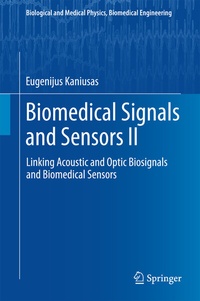
Biomedical Signals and Sensors II
Description

The book set develops a bridge between physiologic mechanisms and diagnostic human engineering. While the first volume is focused on the interface between physiologic mechanisms and the resultant biosignals, this second volume is devoted to the interface between biosignals and biomedical sensors. That is, in the first volume, the physiologic mechanisms determining biosignals are described from the basic cellular level up to their advanced mutual coordination level. This second volume, considers the genesis of acoustic and optic biosignals and the associated sensing technology from a strategic point of view. As a novelty, this book discusses heterogeneous biosignals within a common frame. This frame comprises both the biosignal formation path from the biosignal source at the physiological level to biosignal propagation in the body, and the biosignal sensing path from the biosignal transmission in the sensor applied on the body up to its conversion to a, usually electric, signal.
Some biosignals arise in the course of the body's vital functions while others map these functions that convey physiological data to an observer. It is highly instructive how sound and light beams interact with biological tissues, yielding acoustic and optic biosignals, respectively. Discussed phenomena teach a lot about the physics of sound and physics of light (as engineering sciences), and, on the other hand, biology and physiology (as live sciences). The highly interdisciplinary nature of biosignals and biomedical sensors is obviously a challenge. However, it is a rewarding challenge after it has been coped with in a strategic way, as offered here. The book is intended to have the presence to answer intriguing "Aha!" questions.
Reviews / Votes
"With knowledge of volume 1, the reader tends to see volume 2 as a continuation. However, I feel that volume 2 can also be seen as an independent text for those who show specific interests in acoustic or optic phenomena since all three levels are addressed here in well balanced ways. Thus I also would like to recommend the book as a very valuable stand-alone work." (Univ.Prof.Helmut Pfützner, Vice-president of TU BioMed, Vienna University of Technology May 2015)More details
Other editions
Additional editions
Content
Sensing by Electric Biosignals.- Sensing by Acoustic Biosignals.- Sensing by Optic Biosignals.- Sensing by Mechanic Biosignals.
