

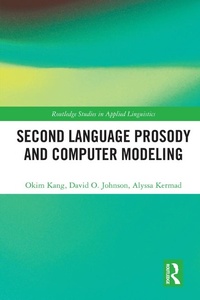
Second Language Prosody and Computer Modeling
1st Edition
Published on 13. September 2021
188 pages
978-1-000-43558-0 (ISBN)
Description

This volume presents an interdisciplinary approach to the study of second language prosody and computer modeling. It addresses the importance of prosody's role in communication, bridging the gap between applied linguistics and computer science.
The book illustrates the growing importance of the relationship between automated speech recognition systems and language learning assessment in light of new technologies and showcases how the study of prosody in this context in particular can offer innovative insights into the computerized process of natural discourse. The book offers detailed accounts of different methods of analysis and computer models used and demonstrates how these models can be applied to L2 discourse analysis toward predicting real-world language use. Kang, Johnson, and Kermad also use these frameworks as a jumping-off point from which to propose new models of second language prosody and future directions for prosodic computer modeling more generally.
Making the case for the use of naturalistic data for real-world applications in empirical research, this volume will foster interdisciplinary dialogues across students and researchers in applied linguistics, speech communication, speech science, and computer engineering.
The book illustrates the growing importance of the relationship between automated speech recognition systems and language learning assessment in light of new technologies and showcases how the study of prosody in this context in particular can offer innovative insights into the computerized process of natural discourse. The book offers detailed accounts of different methods of analysis and computer models used and demonstrates how these models can be applied to L2 discourse analysis toward predicting real-world language use. Kang, Johnson, and Kermad also use these frameworks as a jumping-off point from which to propose new models of second language prosody and future directions for prosodic computer modeling more generally.
Making the case for the use of naturalistic data for real-world applications in empirical research, this volume will foster interdisciplinary dialogues across students and researchers in applied linguistics, speech communication, speech science, and computer engineering.
More details
Series
Edition
1. Auflage
Language
English
Place of publication
London
United Kingdom
Publishing group
Taylor & Francis Ltd
Target group
College/higher education
Illustrations
23 Tables, black and white; 30 Line drawings, black and white; 1 Halftones, black and white; 31 Illustrations, black and white
ISBN-13
978-1-000-43558-0 (9781000435580)
Copyright in bibliographic data and cover images is held by Nielsen Book Services Limited or by the publishers or by their respective licensors: all rights reserved.
Schweitzer Classification
Other editions
Additional editions
Okim Kang | David O. Johnson | Alyssa Kermad
Second Language Prosody and Computer Modeling
Book
05/2023
1st Edition
Routledge
€62.70
Shipment within 10-20 days
Okim Kang | David O. Johnson | Alyssa Kermad
Second Language Prosody and Computer Modeling
Book
09/2021
1st Edition
Routledge
€206.00
Shipment within 15-20 days
Persons
Okim Kang is Professor of Applied Linguistics and Director of the Applied Linguistics Speech Lab at Northern Arizona University, Flagstaff, AZ. Her research interests include speech production and perception, L2 pronunciation and intelligibility, L2 oral assessment and testing, automated scoring and speech recognition, World Englishes, and language attitude.
David O. Johnson is an associate teaching professor of Electrical Engineering and Computer Science at the University of Kansas. His research interests are in artificial intelligence, machine learning, natural language processing, and human-robot interaction.
Alyssa Kermad is an assistant professor of Applied Linguistics and TESOL at California State Polytechnic University, Pomona. Her research interests are in second language speech and pronunciation, speech perception, prosody and pragmatics, second language acquisition, individual differences, and speech assessment.
David O. Johnson is an associate teaching professor of Electrical Engineering and Computer Science at the University of Kansas. His research interests are in artificial intelligence, machine learning, natural language processing, and human-robot interaction.
Alyssa Kermad is an assistant professor of Applied Linguistics and TESOL at California State Polytechnic University, Pomona. Her research interests are in second language speech and pronunciation, speech perception, prosody and pragmatics, second language acquisition, individual differences, and speech assessment.
Content
List of Figures
List of Tables
Introduction
Part I Linguistic Foundations of Prosody
Chapter 1 Overview of Prosody
Chapter 2 Frameworks of Prosody
Chapter 3 Prosodic Analyses of Natural Speech
Part II Computer Applications of Prosody
Chapter 4 Computerized Systems for Syllabification
Chapter 5 Computerized Systems for Measuring Suprasegmental Features
Chapter 6 Computer Models for Predicting Oral Proficiency and Intelligibility
Part III The Future of Prosody Models
Chapter 7 Future Research and Applications
Useful Resources
References
Index
List of Tables
Introduction
Part I Linguistic Foundations of Prosody
Chapter 1 Overview of Prosody
Chapter 2 Frameworks of Prosody
Chapter 3 Prosodic Analyses of Natural Speech
Part II Computer Applications of Prosody
Chapter 4 Computerized Systems for Syllabification
Chapter 5 Computerized Systems for Measuring Suprasegmental Features
Chapter 6 Computer Models for Predicting Oral Proficiency and Intelligibility
Part III The Future of Prosody Models
Chapter 7 Future Research and Applications
Useful Resources
References
Index
